
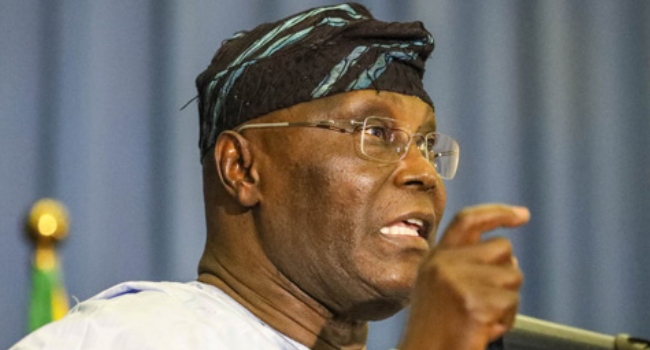
A fiscal argument over how ₦12.8 trillion is parked inside Nigeria’s 2026 budget has hardened into one of the sharpest personal confrontations of the pre 2027 political season, with former Vice President Atiku Abubakar accusing the Presidency of trading disclosure for insults, and the Presidency accusing him of exporting a domestic quarrel to Washington.
Atiku, presidential candidate of the African Democratic Congress, replied on Thursday to a statement issued by the Special Adviser to the President on Information and Strategy, Bayo Onanuga, which had questioned his own record in the United States. In a response signed by his Senior Special Assistant on Public Communication, Phrank Shaibu, the former Vice President said the Presidency had spent several paragraphs on his person while leaving the substance untouched.
“When governments abandon facts for insults and substitute evidence with abuse, they unwittingly admit that they have run out of convincing answers. Nigerians expected clarification. What they received instead was a barrage of name calling and political invective,” he said.
He rejected the argument that his questions amount to an assault on national sovereignty. “No one has reported Nigeria to anyone. Nigeria is not on trial,” he said, adding that the records under discussion “were not created by the opposition, the ADC, or any political actor,” and that “attempting to silence legitimate public inquiry by wrapping oneself in the national flag does not answer the questions before the country.”
The exchange traces back to July 20, when Atiku demanded that President Bola Tinubu account for the Service-Wide Vote in the 2026 Appropriation Act. According to his figures, the provision stood at about ₦638 billion in 2025 and rose to ₦12.8 trillion in 2026, an increase of roughly 1,918 per cent within a single fiscal cycle. He also stated that 84 per cent of the budget sits within only 10 Ministries, Departments and Agencies, and queried a personnel provision of ₦2.19 trillion under the Service-Wide Vote against ₦54.8 billion for personnel at the Federal Ministry of Finance.
“Who exactly are the workers earning ₦2.19 trillion? Where are they? What offices do they occupy? What agencies do they belong to? This is not budgeting; it is budgetary absurdity,” he said, calling on the National Assembly to conduct a line by line review.
The scale becomes clearer against the official record. President Tinubu presented a ₦58.18 trillion proposal to a joint session of the National Assembly in December 2025, tagged “Budget of Consolidation, Renewed Resilience and Shared Prosperity,” carrying ₦34.33 trillion in projected revenue and a deficit of ₦23.85 trillion, equal to 4.28 per cent of Gross Domestic Product. Lawmakers raised the envelope substantially, and the President assented in April 2026 to an Appropriation Act of ₦68.32 trillion, with ₦15.8 trillion for debt service, ₦4.799 trillion for statutory transfers, ₦15.4 trillion for recurrent expenditure and ₦32.2 trillion for capital spending. On those figures, a ₦12.8 trillion Service-Wide Vote would represent close to a fifth of total federal expenditure for the year, and would exceed the ₦5.41 trillion originally proposed for defence and security, the ₦3.52 trillion for education and the ₦2.48 trillion for health.
The ruling All Progressives Congress pushed back on Wednesday through its National Publicity Secretary, Felix Morka, who described the Service-Wide Vote as a lawful and long standing budgetary instrument used to cover government wide obligations and contingencies, and characterised Atiku’s claims as a mixture of ignorance of public finance and calculated mischief. Atiku’s media team, in a statement by Strategic Media Associate Olusola Sanni, dismissed that reply as insults offered in place of an itemised breakdown. No detailed public disclosure of the Service-Wide Vote line items has so far been published by the Budget Office of the Federation.
Atiku had separately faulted a ₦8.05 billion allocation for mosque and church related projects in the same Act, and a ₦22.15 billion provision for the construction and renovation of 106 traditional rulers’ palaces, which he described as falling outside federal constitutional responsibility.
The temperature rose after Von Batten-Montague-York, L.C., a Washington based lobbying firm, announced on Wednesday that it had begun circulating more than 60 pages of United States Department of Justice records to officials in the administration of President Donald Trump, members of Congress and senior congressional staff. The firm stated that it was retained by Atiku in March 2026 under a 12 month contract valued at 1.2 million dollars, covering advocacy, engagement with US policymakers and countering what its filing described as the Nigerian government’s lobbying narratives.
The material carries the title “Background and Chronology of the 1993 U.S. Department of Justice Heroin-Proceeds Forfeiture Case and the 2023 FOIA Litigation Concerning Alleged Heroin Trafficking from Nigeria to the United States Involving Bola Ahmed Tinubu, the current President of the Federal Republic of Nigeria.” It references United States v. Funds in Account No. 263226700 et al., a civil forfeiture action filed before the United States District Court for the Northern District of Illinois, and names Tinubu alongside Adegboyega Mueez Akande and Abiodun Agbele. The firm also pointed to Freedom of Information Act litigation begun in 2023 by journalist Aaron Greenspan, in which a US District Court in 2025 directed agencies including the Federal Bureau of Investigation and the Drug Enforcement Administration to process certain records rather than rely on blanket refusals to confirm or deny their existence. That case remains before the courts.
The 1993 matter has been examined repeatedly in Nigerian courts. The proceeding was civil, not criminal. It ended in a settlement under which 460,000 dollars held in US accounts was forfeited to the American government. Tinubu’s legal team told the Presidential Election Petition Court in 2023 that the compromise terms were preceded by an express record that he admitted no drug related or dishonest conduct, that the order was never registered or domesticated in any Nigerian court, and that a 2003 inquiry through the US Consulate returned no criminal record against him.
The court agreed. Delivering judgment in September 2023, the panel led by Justice Haruna Tsammani held that “the order of forfeiture in exhibit P5 on which the petitioners have relied does not qualify as a sentence or fine or criminal conviction,” and found no evidence of conviction capable of disqualifying him under Section 137(1)(d) of the 1999 Constitution. The Independent National Electoral Commission told the same court that the matter had not been brought to its attention before the February 25, 2023 poll. Atiku, then of the Peoples Democratic Party, and Peter Obi of the Labour Party both raised the forfeiture in their petitions and both lost.
Onanuga’s statement, titled “When Will Atiku Abubakar Report Himself to President Trump?”, framed the lobbying as a breach of national dignity. He wrote that “Atiku Abubakar’s lobbying group in the US has submitted petitions to President Trump and the US State Department regarding a civil forfeiture case from 1993, a matter long settled, with no criminal conviction or finding of guilt,” and argued that “reviving this matter today is an affront to the intelligence of Nigerians and an attempt to rewrite history for personal gain.”
He added that “Nigeria is a sovereign nation, not a satellite of any foreign power,” and said the President “is unfazed by Atiku’s theatrics as he remains focused on his Renewed Hope Agenda, stabilising the economy, attracting investments, securing the nation, and restoring Nigeria’s standing in the world.”
The Presidency then turned to Atiku’s own file, citing the William Jefferson bribery case, which ended in the jailing of the American congressman, and the report of the US Senate Permanent Subcommittee on Investigations chaired by Senator Carl Levin, released on February 4, 2010, titled “Keeping Foreign Corruption Out of the United States: Four Case Histories.” That report stated that between 2000 and 2008, Jennifer Douglas, a US citizen and then wife of Atiku, helped bring more than 40 million dollars in suspect funds into the United States through wire transfers from offshore corporations, including payments the Securities and Exchange Commission linked to Siemens AG in a 2008 civil complaint. About 25 million dollars of that sum passed through more than 30 US bank accounts, and roughly 14 million dollars went to an American university for consulting work tied to a Nigerian university founded by Atiku. Neither Atiku nor Douglas was criminally charged in the United States, and he has consistently denied wrongdoing. Onanuga also said that “if Atiku were Chinese, he would be rotting away in jail for his crimes against Nigerian people,” a remark the ADC candidate’s camp cited as evidence of the Presidency’s preference for abuse over explanation.
Both men carry documented US records that stopped short of criminal conviction, and both are now using those records against each other roughly nineteen months before the 2027 general election. Atiku has contested the presidency repeatedly since 1993 and lost to Tinubu in 2023 on the PDP platform before moving to the ADC.
The unresolved question is fiscal rather than historical. Atiku maintained that electoral victory does not settle every question of accountability, and observed the irony of an administration courting foreign investment, foreign loans and favourable international ratings while treating foreign scrutiny as an attack on independence. He said history shows that confident governments answer scrutiny with openness rather than hostility.
He restated the core demand plainly, asking whether the President forfeited money to the government of the United States on account of drug related offences.
“The Nigerian people deserve answers, not insults. They deserve transparency, not diversion. Until those questions are addressed with facts, no amount of outrage or personal attacks will silence legitimate public inquiry,” Atiku said.
Attention now shifts to the National Assembly, which he has asked to compel disclosure of the beneficiaries, legal basis and spending framework for every item under the Service-Wide Vote. Until that breakdown appears, the ₦12.8 trillion question and the 1993 question are likely to remain locked together in the same argument.