
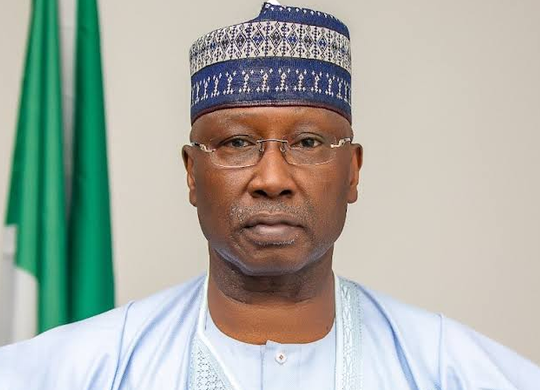
At seventy, Boss Mustapha occupies an unusual place in the political history of Nigeria’s Fourth Republic. His name became nationally prominent not because he sought the stage with unusual frequency, nor because his politics was built around the spectacle that has increasingly come to define public life, but because, for several consequential years, he stood close to the centre of the Nigerian state. As Secretary to the Government of the Federation, he inhabited an office whose importance is sometimes obscured by its bureaucratic title. In practice, it placed him at one of the principal junctions through which the Presidency, ministries, departments, agencies and the wider machinery of government had to coordinate the business of the republic.
His years in that position — from November 2017 to May 2023 — coincided with some of the most demanding episodes of the Buhari presidency: the continuing struggle against insecurity, the political and institutional contests of a divided federation, the management of an increasingly complex economy and, above all, the unprecedented disruption brought by the COVID-19 pandemic, during which he also chaired the Presidential Task Force charged with steering the country through its most severe public health emergency in a generation. In each of these circumstances, the government work required something different from political rhetoric. It required coordination, discretion, patience and the capacity to translate presidential decisions into an administrative process involving institutions whose interests did not always naturally converge.
That was the terrain on which Mustapha’s national reputation was made.
A Long Apprenticeship in Adamawa
Yet, Boss Mustapha’s story did not begin in the Presidential Villa. Long before he became one of the most recognisable figures in the Buhari administration, a professional and political life was in Adamawa, shaped by law, business, relationships and the long apprenticeship through which Nigerian political figures often acquire their understanding of power.
Born Boss Gidahyelda Mustapha in Hong, in what is now Adamawa State, he passed through Hong Secondary School and the North East College of Arts and Sciences in Maiduguri before proceeding to Ahmadu Bello University, Zaria, where he read law, graduating in 1979 and being called to the Nigerian Bar the following year. He spent his National Youth Service at the Directorate of Legal Services at Army Headquarters, reviewing court-martial proceedings — an early, if unglamorous, education in the discipline of institutional process.
The years that followed took him through an Italian consultancy firm and into legal practice in Lagos, before public life claimed more of his attention. He served in the Nigeria Bar Association’s Yola branch leadership, sat as a member of the Constituent Assembly that drafted the 1989 constitution, and chaired state political structures in the old Gongola State as the Peoples Solidarity Party and later the Social Democratic Party organised the transition politics of the Babangida years. He twice sought the Adamawa State governorship, in 1991 and again in 2014, without success — a reminder that his path to national prominence was neither a straight line nor a foregone conclusion, but one built through repeated, patient re-engagement with political life over more than three decades.
By the time he was appointed Managing Director of the Nigerian Inland Waterways Authority in 2016, and then elevated to the SGF’s office the following year, Mustapha arrived not as a newcomer elevated by circumstance, but as a figure whose eventual proximity to the centre of government was the culmination of experiences accumulated over decades in law, party organisation and public administration.
The Character Beneath the Office
Seventy provides an appropriate moment to look backwards across that journey, not simply to catalogue the offices he has held, but to understand the temperament that enabled him to occupy them. For in Nigerian politics, where prominence can be fleeting and proximity to power can easily be mistaken for power itself, Mustapha’s career raises a more enduring question: what does it mean to exercise influence within the state without making personal visibility the principal instrument of that influence?
The answer lies somewhere between politics and administration, between loyalty and judgement, and between the demands of a political principal and the institutional obligations of public office. It is a balance that few who occupy Nigeria’s most sensitive coordinating offices manage to strike for as long, or across as turbulent a period, as Mustapha did.
It is in that space — unglamorous, procedural, largely conducted away from cameras, yet indispensable to the functioning of the state — that Boss Mustapha’s career deserves scrutiny. At seventy, what endures is not a single defining moment but a body of quiet, consequential work: an apprenticeship in Adamawa that took decades to mature, and a tenure at the heart of government that asked, above all, for steadiness when the state needed it most.