
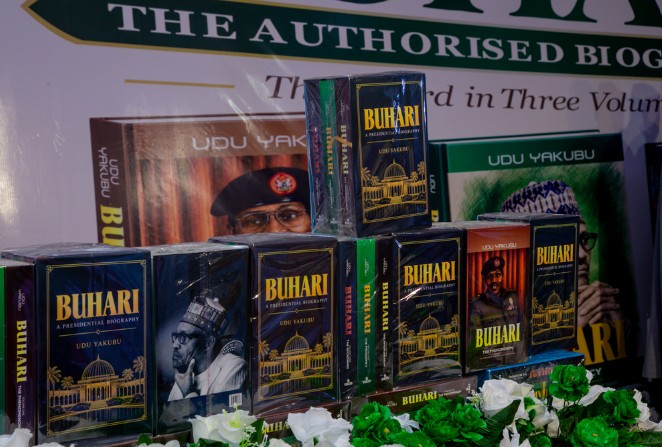
A new biographical account of former President Muhammadu Buhari has reopened one of the most fiercely contested disputes in Nigerian military history, asserting that Olusegun Obasanjo was absent during the decisive final offensive of the Nigerian Civil War and only returned in time to accept the formal surrender of Biafran forces. According to Chapter 8 of the biography, titled “Brothers at War: In Pursuit of One Nation”, the critical operational link-up between the 1st Division and the 3rd Marine Commando was conceived and executed by Obasanjo’s subordinate staff officers, specifically Alani Akinrinade and Godwin Alabi-Isama, while their commander was away from the theatre of operations.
This revelation cuts directly into the established orthodoxy of post-war Nigerian historiography, where receiving the instrument of surrender on 12 January 1970 has long anchored Obasanjo’s credentials as the soldier who ended the 30-month conflict. In Nigerian political life, wartime command has functioned as the ultimate currency of legitimacy for the military class that ruled the country for decades. By stating plainly that events overtook the formal command structure while Obasanjo was away, the text challenges the personal mythology surrounding the end of the war and redistributes credit to field commanders who bore the immediate weight of the final push.
To understand the gravity of this account, one must examine the structural state of the federal war effort in 1969. By the third year of the conflict, initial assumptions of a brief “police action” had collapsed into a grinding war of attrition. The federal military was stretched thin, hampered by severe logistical bottlenecks, international arms restrictions, and acute ammunition shortages that at one point reduced the entire Nigerian Army’s reserve to roughly half a million rounds. In the southern sector, the 3rd Marine Commando had suffered severe setbacks under Benjamin Adekunle, the “Black Scorpion”, whose command had deteriorated due to battle fatigue. General Yakubu Gowon removed Adekunle and redeployed Obasanjo from the Western Region with a specific mandate: to stabilise the front line, halt mounting losses, and recover operational momentum.
Gowon’s overarching strategic design required a coordinated pincer movement. He instructed Obasanjo to liaise with Illiya Bisalla, who had assumed command responsibilities from Mohammed Shuwa in the 1st Division, to execute a link-up around Aba and Umuahia. Once that junction was secured, Gowon intended to issue the final set of orders to bring the secessionist enclave to its knees. Yet, as the biography recounts, the realities of the battlefield outpaced the formal chain of command. Obasanjo was absent at that critical juncture. Rather than waiting in static positions while momentum stalled, his senior staff officers, Akinrinade and Alabi-Isama, grasped the strategic intent of the link-up concept and drove the advance forward from Aba to Umuahia. When that manoeuvre succeeded, they pressed their advantage toward Owerri, collapsing the remaining Biafran defensive perimeter.
The collapse was swift and irreversible. On 9 January 1970, the Biafran leader, Chukwuemeka Odumegwu Ojukwu, fled the enclave with his family and senior officials. Left with an untenable military position and a starving population, the remaining Biafran leadership under Philip Effiong had no option but to capitulate. It was only at this point, after the decisive tactical breakthroughs had already been achieved by his subordinates, that Obasanjo was summoned back to receive the surrender. He subsequently facilitated the transfer of the Biafran delegation to Lagos for the formal ceremonies on 12 January 1970 that officially ended the conflict.
This account corroborates long-standing grievances aired over the decades by veterans of the 3rd Marine Commando, most notably Alabi-Isama himself, who has repeatedly argued in memoirs and public forums that the architects of the final victory were sidelined in official histories. The biography’s endorsement of this version of events carries distinct political weight because it emerges from the camp of Muhammadu Buhari, a fellow civil war veteran and long-time political rival to Obasanjo. Throughout the war, Buhari served on the northern front with the 1st Division under Mohammed Shuwa and Theophilus Danjuma, advancing from Gakem and Ogoja through the Nsukka-Enugu sector and later commanding operations in the gruelling Awka-Abagana-Onitsha axis. His perspective is rooted in the culture of frontline infantry officers who endured heavy casualties, malaria, typhoid, and chronic supply failures while harbouring deep frustration toward high-level decisions made far from the firing line.
For officers like Buhari, battlefield legitimacy was earned through physical presence in the trenches and direct exposure to enemy fire. The biography goes to considerable lengths to document Buhari’s daily routine of rising at two or three in the morning to inspect attacked positions, his narrow escapes from sniper fire, and his shared misery with exhausted troops. Against this standard of frontline endurance, the depiction of Obasanjo returning at the eleventh hour to claim the symbolic prize of surrender serves as an implicit critique of how military glory was distributed in post-war Nigeria.
Beyond the personal rivalry between two former heads of state, the text exposes deeper institutional fractures within the Nigerian military establishment that persisted long after the guns fell silent. The war was won despite profound operational dysfunction, including insubordination at the highest levels—such as Murtala Muhammed’s disastrous, unauthorised attempt to cross the Niger at Onitsha—and a severe disconnect between Lagos and the front. Even the peace that followed was fraught with internal tension. While Gowon’s “No Victor, No Vanquished” declaration and the “Three Rs” programme of reconciliation, reconstruction, and rehabilitation earned international praise, the biography notes that frontline officers quietly resented the policy. Having watched comrades die in the forests and swamps of the East, many soldiers felt that equal treatment without retribution undervalued their sacrifice, though military discipline compelled them to maintain respectful silence.
The historical record of the Nigerian Civil War remains an active battleground precisely because Nigeria never established an official, comprehensive military history of the conflict. In the absence of an authoritative state archive, personal biographies and memoirs have become instruments of political positioning, used by ageing generals to settle old scores and secure their places in the national pantheon. By placing on record that Obasanjo missed the decisive phase of the war he is credited with ending, Buhari’s biography strips away decades of curated prestige and forces a reassessment of command responsibility during Nigeria’s darkest hour. True institutional accountability requires acknowledging that wars are rarely won by the men who sign the final communiques, but by the unnamed and often overlooked commanders who hold the line when leadership is absent.