
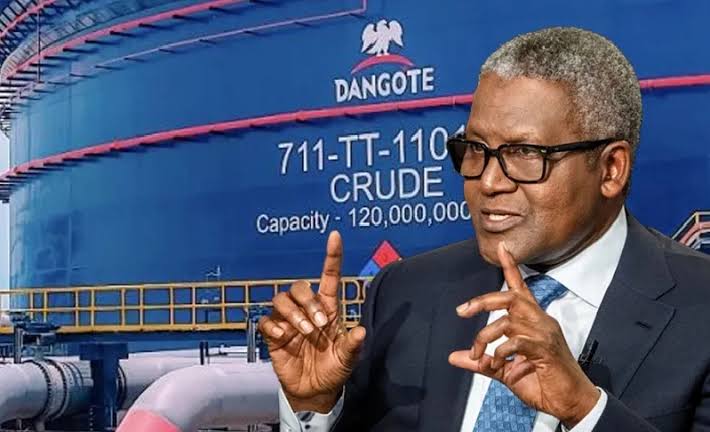
Aliko Dangote has all but concluded a $2.5bn private share placement for Dangote Petroleum Refinery and Petrochemicals FZE, clearing the path for what is widely projected to become the largest initial public offering in Africa’s history and one of the boldest tests yet of the continent’s ability to finance its own industrial ambitions from within.
The transaction, first reported by Bloomberg on Friday and attributed to people familiar with the matter, involved the sale of a stake of up to six per cent in the Lagos based company at a price that values the refinery at approximately $40bn. According to those sources, the placement attracted about $4bn in demand, far outstripping the shares on offer, and was executed in phases, with an initial tranche of roughly $2bn followed by a further $500m raised largely from regional institutional investors. Officials of Dangote Industries declined to comment.
The scale of the appetite marks a striking shift from where the numbers stood only months ago. Dangote first floated a target of around $2bn when he discussed the placement publicly in May, and the final figure, if confirmed, pushes the implied value of the refinery close to double what many analysts were pricing it at as recently as late last year. Business publication BusinessDay reported that the offering was oversubscribed within weeks of opening.
Among the most notable commitments is that of Femi Otedola, chairman of FirstHoldCo, who according to reports pledged $100m and disclosed that he had liquidated his entire holding in Geregu Power Plc to take part. In another first, Nigeria’s pension regulator cleared retirement savings funds to participate, opening a pool worth more than $17bn to a listing that had until now drawn mostly wealthy individuals and large institutions. The private placement itself followed a separate exercise in which the company raised $750m through a debt offering.
Attention now turns to the public listing. The people cited in the Bloomberg report indicated the IPO could raise a further $1.5bn to $2bn, though the timeline remains fluid. Some accounts point to a listing as early as August, while Dangote himself, speaking publicly in May, suggested September. “The IPO that we have right now, there is quite a lot of demand in terms of people disturbing us, pushing us that look, we want to buy,” he said at the time, adding that the plan was to be in the market by September. Roughly ten per cent of the refinery and petrochemicals complex is expected to be offered to the public, with the sale deliberately structured to draw in Nigerians, other Africans and international retail investors. Dangote has also signalled interest in a cross border component listed across several African exchanges rather than the Nigerian Exchange alone, a move that would break the long standing pattern of major African firms raising capital abroad.
To understand why the asset commands this level of demand, it helps to recall what it replaced. Commissioned in 2023 and built at a cost of about $20bn, the Dangote Petroleum Refinery at Ibeju Lekki is the largest single train refinery in the world, with a nameplate capacity of 650,000 barrels per day. For decades Nigeria stood as Africa’s largest crude oil producer while its four state owned refineries lay largely idle, forcing the country to import nearly all of its refined petroleum products at enormous cost in scarce foreign exchange. The Economist Intelligence Unit, in a report this year, described the downstream sector before the refinery as long dysfunctional and noted that the gradual ramp up of the plant since May 2023 had transformed it.
The data behind that transformation is substantial. Figures from the National Bureau of Statistics show that Nigeria’s petrol import bill collapsed by 96.2 per cent in the first quarter of 2026, falling to N87.401bn from N2.271trn in the same period a year earlier, with the bureau attributing the drop mainly to increased domestic production led by the refinery. In March 2026, Nigeria recorded gasoline exports of about 44,000 barrels per day and, for the first time in its history, became a net exporter of petrol, posting a surplus of roughly 3,000 barrels per day. The turnaround has fed directly into the country’s macroeconomic picture. S&P Global Ratings, in upgrading Nigeria’s sovereign credit rating for the first time in fourteen years, cited increased domestic refining capacity and rising hydrocarbon exports among the supporting factors.
The financial profile presented to prospective investors reflects a rapidly expanding parent group. Public analysis indicates that Dangote group revenues grew from $3.3bn to $18bn over five years, while earnings before interest, tax, depreciation and amortisation rose from $1.8bn to $2.8bn across the same span. Against that, the refinery carries about $3.65bn in debt, a load described by analysts as meaningful but proportionate to projected earnings. The sheer size of the planned raise stands out even more when set against the market it will list on. The entire capitalisation of the Nigerian Exchange currently sits at roughly $70bn, meaning a single transaction of this magnitude could reshape the depth and global standing of the exchange in one stroke.
Proceeds from the fundraising are earmarked for an ambitious expansion. The company intends to roughly double processing capacity from 650,000 barrels per day toward 1.4 million to 1.5 million barrels per day by 2028, a target that would place the complex among the very largest refining operations anywhere. The push is part of a wider group strategy that management has framed around reaching $100bn in group revenue by the end of the decade, spanning refining, petrochemicals, fertiliser and other industrial ventures. On feedstock, the refinery has been working to source all of its crude locally, having previously relied on a mix that at one stage stood at about 53 per cent Nigerian crude and 47 per cent imported barrels, much of it from the United States.
The story is not without complicating threads that investors will weigh. Output has at times been uneven. Industry data cited earlier this year showed gasoline exports from the refinery falling to around 10,000 barrels per day in June, down sharply from about 81,000 barrels in April, following a reported reduction in petrol production tied to work on a key processing unit. The refinery has also been drawn into a wider regulatory contest, having initiated legal action over continued fuel import approvals which it argues undermine domestic refining and run counter to the objectives of the Petroleum Industry Act. Global oil price swings have periodically made imported petrol cheaper than the refinery’s gantry price, sharpening competition in its home market. Valuation itself remains a matter of some debate, with estimates ranging from about $40bn to as high as $50bn, and the final offer price still subject to advisers, market conditions and regulatory clearance.
What is not in dispute is the symbolic weight of the moment. A country that spent an estimated N15.42trn on petrol imports in 2024 is now preparing to invite ordinary citizens to buy into the very asset that has begun to reverse that dependence. For Nigeria’s capital market, and for the broader question of whether Africa can mobilise its own savings to fund its own industry, the coming listing is shaping up as one of the most consequential financial events the continent has seen in a generation.