
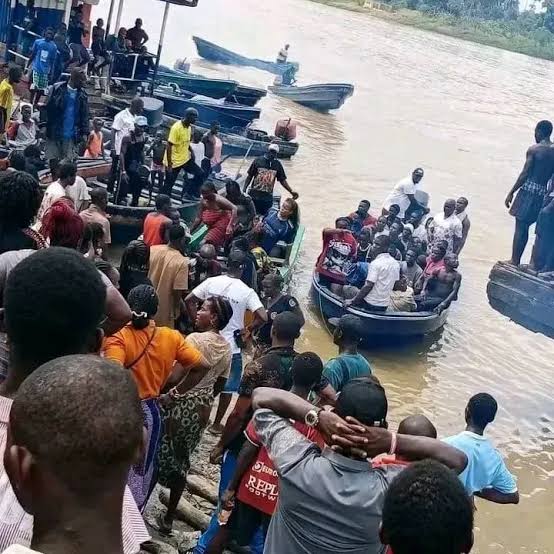
At least 26 people have died after an overcrowded wooden passenger boat capsized on the waterway between Oweikorogha and Otuan communities in the Southern Ijaw Local Government Area of Bayelsa State, in one of the deadliest accidents on the state’s rivers this year. The vessel was carrying mourners from Ayama to Ukubie for a burial when it went down at about 11 a.m. on Friday, according to the Bayelsa State Police Command and local emergency responders.
The police initially confirmed four bodies recovered and 24 survivors rescued on the day of the accident. By Saturday night, divers and marine police had pulled 22 more bodies from the water, raising the toll to 26, with the search resuming on Sunday. Officials have cautioned that the figure could still rise, as several passengers remain unaccounted for.
Governor Douye Diri and his deputy visited the scene on Saturday to assess the recovery effort. Diri said the boat carried no passenger manifest and that those on board were not wearing life jackets, a combination that has made it difficult to establish exactly how many people were aboard. The state’s Commissioner for Information, Orientation and Strategy, Ebiuwou Koku-Obiyai, said the government would support search and rescue teams until the operation ends.
Accounts from the area point to familiar failings. The boat was said to be old and no longer seaworthy, and it reportedly developed a mechanical fault midway through the journey before sinking. Nineteen survivors were treated at the Ayama Clinic, while five with more serious injuries were moved to a hospital in Yenagoa. The boat’s manager has been taken into custody, while the operator is said to have fled.
The disaster fits a grim pattern on Nigeria’s inland waterways, where travel by wooden boat remains the only practical option for many riverine communities. Under rules set by the National Inland Waterways Authority, passenger boats are barred from operating outside 6 a.m. to 6 p.m., and life jackets are mandatory for everyone on board. Enforcement, however, is thin across the creeks of the Niger Delta and the rivers of the north, where overloading and night journeys remain common.
Official records show how costly the lapses have become. At least 326 people died in boat accidents across the country in 2024, a rise of about nine per cent on the previous year, and figures compiled from reported incidents indicate hundreds more have drowned since. The waterways authority puts Nigeria’s navigable network at roughly 10,000 kilometres, of which about 3,800 kilometres are usable, yet much of it operates with little oversight of vessel safety or passenger numbers.
Southern Ijaw, a largely riverine council where roads are scarce, has seen repeated tragedies. In August 2024, about 20 people were burnt to death when a market boat’s engine exploded near Ezetu community, prompting the state government to ban cooking in boats and to order stricter adherence to capacity limits. Smaller collisions and capsizings have continued through 2026, several of them traced to bad weather, poor visibility and the absence of life vests.
Successive warnings have followed each incident. The federal government unveiled an Inland Waterways Transport Code in 2024 to standardise operator conduct and passenger safety, and President Bola Tinubu has previously directed the waterways authority to investigate the rising accidents and prosecute operators who flout the night sailing ban. Community leaders in Bayelsa have again called for tighter checks on vessel seaworthiness and firmer enforcement of life jacket rules.
For now, the immediate concern remains the families gathered at the Ayama waterfront, waiting for news of relatives still missing. The council has said it will prosecute anyone found to have breached safety laws, and the state government has repeated its warnings against overloading, speeding, night travel and sailing in bad weather. Whether those measures hold this time, after years of similar pledges, will decide whether the latest toll marks a turning point or simply the next entry in a long record of preventable deaths.