
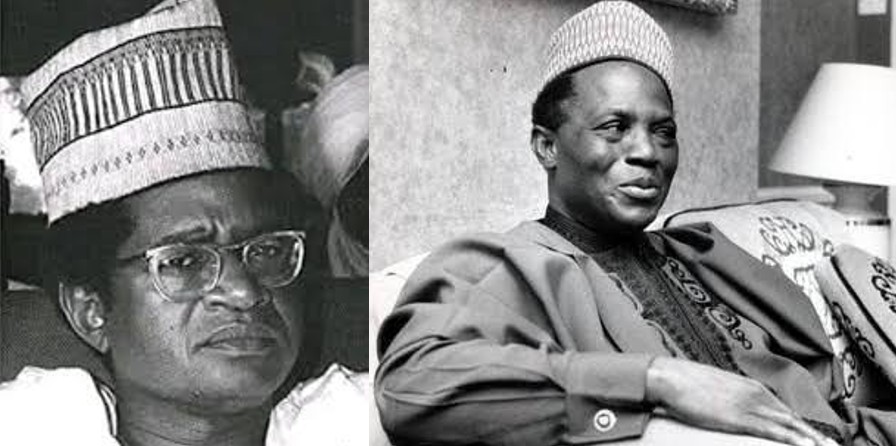
Transitions from military rule to constitutional democracy rarely dissolve the suspicions forged inside the barracks; more often, they merely relocate those anxieties into the quieter, more elusive corridors of cabinet politics. In August 1980, less than a year after the Murtala-Obasanjo military administration completed Nigeria’s historic handover to an elected civilian government, an abrupt administrative manoeuvre in Lagos nearly truncated the military career of Brigadier Muhammadu Buhari. Engineered behind the scenes by key figures in President Shehu Shagari’s cabinet, the attempt to strip a newly appointed field commander of his troops without formal explanation exposed the deep civil-military friction simmering beneath the surface of Nigeria’s Second Republic.
To grasp the gravity of that August 1980 episode, one must examine the delicate institutional recalibration underway across the Nigerian armed forces at the dawn of the new constitutional dispensation. The handover of power in 1979, following the work of the 1975 Constitution Drafting Committee, the 1978 Constituent Assembly, and the 1979 elections in which the National Party of Nigeria (NPN) ticket of Alhaji Shehu Shagari and Dr. Alex Ekwueme prevailed, marked the first time in Nigerian history that a military regime had voluntarily transferred authority to an elected civilian government. Yet that milestone carried profound consequences for the officer corps. Many senior military officers were retired to separate the armed forces from governance and restore a professionalised centre of gravity within the service.
Muhammadu Buhari stood at the exact intersection of that generational and institutional shift. Having attended the War College in 1979 and completed the programme in 1980, he returned to Nigeria at the precise moment the military was being reshaped to fit civilian supremacy. Upon completing his course, he was promoted to the rank of brigadier and, in August 1980, appointed General Officer Commanding (GOC) the 4th Infantry Division. That posting was neither routine nor peripheral. Originally assembled at Enugu in 1964 as a composite garrison command and later reconstituted through the Lagos Garrison Organisation as the 4th Composite Division, the formation carried a remit centred on the federal capital axis, internal security, strategic guarding, and the protection of key installations. It was an institution built to manage Nigeria’s most politically sensitive space.
When Buhari returned to the country, he formally took the traditional salute as GOC of the 4th Division, entering openly into a relationship of command with officers and soldiers who had already acknowledged him as their leader. Simultaneously, however, an influential circle close to President Shagari – notably the Defence Minister, Professor Iya Abubakar, and the Transport Minister, Alhaji Umaru Dikko – raised pointed questions about Buhari’s instinct and temperament. Convinced that his continued presence in the army posed a risk to the fledgling republic, they urged the president to retire him. Shagari neither immediately accepted their recommendation nor dismissed it outright.
Shortly after taking the salute, Buhari received unexpected instructions relocating him to a different, non-command posting in Lagos. Why did an ordinary administrative redeployment provoke such immediate outrage from a disciplined career soldier? The answer lies in the unwritten codes of military authority and institutional honour. Having publicly assumed command of a strategic fighting formation, Buhari viewed an abrupt transfer to a non-command desk as the public withdrawal of authority without explanation or formal process. It rendered him visibly dispensable, placed him under quiet suspicion, and signalled that the civilian leadership – or those speaking in its name – did not trust him to hold troops, exercise operational discretion, or occupy a position of institutional influence. It was, in short, a calculated slight designed to embarrass him and force him out of the service.
Stung by the insult, Buhari refused to accept the posting quietly and sought a direct audience with the commander-in-chief. Standing before President Shagari, he spoke with unadorned candour: to return from an overseas course, take the formal salute as divisional commander, and then be reassigned without explanation was, in his own words, “a humiliation”. Rather than allow himself to be shuffled from post to post in disgrace, he informed the president that he would retire with dignity.
President Shagari’s reaction laid bare the fractured lines of authority within his own administration. Appearing genuinely taken aback, the president expressed surprise and insisted he had no knowledge of the reassignment. “I did not know who did this. I did not know what happened,” Shagari told Buhari. In that moment, the political architecture behind the manoeuvre became unmistakable: the attempt to sideline Buhari had been orchestrated by cabinet figures – principally Abubakar and Dikko – acting out of fear that Buhari might plot to overthrow the government. Shagari intervened immediately, reversed the redeployment, and instructed Buhari to disregard the confusion and resume his duties as GOC.
Yet the cabinet’s anxiety did not emerge from a vacuum; it was rooted in the unresolved history of Nigeria’s post-independence military interventions. Civilian politicians and certain military figures harboured lingering concerns over Buhari’s participation in earlier coups, specifically his involvement in the movement of vehicles and ammunition in 1966, as well as his activities surrounding the 1975 coup. Still, Buhari was hardly unique in that regard. Numerous active senior and mid-level officers still serving in the Second Republic – including Joe Garba, Ibrahim Babangida, Paul Tarfa, Muhammadu Jega, Mamman Vatsa, Mohammed Magoro, Tunde Idiagbon, Sambo Dasuki, Aliyu Gusau, Ibrahim Bako, Halilu Akilu, David Mark, Tunde Ogbeha, Abdulmumini Aminu, Lawan Gwadabe, and Mustapha Jokolo – had played roles in one or more of those earlier episodes. Singling out Buhari for removal was therefore no simple administrative act; any selective purge risked inviting wider demands across the barracks and unsettling discipline throughout the army.
Restored to command of the 4th Infantry Division, Buhari took charge of a complete divisional machine encompassing infantry battalions, artillery, logistics, transport, and supporting arms, reporting directly to army headquarters. Building on his earlier tenure as Military Secretary, he focused on discipline, training, supply, operational readiness, fairer courts-martial, timely payment of allowances, and improved living conditions for soldiers. Even so, the underlying political unease never fully dissipated. Within roughly three years, Buhari was rotated rapidly from the 4th Division in Lagos to the 2nd Division in Ibadan six months later, and four months after that to the 3rd Division in Jos – a sequence that kept him away from the political centre in Lagos while inadvertently widening his profile across three of the army’s four divisions.
Ultimately, the August 1980 cabinet plot revealed three enduring truths about civil-military relations in the Second Republic. First, it demonstrated how deeply civilian ministers distrusted senior officers whose careers had intersected with previous military regimes. Second, it exposed a troubling incoherence at the apex of governance, where senior ministers could attempt to neutralise a key divisional commander without the president’s knowledge. Third, it reinforced Buhari’s own acute awareness of how perilously close political manoeuvring had come to ending his career. Though President Shagari’s intervention preserved institutional order in the short term, the episode left an indelible mark, confirming that even when a military regime handed over power, the shadow of the soldier remained an inescapable presence in the calculations of Lagos.