
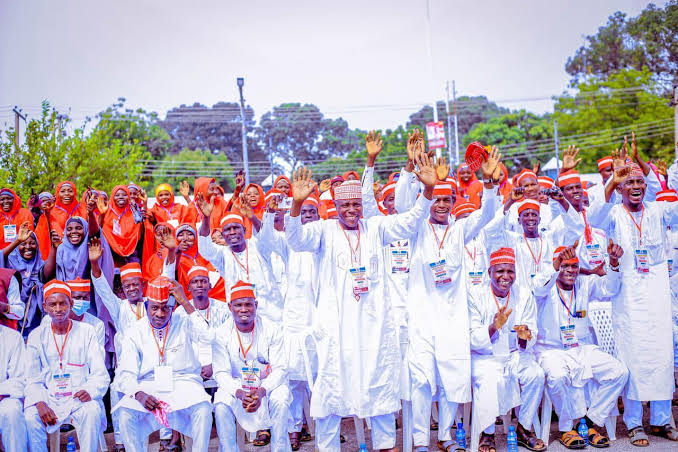
Kano State is preparing to marry off 1,500 couples under a fresh N1.5 billion edition of its long-running mass wedding scheme, with the Hisbah Board confirming that the programme, unlike popular assumption, is open to both Muslim and Christian participants.
The Deputy Commander of the Kano State Hisbah Board, Mujahideen Aminuddeen, disclosed the eligibility details in an interview with the News Agency of Nigeria in Kano on Wednesday. According to him, three Christian couples took part in the last mass wedding held in October 2023, though he could not yet confirm whether any had indicated interest in the forthcoming edition.
Aminuddeen said the initiative, now branded “Auren Gata,” meaning “marriage for the privileged,” is open to widows, widowers, divorcees, spinsters and bachelors. He said it plays a key role in strengthening families and reducing immorality, adding that it also curbs street hawking by girls seeking money for marriage expenses and helps fulfil “Prophet Muhammad’s (SAW) injunction encouraging Muslims to marry and raise families.”
The Commander General of the Hisbah Board, Sheikh Aminu Daurawa, said the government would spend N1 million on each couple, covering beds, mattresses, furniture and food items. He said each groom would receive N100,000 for dowry, while each bride would get N100,000 as empowerment capital. “The government will spend N1 million on each couple, totalling N1.5 billion,” Daurawa said, noting that about 5,000 people applied, out of which 3,000 individuals representing 1,500 couples were selected after screening for HIV, hepatitis B, pregnancy and genotype compatibility.
The scheme carries a firm condition. Daurawa said no beneficiary would be allowed to divorce without the consent of the board, part of a wider effort to reduce marital breakdown that has long shadowed the programme.
The mass wedding is not new to Kano. It was introduced by former Governor Rabiu Kwankwaso during his second term in 2011 as a measure against prostitution and immorality among young people whose families could not afford marriage costs. His successor, Abdullahi Ganduje, sustained it, marrying off 1,520 divorcees in 2017. Governor Abba Kabir Yusuf revived the scheme in October 2023 with 1,800 couples, followed by another 1,800 in December 2024. Records widely reported in the Nigerian press estimate that the state has joined more than 10,000 couples since the programme’s early years, spending several billions of naira in the process.
The spending has drawn recurring debate. The 2025 edition, budgeted at N2.5 billion, was criticised by many as excessive amid inflation and economic hardship. Critics also point to Kano’s education gap, with the state widely reported to carry one of the highest out-of-school populations in the country, put at roughly 989,000 children. Supporters counter that Kano allocated N432.4 billion to education in its 2026 budget, about 29 percent of total spending, above the UNESCO benchmark of 26 percent.
Beyond the figures, the programme reflects deeper social pressures. Northern Nigeria has long recorded high divorce rates linked to poverty, early marriage and weak livelihoods, a reality that shapes both the scheme’s design and its criticism. Whether the counselling, medical screening and post-marriage monitoring promised by the board will translate into lasting unions remains, for now, an open question. A date for the ceremony is yet to be fixed, pending Governor Yusuf’s official announcement.