
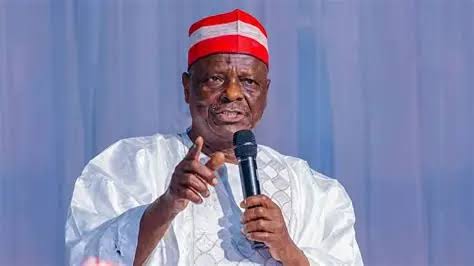
Rabiu Musa Kwankwaso, vice-presidential candidate of the Nigeria Democratic Congress (NDC), has opened a TikTok account, promising followers a direct window into his daily life with 80 days left before Nigerians vote for a new president. The former Kano State governor announced the move on Wednesday in a post on his X handle. “I am on TikTok! I encourage you all to follow me there for authentic information, the latest updates, and exclusive contents directly related to my daily life,” he wrote, signing off with his familiar line, “Nigeria will be OK.”
In a short video attached to the post, Kwankwaso welcomed users to the new account. “Hello TikTokers, welcome to our TikTok account. Turn on your notifications, follow us, share our video, thank you, and God bless you,” he said. The 70-year-old, who turned 70 last week, joins the platform as the running mate to the NDC presidential candidate, Peter Obi.
The choice of platform reflects where Nigerian online audiences now sit. According to DataReportal’s Digital 2026 report for Nigeria, TikTok’s advertising tools reached 47.8 million Nigerian adults in late 2025, up 43.4 per cent in a year. Facebook followed with 38.0 million, YouTube with 30.5 million, while X, where Kwankwaso made his announcement, reached 6.95 million. These are advertising reach figures rather than counts of unique people, but they place TikTok’s adult audience at nearly seven times that of X.
Survey data in the same report, drawn from GWI, show Nigerians use social media on 5.84 days out of every seven, the highest of the 54 countries covered. For campaigns, that frequency matters as much as the size of the audience. It means a candidate’s message can reach the same voter repeatedly within a week.
The electoral arithmetic adds weight to the move. The Independent National Electoral Commission (INEC) says the national register now stands at about 103 million after the completion of the Continuous Voter Registration exercise. Voters aged 18 to 34 number 29,777,576, or 28.79 per cent of the register, while those aged 35 to 49 number 43,265,946, the largest single age group. Together, voters under 50 make up roughly seven in every ten registered Nigerians.
Turnout, however, remains the weak link. In the 2023 presidential election, total valid votes stood at 24,025,940 out of about 93.5 million registered voters, a turnout of under 27 per cent. INEC’s own figures show that the 35 to 49 age group alone is larger than the entire valid vote cast three years ago.
Kwankwaso’s path to the NDC ticket has been eventful. He resigned from the New Nigeria Peoples Party (NNPP), on whose platform he ran for president in 2023, on March 29, 2026, and was received into the African Democratic Congress (ADC) the next day. Weeks later, he and Obi left the ADC for the NDC after consultations over their political future and the party’s zoning arrangement.
Obi was affirmed as the NDC presidential candidate at a special national convention in Abuja on May 30, on a motion moved by Senator Victor Umeh and seconded by former Deputy Senate President Ovie Omo-Agege. He immediately named Kwankwaso as his running mate, saying the former governor would be a partner in government and not a “spare tyre”. Kwankwaso has said the arrangement includes an understanding that Obi will serve a single four-year term before power returns to the North.
The ticket joins two of the strongest challengers from 2023. Obi polled 6,101,533 votes on the Labour Party platform, while Kwankwaso won 1,496,687 votes and carried Kano State. Their combined total of 7,598,220 was higher than the 6,984,520 votes recorded by Atiku Abubakar, but about 1.2 million votes short of President Bola Tinubu’s winning tally of 8,794,726. Votes from one election do not transfer automatically to the next, and both men now face a different field and a larger register.
The NDC recently inaugurated its National Campaign Council, with the party’s National Leader, Senator Henry Seriake Dickson, as chairman and Obi as co-chairman. Kwankwaso serves as co-vice-chairman, while Ibrahim Hussain Abdulkarim heads the council as Director-General.
INEC has fixed the presidential and National Assembly elections for Saturday, January 16, 2027, following the enactment of the Electoral Act, 2026. Campaigns opened on August 19 and close on January 15. Eighteen political parties are fielding presidential candidates, including President Tinubu of the All Progressives Congress and Atiku of the ADC.