
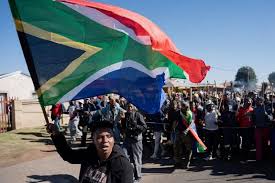
Dozens of anti-illegal immigration protesters marched through a township outside Johannesburg on Monday, a day after South African President Cyril Ramaphosa pledged action against groups accused of fuelling xenophobic violence.
Chanting and singing as they moved through Kwa-Thema, a township about 40 kilometres southeast of Johannesburg, the demonstrators called for tougher government action against illegal immigration. The march was peaceful, with some participants carrying sticks, according to footage aired by the SABC public broadcaster.
The country has seen recurring bouts of anti-migrant violence, with protests intensifying this year as vigilante groups ordered undocumented foreigners to leave by June 30. Anti-migrant protest groups have said they set the deadline for foreign nationals who are in South Africa illegally to leave and have requested talks with the government.
Ramaphosa acknowledged public concerns over illegal immigration but warned that authorities would not tolerate anyone taking the law into their own hands.
“We will and must not allow groups to use the legitimate concerns of South Africans to destabilise our country through inciting lawlessness and violence,” he said in a national address late Sunday. “We will act against forces who are exploiting the concerns of our people about illegal immigration to further their own political, personal or criminal agendas.”
Organisers responded swiftly, saying they were encouraged that the President had put the issue on the national agenda, but vowed to press ahead with their campaign.
Among Africa’s leading economies, South Africa is home to more than three million foreigners, just over five percent of the population, though unemployment running above 30 percent has fuelled tensions with migrant workers. There are no official figures for how many migrants are in the country illegally, though various estimates have put the number at between two million and five million out of a population of 62 million.
The violence is not new. In the worst attacks against immigrants in the last two decades, 62 people were killed in 2008, with further clashes in 2015, 2016 and 2019. In the latest wave of unrest, Mozambique has said five of its citizens were killed.
Last month, hundreds of foreign nationals, including citizens from the Democratic Republic of Congo, Rwanda and Somalia, sought protection in the eastern port city of Durban, saying locals had gone door to door ordering them to leave by the end of the month.
The unrest has prompted several countries to organise the return of their citizens. Ghana arranged repatriation flights for hundreds of nationals, while Malawi and Mozambique organised buses to bring people home. More than 600 Ghanaians were processed for departure over the weekend, South Africa’s border authority said on Monday, taking the tally of those who have left to 995. The first group of Nigerians is due to leave on Wednesday. Nigeria is planning to fly between 2,000 and 4,000 of its people home.
Kenya, Lesotho and Zimbabwe are among the countries that have urged their citizens in South Africa to exercise caution.