
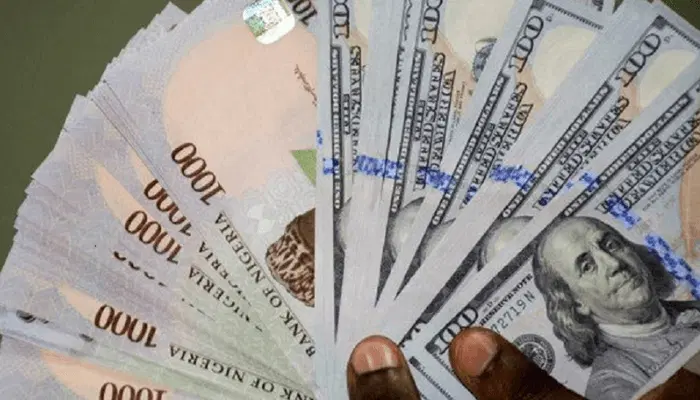
The naira weakened to N1,410 against the United States dollar in the parallel market on Thursday, easing from N1,405 a day earlier, as renewed demand pressure pushed the currency lower across both segments of Nigeria’s foreign exchange market.
At the official window, the currency also lost ground. Data from the Central Bank of Nigeria showed the indicative exchange rate at the Nigerian Foreign Exchange Market (NFEM) rising to N1,365.5 per dollar from N1,361.5 the previous day, a movement of N4 in the dollar’s favour. The shift widened the gap between the parallel and official rates to N44.5 from N43.5, even as interbank turnover at the NFEM thinned, falling by 28.8 per cent to N69.92 million.
The latest depreciation interrupts a stretch of relative calm that has defined the naira through much of June. Earlier in the week, the official rate hovered around the N1,360 range while parallel market dealers quoted between N1,392 and N1,402, a spread far narrower than the several hundred naira that separated the two markets during the volatility of 2023 and 2024.
That convergence is the product of a deep reset in monetary policy. When the Central Bank of Nigeria unified Nigeria’s multiple exchange rate windows in 2023, the naira fell sharply, inflation accelerated, and foreign investors reassessed currency risk. The adjustment was painful but, the apex bank has maintained, necessary. Since then the currency has clawed back part of its losses. In 2025, the naira appreciated by about 7.4 per cent year on year to close near N1,429 per dollar.
External reserves have underpinned the recovery. The Central Bank of Nigeria reported that reserves rose to $50.42 billion as of June 10, 2026, up from $50.11 billion on June 5, sustaining a level above the $50 billion mark that the bank attributes to stronger oil earnings, diaspora remittances, and the return of foreign portfolio investors. Reserves had earlier touched $50.45 billion in February, the highest in 13 years, offering an import cover of about 9.68 months.
Policy adjustments have continued in step. The Central Bank of Nigeria began implementing the fourth edition of its Foreign Exchange Manual from June 1, a move it links to improved liquidity at the NFEM window and firmer reserves. At its February meeting, the Monetary Policy Committee trimmed the benchmark rate to 26.5 per cent, signalling that inflation and foreign exchange pressures were easing. Inflation has also cooled markedly, falling from 34.8 per cent in December 2024 to 15.10 per cent by January 2026.
Whether the current stability holds remains contested. The International Monetary Fund recently urged the Central Bank of Nigeria to preserve exchange rate flexibility, allow two-way movement of the naira, and slow the pace of reserve accumulation, arguing the currency remains undervalued in real terms. The Financial Derivatives Company has placed the naira’s fair value at roughly N1,257 per dollar under purchasing power parity, suggesting an undervaluation of about 11 per cent.
Others are more cautious. The Nigerian Economic Summit Group projects the naira trading around N1,480 to the dollar through 2026, while Fitch Ratings forecasts reserves easing to $47 billion by year end on rising spending pressures.
For now, traders say demand from importers and travellers continues to set the tempo in the informal market, leaving the naira sensitive to every shift in dollar supply.