
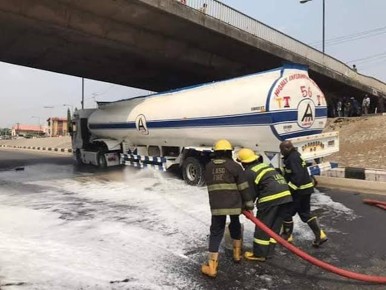
A major industrial disaster was averted in Lagos after a tanker carrying 33,000 litres of ethanol overturned at Second Rainbow Bridge, prompting a swift multi-agency chemical containment operation.
Early on Wednesday, a high-stakes emergency unfolded at a bustling transit point in Lagos as a heavy commercial tanker carrying thirty-three thousand litres of ethanol overturned along the Second Rainbow Bridge in the Amuwo Odofin industrial district. The vehicle lost stability while negotiating a sharp turn on the elevated roadway, causing its central turntable mechanism to snap entirely and dumping the massive steel container directly onto the busy roundabout below.
The abrupt impact immediately blocked the entire arterial stretch, creating a massive traffic bottleneck and putting hundreds of nearby commuters, street traders, and motorists in immediate proximity to a volatile chemical hazard. Because highly concentrated ethanol vaporises rapidly upon exposure to air, the spilt liquid posed a severe risk of catastrophic fire and secondary explosions across the surrounding commercial neighbourhood.
Disaster was ultimately averted through a swift, multi-agency containment operation that locked down the immediate perimeter, suppressed volatile fumes, and neutralised potential ignition sources. The incident highlights the delicate balance between industrial transit safety and emergency preparedness across Nigeria’s commercial capital, where heavy bulk haulage vehicles daily navigate densely populated urban corridors.
Inside the Speeding Incident and Chemical Lockdown
Preliminary investigations conducted by state safety inspectors identified excessive speed as the primary factor behind the rollover. As the FOTON haulage truck bearing registration number APP 346 YC attempted to clear the turn, centrifugal forces strained the mechanical link connecting the tractor unit to the trailer, leading to a catastrophic structural failure of the turntable connection.
Recognizing the immense hazard posed by a potential industrial explosion, the Lagos State Emergency Management Agency dispatched its specialized Eagle Response Team to establish a security cordon. Emergency personnel immediately pushed back gathering crowds, redirected vehicular traffic away from the spill zone, and halted ongoing commercial activity across the affected intersection.
To prevent spark ignition, the Lagos State Fire and Rescue Service worked alongside the Federal Fire Service to deploy heavy applications of chemical foam blanket over the overturned tank and surrounding asphalt. This blanket effectively suppressed highly flammable chemical fumes while emergency technicians assessed the structural integrity of the damaged vessel.
Inter-Agency Coordination and Traffic Recovery
The containment effort drew support from multiple civil security agencies, with officers from the Nigeria Police Force securing the immediate zone against unauthorised entry while operatives from the Lagos State Traffic Management Authority established detour routes to keep surrounding arterial roads moving.
Permanent Secretary of the emergency agency, Dr Olufemi Oke-Osanyintolu, confirmed in an official statement that the rapid, highly coordinated intervention successfully prevented a public tragedy, noting that no fatalities or personal injuries were recorded during the incident or the subsequent recovery process.
Heavy-duty towing equipment was subsequently deployed to elevate the fallen tanker, clear residual debris, and restore safe vehicular access across the Amuwo Odofin transit corridor. The seamless operation underscores how specialised containment protocols can mitigate potentially devastating transport accidents in volatile urban environments.
A Parallel Crisis in Agege Highlights Driver Recklessness
Even as emergency teams finalised recovery operations at Amuwo Odofin, a separate transport disruption occurred across town at the Oke Koto intersection in Agege. In that instance, a heavy industrial cement truck belonging to the Dangote fleet mounted a concrete road divider during transit, becoming firmly wedged atop the structure and completely blocking local traffic flow.
Investigating officers attributed the Agege incident to reckless driving and poor vehicle handling along a restricted roadway. The agency’s specialised Tiger Response Team from the C3 operational centre was immediately deployed alongside traffic management officers to resolve the gridlock.
Utilizing specialized heavy recovery apparatus known as Super Metro, emergency crews lifted the trapped freight vehicle clear of the concrete barrier before towing the truck directly to a state traffic yard for comprehensive inspection and administrative processing. Like the ethanol spill, the Agege incident concluded without injuries or loss of life, allowing authorities to reopen the roadway to normal traffic.
Strengthening Regulations for Hazardous Haulage
While both morning incidents concluded without human casualties, public health experts and transport safety advocates emphasise that recurring commercial vehicle crashes reflect broader systemic vulnerabilities across Nigeria’s freight haulage sector. The routine transportation of flammable chemicals, bulk cement, and heavy industrial goods through densely populated residential and commercial zones presents continuous risks to public safety.
Emergency agency head Dr Oke-Osanyintolu commended the frontline responders for their prompt intervention while issuing a stern warning to commercial logistics companies and long-distance drivers. He urged freight operators to enforce strict adherence to legal speed limits, maintain mechanical coupling systems, and uphold rigorous safety standards when transporting hazardous cargo through public thoroughfares.
As commercial traffic volumes continue to expand across major urban hubs, state authorities face growing pressure to enforce stricter vehicle inspection regimes, regulate heavy haulage operational hours, and penalise reckless driving to ensure that potential highway disasters are stopped long before emergency teams are called to respond.