
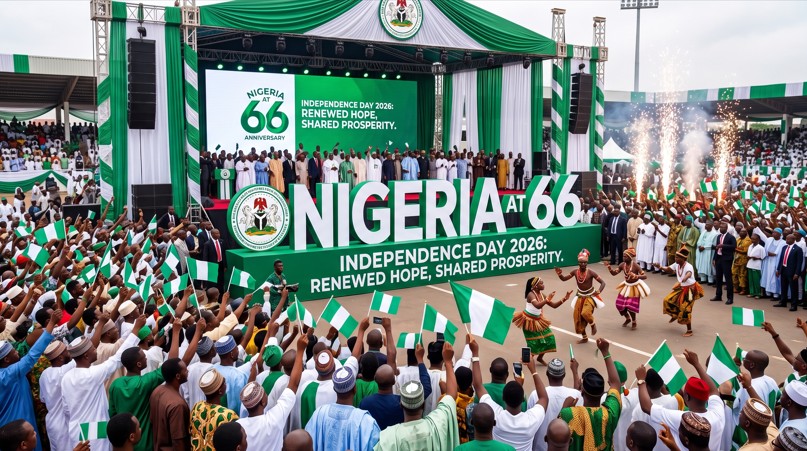
Nigeria will mark 66 years of independence on October 1, 2026, a milestone that invites both celebration and serious reflection. The question, however, is not simply whether Nigerians should wave the green-white-green flag, attend ceremonies or exchange Independence Day greetings. The more difficult question is what, after 66 years of self-government, Nigerians have to show for the freedom won in 1960.
There are compelling reasons for pride. There are also compelling reasons for dissatisfaction.
The Federal Government itself has chosen a relatively restrained approach to this year’s anniversary, with a low-key programme and a presidential broadcast rather than a large-scale celebration. That may be appropriate for a country whose citizens are still grappling with the cost of living, insecurity, unemployment, poverty and inadequate public services.
But an anniversary need not be a celebration of government performance. Independence Day belongs to the people. It is an opportunity to celebrate Nigeria as a country while asking whether the promise of independence is being fulfilled.
66 years of survival is itself an achievement
Nigeria’s story since 1960 has not been a straight line. The country has experienced military coups, a civil war, prolonged military rule, economic crises, structural adjustment, religious and ethnic tensions, electoral disputes and persistent insecurity. Yet Nigeria has survived.
Since 1999, it has maintained uninterrupted constitutional democracy—the longest continuous democratic period in its history. The country has also remained territorially intact despite powerful centrifugal pressures.
That achievement should not be dismissed.
There has also been substantial economic and social transformation. Nigeria of 2026 is not the Nigeria of 1960. Telecommunications have revolutionised communication and business. Banking and financial services have expanded dramatically. Nollywood has created an internationally recognised cultural industry. Nigerian entrepreneurs have built companies across Africa and beyond. The technology sector has produced globally recognised businesses, while Nigerian professionals continue to make their mark internationally.
The country’s universities, although facing serious challenges, have produced generations of professionals in medicine, engineering, law, science, education, business and the arts.
Nigeria has also retained considerable diplomatic and geopolitical influence in Africa. These are legitimate grounds for recognising what Nigerians have achieved. But they should not obscure what remains unfinished.
The uncomfortable economic reality
Perhaps nowhere is the contradiction more obvious than in the economy.
Nigeria’s macroeconomic picture has improved in some important respects. The World Bank says real GDP grew by 4.2 per cent in the first half of 2026, while external reserves reached $51.9 billion at the end of July. It also reports that inflation declined substantially from its 2025 peak, although food inflation remained high.
The IMF similarly estimates 2026 growth at about 4.1 per cent and acknowledges that the government’s reforms have improved macroeconomic outcomes and resilience. But it also says that conditions remain difficult for many Nigerians.
An improving economy is not necessarily the same thing as an improved household economy. For a family struggling to pay rent, buy food, pay school fees or transport children to school, the most important economic statistic is not necessarily GDP growth. It is whether income is growing faster than the cost of living.
This is where Nigeria’s independence anniversary becomes particularly uncomfortable. The World Bank estimates that 69.6 per cent of Nigerians were living below the lower-middle-income poverty line of $4.20 a day in 2025, while 50.8 per cent were living in extreme poverty.
The IMF has also estimated that poverty reached 63 per cent under Nigeria’s national poverty line and that 27 million Nigerians experienced food insecurity in late 2025. These figures put the meaning of independence into sharper perspective.
Political independence means little to a citizen who remains trapped in economic insecurity.
The reforms—and their price
The Tinubu administration’s economic reforms have fundamentally altered the policy landscape.
The removal of the petrol subsidy and foreign-exchange reforms were intended to correct longstanding distortions, improve government finances and create conditions for investment and growth. The government says these reforms are now producing greater macroeconomic stability and laying the foundation for shared prosperity.
There is evidence of improvement in several macroeconomic indicators. But reforms also have distributional consequences. The removal of the subsidy transferred a substantial part of the cost of petrol from government finances to consumers. Exchange-rate adjustments also increased the naira cost of imports and contributed to pressure on household purchasing power.
The Centre for the Promotion of Private Enterprise recently argued that although macroeconomic indicators have improved, the gains have not yet translated sufficiently into stronger household welfare or lower business operating costs.
That is perhaps the central economic question Nigeria should confront at 66: How quickly can macroeconomic stability become household prosperity?
Growth without enough jobs
Another challenge is employment. Nigeria has one of Africa’s largest and youngest populations. That can be an enormous economic advantage—but only if the economy creates sufficient productive employment.
The World Bank notes that approximately 3.5 million people enter Nigeria’s labour force each year, while weak job creation and limited entrepreneurial opportunities remain significant concerns. This is more than an economic statistic. It is a question about the country’s future.
A young Nigerian who finishes university or acquires a vocational qualification expects more than patriotic speeches. He or she expects an opportunity to use that education productively. If the economy cannot absorb its young population, frustration can manifest itself through migration, crime, political instability or disengagement from the national project.
Nigeria therefore needs an economic model that produces not merely growth but productive employment, rising real incomes and greater economic mobility.
Insecurity remains a national wound
There is another reason why Independence Day cannot be reduced to ceremonial celebration: insecurity. The World Bank continues to identify banditry and kidnapping, particularly in the North-West, insurgency in the North-East and separatist agitation in the South-East among Nigeria’s major challenges.
A nation cannot fully enjoy independence when large numbers of citizens are afraid to travel, farm, conduct business or send their children to school.
Security is also an economic issue. Farmers who cannot safely access their farms cannot produce at full capacity. Businesses cannot invest confidently in insecure locations. Communities cannot develop when schools, markets and healthcare facilities are repeatedly disrupted.
The government acknowledges that security challenges remain unresolved even while pointing to progress in some areas. That acknowledgement is important because sustainable national progress requires honesty about both achievements and failures.
Infrastructure and public services
After 66 years, Nigerians also have every reason to ask why electricity, transport, water, healthcare and education remain such persistent challenges. There have certainly been improvements. Nigeria’s telecommunications revolution is perhaps the clearest example of what sustained investment and competition can accomplish.
But electricity supply remains inadequate, infrastructure gaps continue to raise business costs, and the quality of public education and healthcare remains uneven. The World Bank identifies infrastructure, human capital and public-sector capacity among the areas requiring sustained attention.
The anniversary therefore provides an opportunity to change the definition of national development. A country should not measure success only by the number of roads constructed or projects commissioned. It should ask whether those roads reduce travel time, whether electricity enables factories to operate competitively, whether schools produce employable graduates and whether hospitals provide affordable quality care.
What exactly should Nigerians celebrate?
Perhaps the answer lies in distinguishing celebrating Nigeria from celebrating its circumstances. Nigeria’s independence is worth commemorating because it represents sovereignty, national identity and the right of Nigerians to determine their own political destiny. But commemoration should not become self-congratulation. There is nothing contradictory about celebrating Nigeria while criticising its shortcomings. Indeed, genuine patriotism should make honest criticism possible.
The Nigerian citizen who demands better roads, safer communities, reliable electricity, accountable government and a stronger economy is not necessarily rejecting Nigeria. He may actually be demanding that the country live up to its potential.
That is why the theme of this year’s anniversary—“From Reforms to Stability: Consolidating Nigeria’s Renewed Hope for Shared Prosperity”—is significant. The Federal Government itself says the next challenge is to translate reforms and stabilisation into tangible improvements in people’s lives.
That is the real test.
Independence should be measured by what citizens can do
After 66 years, perhaps Nigeria should redefine what independence means. Independence should mean that a child born in a poor household can receive quality education and compete fairly with a child from a wealthy family.
It should mean that a farmer can cultivate his land without fear. It should mean that a young graduate can find productive employment without knowing somebody in government.
It should mean that an entrepreneur can build a business without spending a disproportionate amount of money overcoming infrastructure and regulatory obstacles. It should mean that citizens can criticise their government without fear.
And it should mean that the wealth generated from Nigeria’s natural and human resources translates into a better quality of life for the majority.
These objectives remain unfinished.
So, is Nigeria’s 66th anniversary worth celebrating?
There is no single answer that captures the experience of more than 200 million Nigerians.
For some, the anniversary will represent survival, resilience, family, culture, national pride and hope. For others, the occasion will be overshadowed by the daily struggle to afford food, secure employment, remain safe and provide a decent future for their children.
Both experiences can be true at the same time.
Nigeria at 66 therefore deserves neither uncritical celebration nor complete despair. It deserves reflection. The country has survived crises that could have destroyed it. It has produced remarkable people, businesses, institutions and cultural achievements. It has made significant economic reforms and is showing signs of macroeconomic stabilisation.
But millions of Nigerians are still waiting for independence to translate into something more tangible: security, opportunity, dignity and a decent standard of living. Perhaps that is the most appropriate way to mark October 1, 2026. Raise the flag. Sing the anthem. Remember those who fought for independence. Celebrate what Nigerians have achieved.
But after the ceremony, return to the harder work. Because 66 years after independence, the greatest celebration of Nigeria would not be another speech about its potential. It would be a country in which ordinary Nigerians can finally experience that potential in their everyday lives.