
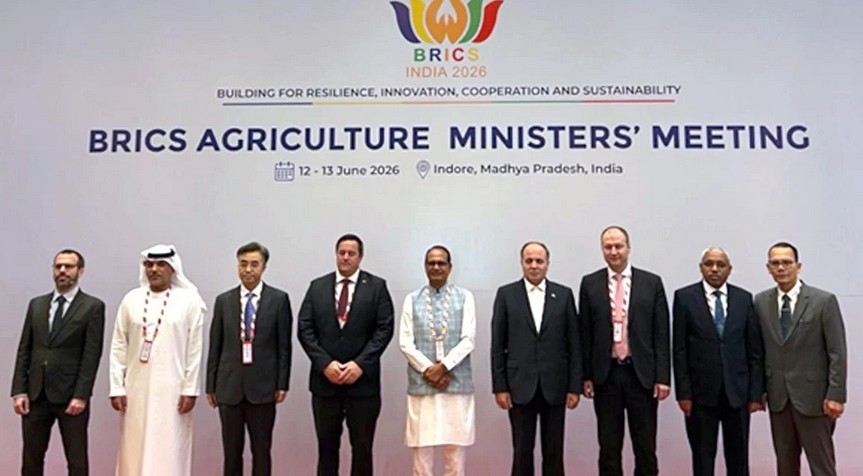
The Federal Government has formally requested strategic partnership and technical support from the BRICS economic bloc to fundamentally revamp Nigeria’s agricultural sector and guarantee long-term national food security. Speaking at the 16th BRICS Agriculture Ministers’ Conference held in Indore, India, Nigeria’s Minister of Agriculture and Food Security, Senator Abubakar Kyari, stated that the administration is determined to leverage the bloc’s bilateral cooperation frameworks. The targeted intervention aims to bypass traditional, sluggish Western developmental channels in favor of the advanced agrarian technologies, machinery, and fertilizer networks possessed by the emerging global powers.
The strategic push comes at a critical time as Nigeria battles an increasingly precarious domestic food supply chain and a rapidly expanding demographic curve. Kyari warned global delegates that the nation’s population is projected to soar to approximately 400 million by 2050, turning food security into an absolute national emergency. Currently, local farmers utilize barely half of the country’s vast arable land resources due to deep structural constraints and a severe lack of mechanized equipment. The ministry wants to partner with BRICS members to establish localized manufacturing plants for tractors, drones, and climate-resilient seeds to dramatically scale up farm-gate productivity.
On the sidelines of the main summit, Nigeria held high-stakes bilateral talks with major agricultural powerhouses, including newly integrated BRICS partner Iran. Iranian Minister of Agriculture Gholamreza Nouri Ghezeljeh pledged Tehran’s explicit support, offering to facilitate the direct transfer of technical know-how in extraterritorial agriculture and advanced livestock breeding. Iran also committed to helping the country build modern cold-chain infrastructure, animal vaccine manufacturing labs, and localized post-harvest processing hubs. This specialized technological injection is expected to systematically lower Nigeria’s high food-loss metrics, which currently waste up to 40 per cent of seasonal harvests before they reach urban markets.
The collaborative framework adopted at the conclusion of the Indore summit perfectly aligns with Abuja’s recent, aggressive pivot toward digital farming utilities and data-driven agroecology. The BRICS joint declaration heavily prioritizes the integration of Artificial Intelligence (AI) and satellite-based monitoring to build climate-resilient farming systems. Parallel to these global talks, the International Food Policy Research Institute (IFPRI) has launched a localized initiative in Nigeria to test generative AI advisory platforms for rural extension agents. By combining international BRICS partnerships with grassroots digital tech, the administration hopes to shield local food production from erratic rainfall and prolonged droughts.
The aggressive diplomatic outreach to the Global South coalition underscores a profound legislative determination to transform agriculture into the ultimate driver of national economic diversification. For an economy frequently squeezed by volatile international crude oil markets and constrained foreign exchange liquidity, achieving food self-sufficiency is a necessary prerequisite to sovereign economic survival. The government believes that drawing heavy investment from established agritech leaders will bypass deep-seated local funding gaps. The ultimate success of the BRICS gamble will rest on how swiftly the ministry can translate these international diplomatic protocols into actual tractors on local factory floors.