
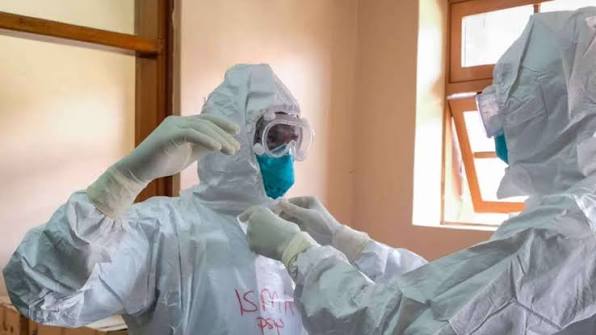
The woman at the centre of Nigeria’s first Ebola case in 12 years is infected with the Bundibugyo strain, a variant of the virus for which the World Health Organisation says there is no approved vaccine or specific treatment. Olajumoke Babatunde, Director of the Public Health Laboratory Service at the Nigeria Centre for Disease Control and Prevention (NCDC), confirmed the strain on Wednesday. “We did three levels of tests, but all molecular. The strain was Bundibugyo,” she told an emergency incident management meeting in Abuja.
Health officials at the meeting said the patient, described by one official as a diplomat, had deteriorated into multi-organ failure. She is being treated in an isolation facility in the Federal Capital Territory. The Coordinating Minister of Health and Social Welfare, Professor Muhammad Ali Pate, had announced the case on Tuesday, October 20, saying 44 close contacts had been identified.
The timeline released by the WHO raises hard questions about detection. According to the agency, the patient arrived in Nigeria on October 3, developed symptoms on October 7 and sought care at a private health facility in Abuja on October 11. Laboratory confirmation came only on October 20, nine days after she first walked into a hospital and 17 days after she landed.
Most of the 44 contacts are health workers, according to NCDC officials, and they include the patient’s husband. Officials are also tracing passengers on her flight from Uganda, though they believe she was not showing symptoms during the journey. The WHO’s guidance is that Ebola can take between two and 21 days to show symptoms, which means contacts must be monitored for three weeks after their last exposure.
Where she caught the virus remains disputed. Uganda’s Director-General of Health Services, Professor Charles Olaro, said the patient, whom his ministry described as a Nigerian woman who travelled to eastern Democratic Republic of the Congo for business, only transited through Uganda in early October without symptoms. He said her transit did not establish that she was infected there, and that Uganda had no confirmed active Ebola case. Uganda was declared Ebola-free in August after recording 20 cases and two deaths.
The wider outbreak gives the Abuja case its weight. The DRC declared the outbreak on May 15, 2026, and the European Centre for Disease Prevention and Control puts the toll at 9,552 confirmed cases and 4,602 deaths as of October 18. That is a death rate of about 48 per cent, and the United States Centers for Disease Control and Prevention ranks it as the second-largest Ebola outbreak ever recorded. Kenya has confirmed eight cases and one death, and the WHO says Nigeria is now the fifth country to detect the virus since May.
Pate has urged calm, pointing to Nigeria’s record. “We have done it in 2014, and we have good public health institutions,” he said. “Nigerians should be reassured. We must be vigilant, but not panic,” he added, urging the public to rely on trusted sources.
That 2014 record is a strong one. After Liberian-American traveller Patrick Sawyer collapsed at the Lagos airport in July 2014, Nigeria recorded 19 confirmed cases, one probable case and eight deaths, according to the CDC, while tracing 894 contacts. The WHO declared Nigeria free of Ebola on October 20, 2014, exactly 12 years before Pate confirmed the new case.
The money question has quickly become political. President Bola Tinubu approved ₦10 billion for Ebola preparedness in June and set up a Presidential Task Force chaired by his Chief of Staff, Femi Gbajabiamila, according to a State House statement. Former Vice President Atiku Abubakar, in a statement by Phrank Shaibu, Director of Strategic Communication of the ADC Presidential Campaign Council, demanded a public audit. “Where is the money? Publish the amount actually disbursed, the dates of payment, every contract awarded,” he said.
Atiku argued that the gap between the patient’s hospital visit and the official announcement left contacts unmonitored and health workers without adequate protective equipment. He also warned against using the outbreak to restrict political campaigns and voter participation. The government has not publicly responded to the audit demand.
The National Assembly has also stepped in. Following a motion by Senator Francis Adedayo Faduyile (APC, Ondo South), the Senate asked for compulsory screening of all arriving passengers at airports, seaports and land borders, exit screening during declared emergencies and the release of emergency funds from service-wide votes. It also called for the repeal and re-enactment of the Quarantine Act of 1926.
In the House of Representatives, a motion by Amobi Ogah (Abia) urged the immediate release of outstanding appropriated funds to health agencies. The NCDC has asked members of the public to report suspected cases through its toll-free line, 6232. The next three weeks of contact monitoring will show whether the virus has spread beyond the first patient.