
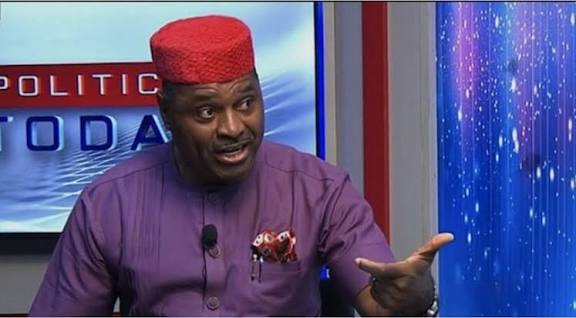
Barely a day after accepting a fresh role at the heart of Atiku Abubakar’s 2027 campaign, Kenneth Okonkwo has moved to douse the controversy that trailed his earlier rejection of Rotimi Amaechi as running mate, insisting that his objection was never personal and that the country’s electoral law, not internal politics, narrowed the field of eligible candidates.
The Nollywood actor turned lawyer, newly appointed spokesperson for the African Democratic Congress presidential candidate, spoke on Channels Television’s Politics Today on Thursday. His remarks came scarcely 24 hours after he announced, in a post on his verified X handle, that Atiku had offered him the position of campaign spokesperson for the 2027 general election.
Pressed on whether he still opposed Amaechi’s emergence as Atiku’s deputy, Okonkwo appeared to distance himself from that position. “I do not know where you got that from,” he said. He then affirmed his loyalty to the party’s decision. “First and foremost, he is the choice of the party and everybody that is a loyal party member,” he added.
The reversal is striking because Okonkwo had, weeks earlier, been one of the loudest voices against the ticket. Following the ADC’s unveiling of Amaechi, the former Rivers State governor and one time Minister of Transportation, Okonkwo publicly withdrew his support, describing the choice of a candidate from the South-South as marginalisation of the South-East and vowing not to campaign for any ticket that lacked a South-East candidate at the top or as deputy. “I am not favourably disposed to campaigning for any presidential ticket that does not have a person of South-East origin as president or vice president in 2027,” he had said at the time.
On Thursday, he recast that earlier stance as a regional aspiration rather than opposition to Amaechi as a person. “I said I expected that the Vice President should come from South-East. It was a geopolitical expression, not the person of anybody, and of course I understood the limitations within the Electoral Act 2026,” he said. He pointed to the membership rule that shaped the party’s options. “Remember, for anybody to be eligible to contest, you must have been a member 21 days before the primary, so the people from the South-East that I would have preferred, strictly speaking, were not even registered members, so we are restricted.”
Okonkwo listed the leading contenders who had signalled interest before the primary as Atiku Abubakar, Amaechi, businessman Mohammed Hayatu-deen and Peter Obi. He argued that Obi’s exit from the coalition left the South-East without a ready standard bearer. “Rotimi Amaechi, Hayatu-deen, Atiku Abubakar and Peter Obi, these were the people that were showing interest to contest the presidential election, and then when Peter Obi left, South-East was thrown into confusion, and you have to pick a vice president that has elicited interest that he wants to embark on the onerous duty of campaigning around the nation,” he said.
The context he referenced is well documented. Atiku emerged as the ADC’s presidential candidate at the party’s primary in May 2026, defeating Amaechi and Hayatu-deen, with Amaechi finishing as runner-up. The party’s National Publicity Secretary, Bolaji Abdullahi, formally announced Amaechi as running mate in a statement in June, describing the pairing as a “unity and rescue ticket.” Obi, who had earlier flirted with the ADC-led coalition, left to pick up the presidential ticket of the Nigeria Democratic Congress.
Okonkwo further argued that Amaechi’s strong showing at the primary made his bloc of supporters impossible to sideline. “Amaechi got up to 500 and something voters in the primary, you cannot alienate them,” he said. His grievance, he explained, was less about the outcome than the process. “What I was agitating is that even if you have constraints, you ought to get the people of South-East and sit down with them and say, look, these are my constraints. Then they will know what they will present to their people,” he said.
He credited Atiku with personally stepping in to calm the tensions once he returned from a trip abroad. “Atiku was not in Nigeria when the party made the announcement, he traveled, so when he came in, he did the needful. If you recall, and that is the beauty of this great democrat. When he came in, everything was halted. When he came in, he went into dialogue, called all the parties,” he said.
The interview also revived Okonkwo’s long running quarrel with his former principal. Once a prominent face of the Obi-Datti Presidential Campaign in 2023 on the platform of the Labour Party, Okonkwo parted ways with Obi in 2024, and on Thursday he accused the former Anambra State governor of betrayal, contrasting Obi’s conduct with what he portrayed as Atiku’s willingness to overlook past criticism. He recalled announcing publicly in 2024 that he no longer spoke for Obi, citing what he called a lack of decisiveness. “He was the one who betrayed me,” Okonkwo said, while praising Atiku as a leader with an eye for talent.
The realignment plays out against a busier legal and political backdrop. Okonkwo’s appointment came as Obi pursued him in court, with an Anambra State High Court granting the NDC candidate leave to serve him with summons by substituted means, part of a defamation suit. During the same Channels appearance, Okonkwo levelled fresh allegations against Obi and the South-East caucus of the NDC over the conduct of that party’s House of Representatives primaries, claims that have not been independently established and which the NDC has been widely reported to reject.
The episode mirrors familiar strains within Nigeria’s opposition. The build up to the ADC ticket has drawn comparisons with the 2023 cycle, when Atiku defeated Nyesom Wike in the Peoples Democratic Party primary before settling on Ifeanyi Okowa as running mate, a decision that deepened divisions the opposition never fully healed. Party figures have said publicly that the ADC is determined to avoid a repeat, insisting that stakeholders across the six geopolitical zones were consulted before the Atiku-Amaechi pairing was confirmed.
With the 2027 contest still taking shape and the coalition working to present a united front against President Bola Tinubu and the ruling All Progressives Congress, the reconciliation of one of its most vocal early critics offers an early test of how far the ADC can hold its disparate blocs together. Whether Okonkwo’s shift settles the South-East question within the party, or merely postpones it, is likely to remain a live issue as campaigning gathers pace.