
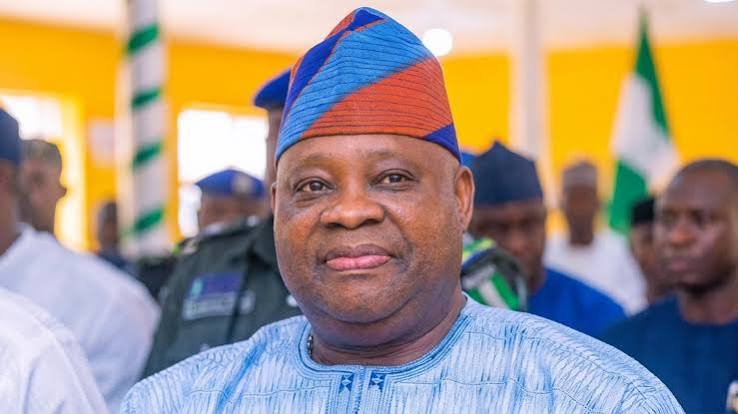
Less than 48 hours before Osun State voters head to the polls, two governorship candidates have withdrawn from Saturday’s election and thrown their weight behind the incumbent governor, Senator Ademola Adeleke, in a last-minute political realignment that has significantly altered the shape of the contest.
Adebayo Simon Adewale of the Allied Peoples Movement (APM) and Adedamola Adebayo of the Peoples Democratic Party (PDP), popularly known as Fryo, announced their withdrawal at separate press briefings in Osogbo on Thursday, urging their supporters and party members to back Adeleke’s re-election bid.
The withdrawals come as the Independent National Electoral Commission (INEC) confirms that 1,906,390 voters are expected to participate in the election across 30 local government areas, 323 wards and 3,763 polling units. The figure represents 81.5 per cent of the state’s 2,339,233 registered voters, with 426,842 Permanent Voter Cards remaining uncollected.
Adewale, addressing journalists in Osogbo on Thursday, said his decision followed what he described as “deep reflection and extensive consultation” with party leaders, supporters and other stakeholders. He insisted that his withdrawal was not motivated by pressure or personal interest but by a conscious choice to prioritise the interest of Osun State above personal ambition.
“I, Adebayo Simon Adewale, the governorship candidate of Allied Peoples Movement in Osun governorship election 2026, after deep reflection and extensive consultation with party leaders, supporters, and stakeholders, have decided to withdraw from the Osun State governorship election,” he said.
The APM candidate said his assessment of the political situation in the state convinced him that Adeleke deserved another term to consolidate the achievements of his administration.
“Having carefully assessed the situation, I believe Governor Adeleke Ademola deserves another term to consolidate the progress of his administration as recorded,” Adewale said.
He subsequently declared his full support for Adeleke’s re-election and called on his supporters, members of the APM and the people of Osun to back the incumbent governor.
“This decision is about the future of Osun. Politicians should always serve the people, and today I have chosen the path that I believe will best advance peace, stability, development, and the collective interest of our state,” he said.
In a separate development, the PDP governorship candidate, Adedamola Adebayo, also announced his withdrawal and declared support for Adeleke during a press briefing in Osogbo.
“I, Honourable Adedamola Adebayo, known as Fryo, hereby endorse His Excellency, Senator Ademola Adeleke ahead of the August 15, 2026 governorship election,” he said.
He urged PDP members, supporters and the party’s structure to support the incumbent governor.
“I encourage all PDP members, supporters and structure to share this position peacefully. Support the emergence of Ademola Adeleke as the governor till 2030,” he said.
A History Of Tight Contests And Legal Battles
Saturday’s election is the latest chapter in a political contest that has defined Osun State since the return to democratic rule in 1999. The state has conducted seven governorship elections, and every election except 1999 has been challenged through an election petition.
The 2022 governorship election, which brought Adeleke to power, was one of the most fiercely contested in the state’s history. Adeleke, then running on the PDP platform, defeated the incumbent governor, Adegboyega Oyetola of the All Progressives Congress (APC), by 403,371 votes to 375,027, according to figures announced by INEC.
However, the election did not end with INEC’s declaration. Oyetola challenged the result, alleging over-voting and other irregularities. The Osun State Governorship Election Petition Tribunal, in January 2023, overturned Adeleke’s victory in a split decision and declared Oyetola the winner. Adeleke rejected the judgment and appealed.
The Court of Appeal later reversed the tribunal’s decision and restored Adeleke’s victory. Oyetola subsequently took the matter to the Supreme Court, which on May 9, 2023, affirmed Adeleke’s victory, holding that Oyetola and the APC had failed to establish the allegation of over-voting sufficiently to overturn the election result.
Four years later, the political landscape has changed substantially. Adeleke, who won the 2022 election on the PDP platform, is seeking a second term under the Accord Party. Oyetola, now Minister of Marine and Blue Economy, has stepped aside from the governorship contest and is backing the APC candidate, Bola Oyebamiji. Former Speaker of the Osun State House of Assembly, Najeem Salaam, is also contesting under the African Democratic Congress (ADC).
Thirteen candidates are contesting the election, but the race has increasingly shaped up as a contest among Adeleke, Oyebamiji and Salaam. The withdrawals of the APM and PDP candidates reduce the number of candidates directing their campaigns towards the electorate.
The PDP’s failure to field a candidate for the 2026 polls is itself a significant development. The party, which won the 2022 election with Adeleke at its helm, is now without a candidate of its own in the race.
Oyebamiji, a former Commissioner for Finance in Osun State, was appointed Managing Director of the National Inland Waterways Authority (NIWA) in October 2023, a position his campaign has cited as evidence of his administrative experience. Salaam, a former Speaker of the Osun State House of Assembly, is campaigning on the ADC platform, presenting himself as an alternative to both the incumbent and the APC candidate.
Despite the large number of registered voters, turnout has steadily declined across successive governorship elections in Osun State, raising questions about whether Saturday’s poll can reverse the trend.
In 2022, almost two million voters were registered, but only 42.09 per cent turned out to vote, the lowest turnout recorded in Osun’s governorship election history. Since the state was created in 1991, eight governorship elections, including the court-ordered 2010 rerun, have been conducted. Turnout has crossed the 50 per cent threshold only twice: in 2003, when it stood at 54.42 per cent, and in 2014, when it reached 54.17 per cent. Participation subsequently declined to 45.74 per cent in 2018 before falling further in 2022.
This year, security concerns have assumed greater prominence as political campaigns have become increasingly hostile. Reports of attacks involving supporters of rival political parties have raised fears that violence could suppress participation.
A Kimpact Development Initiative pre-election security assessment recorded 73 election-related violent incidents ahead of the 2026 poll. Amnesty International Nigeria has projected low voter turnout for the election, citing concerns over political violence and threats ahead of the poll. The Country Director of Amnesty International Nigeria, Isa Sanusi, expressed concern that voter apathy remained a broader challenge in Nigeria.
More than 30 people have reportedly been killed in politically related violence across the state, while political actors have continued to issue inflammatory statements despite a peace accord signed by parties contesting the election.
The controversy intensified after a video emerged in which Francis Fadahunsi, a senator representing Osun East Senatorial District, appeared to urge supporters to “kill” members of the rival Accord Party. The senator has since said his comments were misinterpreted, while the Osun State Police Command invited him for questioning.
President Bola Tinubu, represented by Senate President Godswill Akpabio at the APC governorship rally in Osogbo on Thursday, assured residents of adequate security during and after the election.
“Let me assure all Osun indigenes that adequate security has been provided all over the state to ensure people come out to cast their votes for the candidate of their choice without any fear or intimidation,” Tinubu said.
The Federal Road Safety Corps has deployed 2,500 personnel and 50 operational vehicles, including seven heavy-duty tow trucks and six ambulances, for traffic management and emergency response during the election. The Nigeria Police Force has also deployed 15,000 policemen, 31 Commissioners of Police, helicopters and drones.
While the APM and PDP candidates have endorsed Adeleke, the incumbent governor has also faced a significant withdrawal of support. The National Chairman of the Accord Party, Professor Christopher Imumolen, announced on Thursday the withdrawal of the party’s support for Adeleke, endorsing Oyebamiji instead.
Imumolen made the declaration at the APC Osun State Governorship Mega Rally in Osogbo, where he said the party’s National Working Committee had resolved to support Oyebamiji. He urged members of the Accord Party across the state to vote for Oyebamiji and the APC in Saturday’s election.
“As Chairman of the Accord Party, and with all our National Working Committee members here present, we withdraw our support for Governor Adeleke and support AMBO. All our members are enjoined to vote for AMBO and the APC in Saturday’s election,” Imumolen said.
The endorsement came a day after the Accord Party suspended its mega rally scheduled for Wednesday, August 12, 2026.
The governorship candidate of the All Progressives Grand Alliance (APGA), Adesina Adeyemi-Doro, also withdrew from the race and endorsed Oyebamiji.
The withdrawal of two candidates less than 48 hours before the election represents a significant last-minute realignment in a race that has been closely contested. For Adeleke, the endorsements from the APM and PDP candidates could help consolidate support among voters who might otherwise have split their votes among multiple candidates.
For the APC and Oyebamiji, the Accord Party chairman’s withdrawal of support for Adeleke and endorsement of Oyebamiji represents a counter-balancing move. The withdrawal of the APGA candidate and his endorsement of Oyebamiji further adds to the complexity of the political calculations.
The withdrawals also reflect the broader pattern of political realignments that have characterised the 2026 election. In the months leading up to the poll, defections, legal battles, local government disputes and allegations of political violence have shaped the contest.
As voters prepare to cast their ballots on Saturday, the question remains whether the last-minute endorsements and withdrawals will translate into actual votes. With a history of declining turnout and rising security concerns, the outcome of the election may depend less on the endorsements of withdrawing candidates and more on whether registered voters are willing to risk their safety to exercise their democratic rights.