
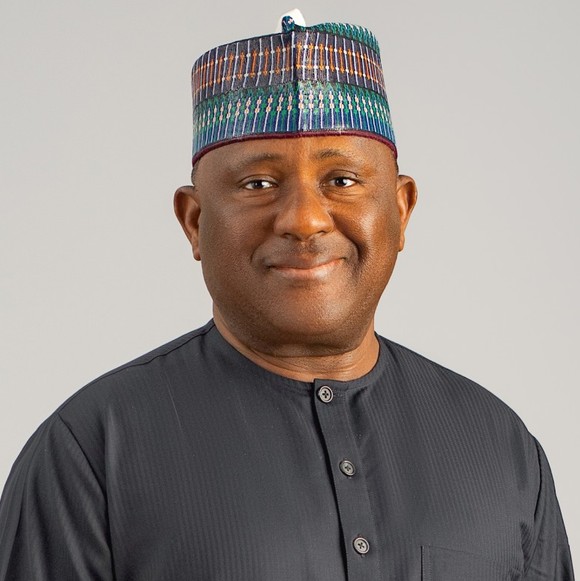
BUA Group Chairman, Alhaji Abdul Samad Rabiu, has offered an unusually personal account of his relationship with the late President Muhammadu Buhari, describing the former Nigerian leader as a father, mentor, trusted friend and source of strength to himself and his family.
Rabiu’s reflections were delivered at the public presentation of Buhari: The Authorised Biography, the three-volume account of the life and public career of the former President. Rabiu used the occasion to disclose the depth of a relationship that, according to him, went considerably beyond the conventional interaction between a President and one of Nigeria’s leading businessmen.
“President Muhammadu Buhari was everything to me,” he said.
“He was a father, a mentor, a trusted friend and a pillar of strength to me and my family.”
Rabiu described Buhari as “an iroko tree upon which I leaned when my strength was failing”, recalling that the former President stood by him during some of the most difficult periods of his personal and business life.
The BUA Chairman’s account presented a side of Buhari less frequently visible in the public controversies that accompanied his years in power. Behind the austere public image, Rabiu recalled a man capable of friendship, reassurance and personal concern, particularly when those close to him were passing through difficult circumstances.
That relationship was tested most seriously, Rabiu said, when disputes involving certain government agencies threatened the survival of his business.
He recalled a period of enormous pressure in which everything he had worked to build appeared endangered. It was at that point, he said, that Buhari’s role moved beyond friendship to a test of principle.
According to Rabiu, the President refused to be influenced by powerful interests and insisted that the matter should be decided on the basis of what was right.
“I remember vividly when he assured me that he would always do what was right, regardless of who was involved or how powerful they might be,” Rabiu recalled.
“I was moved to tears by those words and by his genuine concern for me.”
He said Buhari’s steadfastness ultimately helped save his business, leaving him with a debt of gratitude he would carry for the rest of his life.
“For that, I will remain eternally grateful to him. It is something I will never forget for as long as I live.”
Rabiu’s testimony added a personal dimension to a presentation devoted to documenting Buhari’s long and often contested public career.
The three-volume Buhari: The Authorised Biography traces the former President’s journey through military service, civil war, military government, detention, opposition politics and two terms as democratically elected President.
For Rabiu, however, the historical figure documented in those volumes was also a man encountered at close quarters.
“To the nation, he was a President and a statesman. To me and my family, he was much more,” he said.
“He was a father figure, a cherished family friend and a source of wisdom, encouragement and comfort.”
Rabiu said Buhari valued loyalty, friendship and family and retained what he described as “the human touch” despite the enormous pressures of presidential office.
Unable to attend personally because of a previously scheduled engagement in London, he asked Senator Lawal Shuaibu to represent him and deliver the message. But Rabiu also ensured that his tribute went beyond words.
He authorised a ₦500 million commitment towards the acquisition of copies of Buhari: The Authorised Biography, the largest acquisition commitment announced at the presentation.
The intervention was intended to help extend the reach of the books and preserve the former President’s record for future generations.
For Rabiu, the acquisition was therefore inseparable from the relationship he had described. It was an act of remembrance towards a man whom he regarded not simply as a former President, but as a protector, mentor and friend whose intervention at a critical point in his life had left a permanent impression.
The public presentation thus became, for Rabiu, both a national occasion and a deeply personal one: an opportunity to help preserve the historical record of a President, and to honour the memory of the man he had once leaned upon as an “iroko tree”.