
By N’Mazi Obiomah O. Igbokwe.
W. B. Yeats gives us an unusually powerful metaphor for thinking about Nigerian politics, but the key is to use it as a political literary analogy, not as a prediction that a particular party or candidate will win.
In The Second Coming, Yeats writes: “Turning and turning in the widening gyre.
The falcon cannot hear the falconer.”
The image is simple but profound: the falcon has flown so far from the falconer that the falconer’s voice can no longer control or guide it. The relationship between the one who directs and the one who is supposed to respond has broken down. Viewing the Nigerian political analogy, we could say that the Nigerian electorate is the falconer while the political class is the falcon. In a democracy, the theoretical chain flows thus: the people vote for the government, which governs, or represents them. The people demand accountability from them.
But when politicians become insulated from everyday experiences of citizens, that chain begins to break.
The politician hears the electorate during campaigns chanting;
“Give us jobs.”
“Give us security.”
“Reduce the cost of living.”
“Fix electricity.”
“Protect our communities.”
“Give our children opportunities.”
“Stop corruption.”
But after the election, the political system begins to speak a different language, a language of power, appointments, defections, alliances, primaries, patronage and the preservation of political influence.
That is the Nigerian version of: “The falcon cannot hear the falconer.”
And there is an interesting dimension to this as we approach 2027.
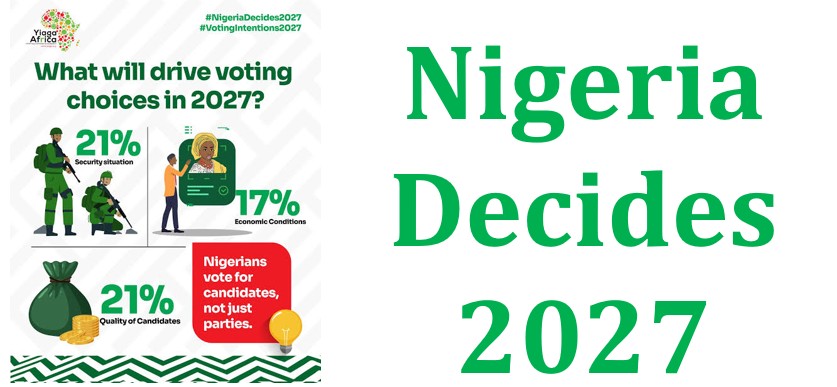
A recent Yiaga Africa survey reported that 84% of respondents said they were likely or very likely to vote, while 49% indicated a desire for leadership change as their leading motivation. The same survey found that economic conditions and security were among the major issues shaping voter priorities. Yet only 34% expressed confidence that INEC would conduct credible elections.
So there is a paradox:
The falconer has not disappeared.
The falconer is still speaking.
The question is whether the falcon is listening and whether the falconer will actually determine the direction of flight.
And then Yeats takes us somewhere darker.
The next line is: “Things fall apart; the centre cannot hold.”
That line has extraordinary resonance for political analysis.
A political system depends upon a centre that holds: institutions, legitimacy, public trust, constitutional order, shared national purpose and some belief that the political process can produce meaningful change. The danger is not simply that politicians stop listening. It is that citizens stop believing that speaking matters.
This distinction is crucial. If citizens believe “They don’t listen to us, but our votes can still change things,” then democracy retains an important corrective mechanism. But if citizens believe “They don’t listen, and our votes don’t matter anyway,” then political alienation can deepen.
That is precisely why current concerns about trust in electoral institutions, insecurity and vote buying matter. The International Republican Institute’s 2026 pre-election assessment identified declining public trust, economic hardship, insecurity, political fragmentation, monetisation and election-related violence as significant challenges to Nigeria’s 2027 democratic process.
But the metaphor can be read in another way. I would actually make the metaphor more sophisticated than simply saying “politicians don’t listen.” Two falcons are in Nigeria’s political arena. The first is the political establishment, which has become increasingly distant from ordinary citizens. The second is the electorate itself, which is becoming increasingly difficult for traditional political structures to control.
Social media, younger voters, independent political movements, shifting alliances and dissatisfaction with established parties can make the electorate less predictable.
Recent reporting already describes the 2027 landscape as one of considerable political realignment and fragmentation. So perhaps the Nigerian adaptation of Yeats should be: The politicians can no longer hear the people, and the people can no longer be commanded by the politicians.
That is potentially much more profound. And this brings us to 2027, and I would not say that Yeats allows us to predict what will happen in 2027. Nor can we responsibly conclude from the metaphor that a political upheaval or that any particular candidate will prevail.
But we can identify the conditions that make 2027 consequential. INEC currently schedules the presidential and National Assembly elections for January 16, 2027, with governorship and State House of Assembly elections on February 6, 2027.
The political question therefore isn’t simply: “Who will win?” A deeper question is: Will the 2027 election restore the connection between the falcon and the falconer or show just how far apart they have become?
This is a very powerful thesis for an essay, speech or article.
The central argument could be: Nigeria’s political crisis is not merely a crisis of politicians who refuse to listen. It is increasingly a crisis of democratic relationship in which the governed feel unheard, the governing class feels increasingly insulated, and the institutions designed to connect the two are struggling to command public confidence. And then the final question becomes almost haunting: When the falcon can no longer hear the falconer, who or what determines the direction of flight?
That could become the opening and closing idea of a very strong 2027 Nigerian political discussion, especially if we weave Yeats’s The Second Coming together with the Nigerian experience of 2023–2026, the cost of living crisis, insecurity, youth disillusionment, party realignments, vote buying, declining institutional trust and the choices facing the electorate in 2027.