
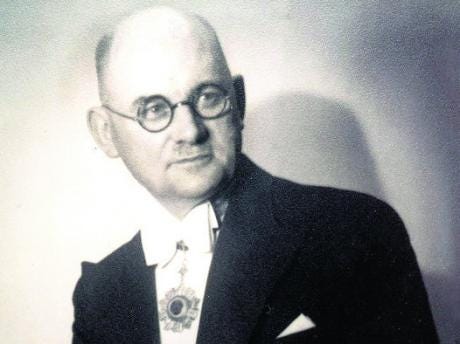
History is replete with paradoxes, but few are as stark as the image of a Nazi swastika serving as a literal shield to protect innocent lives. In the winter of 1937, as the city of Nanking fell into a terrifying abyss of violence, this symbol of totalitarian terror became an unlikely beacon of sanctuary. At the center of this paradox was John Rabe, a German businessman who would come to be known as the “Oskar Schindler of China”. Much like Schindler, Rabe was a deeply complicated figure: a loyal member of the National Socialist German Workers’ Party (NSDAP) who used his political credentials and administrative authority to orchestrate one of the greatest humanitarian rescues in human history. His story is a testament to the power of a single individual choosing to witness, refuse apathy, and utilize whatever systemic leverage they possess to protect human dignity against overwhelming evil.
The Pragmatic Businessman and the Nazi Badge
Born in Hamburg in 1882, John Rabe spent nearly three decades living and working in China. By the 1930s, he was a successful, pragmatic executive serving as the director of the Siemens Corporation’s branch in Nanking, which was then the capital of the Republic of China. Rabe was not an ideological fanatic; rather, his world revolved around German commerce and the community he had built in his adopted home. He joined the Nazi Party in 1934, primarily as a matter of bureaucratic expediency. Eager to secure official party approval and funding for a German school to benefit the children of his local employees, Rabe signed his membership papers. He possessed a politically naive, highly idealized view of Adolf Hitler, believing the Führer to be a well-intentioned reformer who would naturally stand against injustice and promote order. This profound cognitive dissonance would later set up a dramatic clash between his loyalty to his homeland and his humanitarian instincts.
The Descent into Darkness
In late 1937, the Second Sino-Japanese War escalated rapidly. The Imperial Japanese Army marched toward Nanking, subjecting the heavily populated capital to relentless bombing campaigns. As foreign diplomats, businessmen, and wealthier citizens fled the approaching onslaught, Rabe chose to stay. He was driven by a deep sense of moral duty to the Chinese people who had worked alongside him and trusted him. “There is a question of morality here,” Rabe wrote in his diary as the siege closed in. “I cannot bring myself for now to betray the trust these people have put in me, and it is touching to see how they believe in me”.
Recognizing the imminent slaughter of non-combatants, Rabe united with a small group of remaining Westerners, primarily American missionaries, doctors, and educators, to establish the Nanking Safety Zone. This zone, a mere four-square-kilometre area in the western quarter of the city, was designed to act as a neutral haven for unarmed civilians. The International Committee elected Rabe as its chairman. This decision was calculated: Germany had recently signed the Anti-Comintern Pact with Japan, making the German flag and the Nazi swastika powerful diplomatic assets. The committee hoped that a prominent German official could command the respect of the invading Japanese forces.
The Sovereign Shield
On December 13, 1937, Nanking fell. What followed was a six-week campaign of systematic murder, torture, looting, and mass rape. The Japanese military disregarded the neutral status of the city, but the International Committee desperately maintained the “bluff” of the Safety Zone.
Rabe transformed his own residence and the surrounding Zone into a sovereign shield. He painted a massive Nazi swastika on a canvas canopy in his garden, hoping Japanese bombers would recognize the Allied symbol and spare the hundreds of refugees huddled beneath it. When Japanese soldiers attempted to scale the walls of his compound to abduct women or execute men, Rabe would confront them directly. Armed with nothing but his Siemens executive authority and his Nazi Party armband, he would thrust the swastika under the noses of the armed soldiers and command them to leave. Remarkably, it worked. The soldiers, conditioned to respect the authority of their European ally, would retreat.
Within the boundaries of the Safety Zone, Rabe acted as a de facto mayor, managing food distribution, housing, and basic security for up to 250,000 refugees. Every day was a desperate struggle. Rabe and his fellow committee members, such as the missionary Minnie Vautrin and the surgeon Dr. Robert Wilson, worked tirelessly to fend off atrocities. Rabe’s diaries contain harrowing accounts of running from one end of the Zone to the other, physically pulling soldiers off of civilian victims. Through sheer force of will, administrative skill, and strategic exploitation of his political status, Rabe managed to preserve the lives of a quarter of a million people during one of the darkest chapters of the 20th century.
The Heavy Price of Witnessing
In February 1938, as the worst of the violence began to subside, Rabe was recalled to Germany by Siemens. He left Nanking carrying a massive, 1,800-page diary detailing the horrors he had witnessed, alongside photographs and film reels smuggled out of the country. True to his naive belief in Nazi justice, Rabe’s first instinct upon returning to Berlin was to seek an audience with Adolf Hitler. He believed that if the Führer only knew what their Japanese allies were doing, he would intervene.
Instead of a hero’s welcome, Rabe was met with the harsh reality of the totalitarian state he served. He was arrested by the Gestapo, interrogated for three days, and stripped of his documentation. Though his Siemens connections secured his release, he was issued a strict directive: he was to be silenced. He was forbidden from giving further lectures, showing his photographs, or speaking of the Nanking atrocities. For the remainder of the Second World War, the savior of Nanking lived in enforced, agonizing silence.
A Circle of Redemption and Gratitude
The end of World War II in 1945 brought no relief. Under the Allied occupation of Berlin, Rabe’s Nazi Party membership made him a target for denazification. Stripped of his pension and work permits due to his past political affiliation, Rabe fell into extreme poverty. The man who had managed a massive international humanitarian zone was now starving in a ruined, divided Berlin, unable to afford coal or basic food.
But the moral universe has a way of balancing its debts. Word of Rabe’s desperate situation eventually reached the survivors of Nanking. The Chinese city did not forget the “Good Man of Nanking”. In an extraordinary display of cross-continental gratitude, the citizens and government of Nanjing raised a large sum of money to purchase food, medicine, and supplies. Month after month, packages of butter, flour, sugar, and insulin were sent to the Rabe family in Berlin. This circle of gratitude kept Rabe alive during the final years of his life.
John Rabe died of a stroke on January 5, 1950, in relative obscurity in West Berlin. It was only decades later, with the public release of his extensive diaries in 1996, that his legacy was fully restored to the world. Today, his former residence in Nanjing stands as a museum of peace, and his grave rests in Berlin, honored by both the German and Chinese peoples.
The Legacy
John Rabe’s life proves that moral heroism does not require a spotless character or an unstained past. Rabe was a flawed man who wore a compromised badge. Yet, when confronted with absolute horror, he did not look away. He weaponized his complicity, turning a symbol of hatred into a shield of mercy, proving that in the darkest corners of history, a single choice to see can alter the fate of hundreds of thousands.