
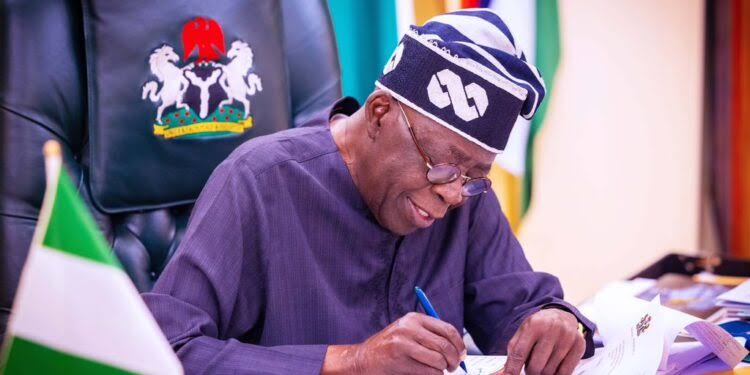
President Bola Ahmed Tinubu has allowed almost five months to pass without acting on the Federal Audit Service Bill, one of the most consequential public finance reforms to reach his desk in years, leaving the legislation stranded between passage and law and reviving old doubts about the depth of official commitment to accountability.
The delay sits awkwardly against the clear language of the Constitution. Section 58(4) of the 1999 Constitution, as amended, gives the President 30 days from the day a bill is presented to either sign it or withhold assent and give reasons to the National Assembly. That window closed long ago. The Bill, according to legislative records, was transmitted to the presidency early this year after the Senate concluded work on it on 18 December 2025, with the House of Representatives having originated the measure.
The silence is striking for a President who has, on other occasions, moved with unusual speed. The Electoral Act Amendment, for instance, was signed on the same day the National Assembly passed it. On the audit reform, however, there has been no assent, no veto, and no public explanation.
At the heart of the matter is the obsolete framework still governing federal audits. The Audit Ordinance of 1956, a pre independence instrument designed for colonial administration, remains the primary reference for audit work even though it ceased to be part of Nigerian law following the Revised Edition of the Laws of the Federation decree of 1990 and was left out of the 2004 Laws of the Federation. That gap has left the Auditor General for the Federation operating largely on the strength of an outdated law, a situation reform advocates describe as a legal vacuum at the centre of a budget that now stands at N68.32 trillion for 2026.
The proposed law would close that gap decisively. It repeals the 1956 ordinance, establishes an autonomous Federal Audit Service and a Federal Audit Board, and grants the Auditor General expanded powers covering value for money audits, forensic audits, and scrutiny of grants, loans, subsidies, intervention funds, and public private partnerships. It also introduces something the current system lacks entirely, which is hard statutory timelines.
Under the Bill, the financial statements of the Federal Government must reach the Auditor General no later than 30 June of the following year, while accounting officers of ministries, departments, agencies, and other statutory bodies must submit their accounts within 90 days of the end of the financial year. A fine of N500,000 awaits those who breach the deadline. The Auditor General would also gain teeth long denied the office, including the power to surcharge public officers for unaccounted spending, to withhold the emoluments of anyone who ignores an audit query for more than 30 days, and to issue a warrant of arrest against officials who refuse to appear as witnesses in audit investigations.
The cost of the current weakness is visible in the numbers. The most recent audited consolidated financial statement before the National Assembly is that of 2022. Statements for 2023, 2024, and 2025 remain unsubmitted, leaving the Auditor General with nothing to examine. The delay is enabled by a loophole. The Fiscal Responsibility Act 2007, in Section 49(1), requires publication of audited accounts within six months of year end but sets no deadline for the Accountant General to hand the statements to the Auditor General in the first place.
Enforcement has been equally hollow. The 2021 audited report recorded that of 29 recommendations in the 2020 report, only six were implemented, one was in progress, and 22 were ignored outright, a reflection of an office that advises but cannot compel.
Frustration has been building. In February, the Public Accounts Committee of the House of Representatives ordered the Accountant General and Auditor General to submit the outstanding statements for 2023, 2024, and 2025 by October 2026. On 8 May 2026, the Accountant General told World Bank representatives the 2023 accounts would be ready within two weeks. That has not happened.
A coalition of civil society organisations, among them the Centre for Social Justice, ActionAid Nigeria, BudgIT, Accountability Lab, the Africa Network for Environment and Economic Justice, and the Paradigm Leadership Support Initiative, has pressed the presidency for months to act. The Centre for Social Justice has gone further, urging the National Assembly to invoke Section 58(5) of the Constitution and override the President by a two thirds majority if his position remains unexplained.
The Executive Director of the Paradigm Leadership Support Initiative, Olusegun Elemo, has publicly argued that a President genuinely committed to transparency would have signed the Bill quickly, noting that the law would arm the Auditor General with real power to sanction financial misconduct. A professor of accounting and financial development at Lead City University, Godwin Oyedokun, has similarly stressed the need to tie audit findings to mandatory consequences and to build a system of regular follow up on past recommendations.
Notably, the Bill is not new to the presidency. Versions of it passed under Presidents Olusegun Obasanjo, Goodluck Jonathan, and Muhammadu Buhari, and each time assent was withheld without further legislative resistance. Whether the current National Assembly breaks that pattern, or the President finally acts as the 2027 election cycle narrows the window for structural reform, remains the open question.