
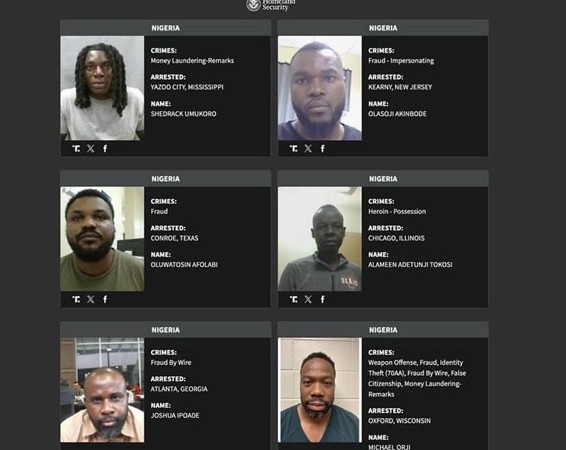
The United States Department of Homeland Security has published the names and photographs of 24 Nigerian nationals arrested by immigration officers over alleged offences ranging from fraud and money laundering to drug-related crimes, assault and identity theft.
The United States Department of Homeland Security (DHS) has released the names and photographs of 24 Nigerians arrested by the US Immigration and Customs Enforcement (ICE) in different parts of the country.
The disclosure, published as part of the Trump administration’s immigration enforcement campaign, identifies the individuals, the offences associated with their cases and the locations where they were arrested.
The offences listed include wire fraud, mail fraud, money laundering, identity theft, drug-related offences, weapons violations, forgery, assault, larceny and cruelty towards a child.
In announcing the arrests, DHS described the individuals as part of what it called the “worst of worst criminal aliens” targeted under the administration’s deportation policy.
The department said ICE officers were carrying out the president’s pledge to intensify deportations, beginning with non-US citizens identified by the administration as priorities for removal.
Full list of 24 Nigerians
According to the information published by DHS, the individuals and the offences associated with their cases are as follows:
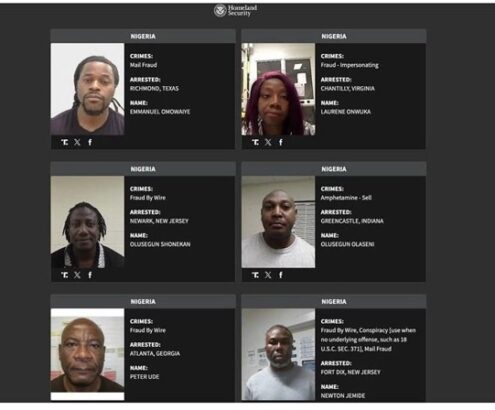
- Emmanuel Omowaiye — Mail fraud; arrested in Richmond, Texas.
- Laurene Onwuka — Fraud and impersonation; arrested in Chantilly, Virginia.
- Olusegun Shonekan — Wire fraud; arrested in Newark, New Jersey.
- Olusegun Olaseni — Sale of amphetamines; arrested in Greencastle, Indiana.
- Peter Ude — Wire fraud; arrested in Atlanta, Georgia.
- Newton Jemide — Wire fraud, conspiracy and mail fraud; arrested in Fort Dix, New Jersey.
- Shedrack Umukoro — Money laundering; arrested in Yazoo City, Mississippi.
- Olasoji Akinbode — Fraud and impersonation; arrested in Kearny, New Jersey.
- Oluwatosin Afolabi — Fraud; arrested in Conroe, Texas.
- Alameen Adetunji Tokosi — Drug possession; arrested in Chicago, Illinois.
- Joshua Ipoade — Wire fraud; arrested in Atlanta, Georgia.
- Michael Orji — Weapons violation, fraud, identity theft, wire fraud, false citizenship and money laundering; arrested in Oxford, Wisconsin.
- Ahmadu Apooyin — Drug-related offence; arrested in Baltimore, Maryland.
- Teslim Kiriji — Money laundering; arrested in Yazoo City, Mississippi.
- Onomen Uduebor — Identity theft; arrested in Seattle, Washington.
- Charles Ochi — Money laundering; arrested in White Deer, Pennsylvania.
- Daniel Eta — Wire fraud; arrested in White Deer, Pennsylvania.
- Ifeanyi Ibennah — Cruelty towards a child; arrested in Tampa, Florida.
- Kazeem Runsewe — Wire fraud; arrested in Thomson, Illinois.
- Fatiu Lawal — Wire fraud; arrested in Lompoc, California.
- Justin Akubueze — Money laundering; arrested in Orem, Utah.
- Moyinoluwaseun Okeowo — Larceny, forgery and concealing stolen property; arrested in Orlando, Florida.
- Babajide Oluwaseun Faseyi — Assault; arrested in Alden, New York.
- Bright Eigbedion — Money laundering; arrested in Lompoc, California.
The list was reported by Nigerian media outlets citing information released by the US Department of Homeland Security.
Fraud and money laundering feature prominently
Financial crimes account for a substantial portion of the offences listed by the US authorities.
Several of the individuals were identified in connection with wire fraud, which generally involves the use of electronic communications or interstate communications systems to carry out a fraudulent scheme. Others were listed for mail fraud, impersonation, identity theft and money laundering.
Money laundering is listed against Shedrack Umukoro, Teslim Kiriji, Charles Ochi, Justin Akubueze and Bright Eigbedion. Michael Orji is associated with several listed offences, including money laundering, wire fraud and identity theft.
Other entries involve drug-related offences, weapons violations, assault, forgery, larceny and child cruelty.
However, the published list does not provide detailed accounts of the circumstances surrounding each case, the evidence involved or the outcomes of the individual proceedings.
The information should therefore be understood as a summary of the offences associated with the listed individuals, rather than a complete account of their respective cases.
Part of wider US immigration enforcement
The publication comes amid an intensified immigration enforcement campaign under President Donald Trump, whose administration has prioritised the detention and removal of non-US citizens it identifies as criminal offenders.
DHS said the arrests formed part of its broader efforts to enforce immigration laws and carry out deportations across the country.
The agency’s public disclosures identify individuals arrested in multiple states, including Texas, New Jersey, Georgia, Florida, California, Illinois and Pennsylvania.
The release of names and photographs is intended to publicise enforcement actions against individuals whom the department says are priorities under its policy.
The announcement has also drawn attention in Nigeria because of the number of nationals identified and the range of offences listed.
Nevertheless, the cases concern specific individuals and should not be treated as representative of Nigerians living in the United States generally.
Arrest does not automatically mean deportation
Although the announcement forms part of the US government’s deportation campaign, the published information does not establish that all 24 Nigerians have been deported.
It also does not provide sufficient details to determine the final legal status of every individual or whether each offence listed resulted in a criminal conviction.
Criminal proceedings and immigration proceedings are distinct processes. An arrest does not, by itself, establish guilt, and immigration authorities may pursue removal proceedings according to the circumstances and applicable law.
The DHS announcement identifies the individuals and the offences associated with their cases, but further information from court records or immigration authorities would be needed to establish the outcome of each case.
The 24 names and photographs therefore form part of the latest public disclosure by US immigration authorities as the Trump administration continues its enforcement operations.