
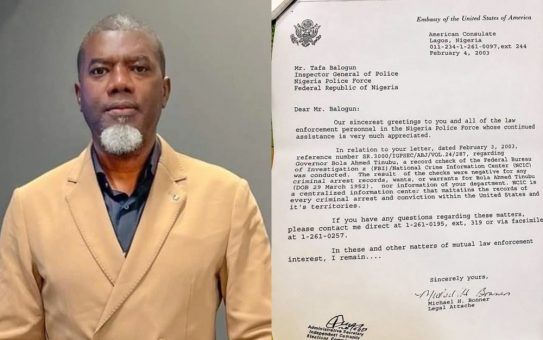
Nigeria’s Ambassador-designate to Mexico, Reno Omokri, has stated that there is no criminal FBI record linking President Bola Tinubu to criminality, distinguishing between the existence of agency records and a formal criminal record.
Speaking on the City Boy Movement Podcast in Abuja on Tuesday, Omokri said an FBI record should not automatically be interpreted as evidence of criminality. “There is no criminal FBI record against President Bola Tinubu. There’s nothing like that. A record is just that, a record; there is a difference between a record and a criminal record.”
He said his position was supported by an FBI record check conducted following a request by Nigerian authorities. “The result of the check was negative for any criminal arrest records, warrants or wanted status for Bola Tinubu. So, there is no criminal FBI record against the President.”
Omokri added that records currently discussed publicly by opposition figures originated from an earlier investigation rather than a new criminal case. “There is no 2026 case. What happened is that a gentleman filed a Freedom of Information Act request. This is not a new case; it relates to a 1993 investigation.”
The historical matter centres on a 1993 civil forfeiture case in the United States District Court for the Northern District of Illinois, case number 93 C 4483. United States authorities sought forfeiture of funds held in certain bank accounts linked to Tinubu and others, alleging connections to a heroin trafficking investigation spanning the late 1980s and early 1990s.
Court records show that approximately $460,000 held in an account associated with Tinubu was ordered forfeited to the United States in October 1993. Other funds previously frozen were returned. The proceeding was civil and in rem, directed at the funds rather than a criminal prosecution of individuals. No indictment or criminal conviction was recorded against Tinubu in that matter.
A 2003 communication from United States authorities to Nigerian officials, referenced by Omokri and previously reported in public discourse, indicated that a check of the FBI’s National Crime Information Center returned negative for criminal arrest records, warrants or wanted notices for Tinubu.
Tinubu has consistently denied any involvement in drug trafficking or money laundering. His legal representatives have maintained that the civil nature of the forfeiture does not equate to a finding of criminal culpability. The Presidential Election Petition Court in 2023 considered related arguments and found that petitioners had not established a criminal conviction.
Ongoing Freedom of Information Act litigation in the United States seeks access to historical investigative records held by agencies including the FBI and the Drug Enforcement Administration. Agencies have released some materials while withholding or redacting others, citing protections for investigative methods, sources and privacy. Tinubu’s legal team has intervened in aspects of the litigation, arguing for the application of available legal protections under United States law.
Omokri, who previously worked politically with former Vice President Atiku Abubakar, said his current stance was shaped by personal investigations and a willingness to revise earlier views when presented with verifiable evidence. He recalled travelling to Chicago State University in 2022 to examine claims about Tinubu’s educational background and obtaining certified documents relating to the civil forfeiture case.
“I went to Chicago State University with a witness who is still a supporter of Atiku Abubakar. I was given incontrovertible evidence that Tinubu attended the school,” he said. On the forfeiture documents, he stated that certified true copies established that previous assertions he had held were incorrect. “This man was not who I thought he was.”
He said his support for Tinubu was based on facts and policy outcomes rather than personal loyalty. Omokri argued that several economic measures pursued by the Tinubu administration, including fuel subsidy removal, exchange rate reform, devolution of powers and student loans, reflected proposals previously advocated within the Peoples Democratic Party.
On subsidy removal, he maintained that restoring the policy would place unsustainable pressure on Nigeria’s finances and effectively subsidise fuel consumption in neighbouring countries. “If you bring back fuel subsidy, you are not going to be subsidising Nigeria. You’re going to be subsidising West Africa, and that will destroy our economy.”
Looking ahead to the 2027 presidential election, Omokri expressed confidence that Tinubu would secure victory and called for national reconciliation afterwards. He urged Nigerians to evaluate the administration through measurable outcomes rather than political sentiment, describing himself as fact-driven.
Opposition voices and some activists continue to highlight the existence of historical United States investigative materials and the civil forfeiture as matters of public interest. They argue that fuller disclosure of agency records would enhance transparency. Supporters of the President, including Omokri, emphasise the absence of any criminal indictment or conviction and the distinction between civil proceedings and criminal guilt.
The debate forms part of broader political contestation ahead of 2027. As of early September 2026, no new criminal charges have been filed against Tinubu in the United States arising from the 1990s investigation, and the FOIA litigation remains ongoing. The distinction between the existence of investigative records and a formal criminal record continues to be a central point of contention in public discussion.