
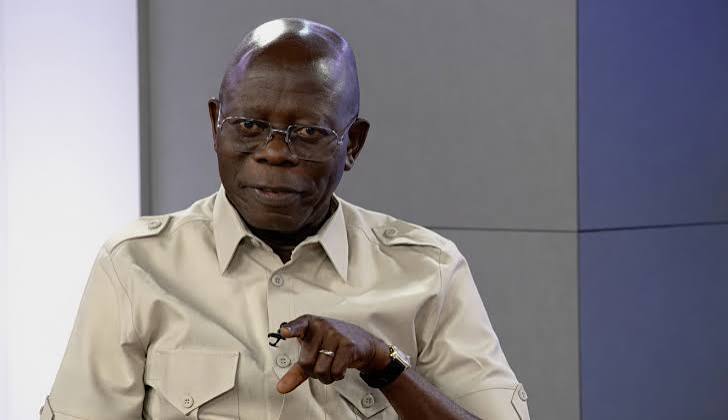
Senator Adams Oshiomhole’s claim that Peter Obi has failed to offer Nigerians an alternative to President Bola Tinubu’s policies has brought renewed attention to the competing economic arguments ahead of the 2027 presidential election, particularly as the government seeks to defend its reforms against concerns over workers’ welfare and living costs.
Speaking on Channels Television’s Politics Today on Thursday, November 5, Oshiomhole, who represents Edo North, described Obi, the Nigeria Democratic Congress (NDC) presidential candidate, as a trader whose approach to governance prioritises immediate returns over long-term development.
“Peter Obi has not offered any alternative,” the former Edo State governor said, questioning whether the opposition candidate had explained how he would address insecurity differently.
“I’ve always said that Peter Obi is a trader; the logic of a trader is short term turnover. A statesman that Tinubu represents thinks of the next generation,” he added.
The remarks reflect an emerging line of political argument ahead of the election: whether Tinubu’s economic reforms should be sustained or replaced with a different approach. However, Oshiomhole’s characterisation of Obi’s business background does not, by itself, establish whether the opposition candidate has credible policy alternatives.
Oshiomhole defended the administration’s record, particularly its intervention on workers’ welfare, citing the recently approved ₦70,000 transport allowance as evidence of Tinubu’s commitment to easing economic hardship.
The Federal Ministry of Labour and Employment announced the intervention following an October 27 meeting with the Nigeria Labour Congress (NLC). The agreement provides for ₦70,000 in transport support across public service levels for six months, beginning in November 2026.
If implemented as a monthly payment, the intervention would amount to ₦420,000 per eligible worker over six months. For someone earning ₦70,000 monthly, an additional ₦70,000 would temporarily double their monthly receipts, although the allowance is separate from basic salary and does not constitute a permanent wage increase.
That distinction is central to the disagreement within organised labour. While the NLC participated in negotiating the intervention, the Trade Union Congress (TUC) rejected it on October 28, demanding a lasting salary increase instead of temporary relief.
The Joint National Public Service Negotiating Council subsequently defended the agreement, arguing that transport support would help workers cope with rising commuting costs. The differing positions illustrate the challenge of balancing immediate financial assistance with demands for more sustainable improvements in earnings.
The October 27 agreement also provides for outstanding peculiar allowances dating from May 2026 to be paid in three instalments beginning in November. However, government and labour representatives did not resolve their disagreement over the effective date of minimum wage implementation arrangements, leaving an important element of workers’ remuneration unsettled.
Nigeria’s statutory minimum wage was raised from ₦30,000 to ₦70,000 in 2024, representing an increase of approximately 133 per cent. Nevertheless, the nominal increase alone cannot establish whether workers are better off, because purchasing power also depends on inflation, transport expenses and the prices of essential goods.
Oshiomhole also criticised former Vice President Atiku Abubakar over the exchange-rate system associated with the administration of former President Olusegun Obasanjo. His argument contrasted previous currency arrangements with Tinubu’s foreign-exchange reforms.
The Tinubu administration moved to unify foreign-exchange markets in June 2023, following the removal of petrol subsidies in May. Both measures represented major changes in economic policy, but their effects on household welfare remain an important part of the political debate.
For the opposition, the challenge is to demonstrate how proposed alternatives would improve economic conditions, strengthen security and remain financially sustainable. For the governing party, the corresponding test is whether its policies produce measurable improvements in household purchasing power, employment and public services.
Oshiomhole’s intervention therefore raises a question that extends beyond his criticism of Obi: whether voters in 2027 will judge competing candidates principally by their proposed policies or by the economic outcomes Nigerians experience before the election.