
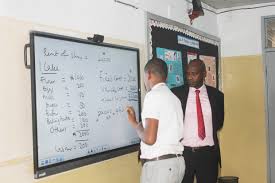
Indigenous technology company Wowbii Infrastructure has donated 20 units of interactive boards to the Unity Schools Old Students Association as part of efforts to strengthen digital learning infrastructure in Federal Government Colleges and align Nigeria’s public education system with global classroom technology standards.
The presentation of the equipment took place over the weekend in Lagos in the presence of alumni leadership and stakeholders, marking a significant private sector contribution to the Federal Government’s ongoing drive to digitalize public schools and modernize teaching methods across the country’s educational institutions.
Gbolahan Olayomi, Founder and Group Chief Executive Officer of Equipment Hall Limited and Wowbii Infrastructure, said the donation was a strategic intervention aimed at improving classroom delivery and enhancing student engagement in institutions that have historically served as pillars of Nigeria’s educational excellence and national integration.
“Supporting USOSA with modern interactive learning technology is a strategic contribution toward improving classroom delivery, enhancing student engagement and aligning our schools with global digital learning standards,” Olayomi stated during the presentation ceremony.
According to a statement made available to journalists in Port Harcourt on Sunday, the Unity Schools Old Students Association, under the leadership of its President-General, Mike Magaji, has continued to play an active role in the development and support of Federal Unity Colleges across the country, working closely with partners and stakeholders to improve infrastructure, learning conditions and academic outcomes.
The donation comes as Nigeria’s education sector continues to grapple with infrastructure deficits, outdated teaching methods and limited access to modern learning tools, particularly in public schools. The Federal Government has in recent years prioritized digital transformation as a key component of educational reform, with initiatives aimed at equipping classrooms with interactive technology, improving internet connectivity and training teachers in digital pedagogy.
Unity Schools, formally known as Federal Government Colleges, were established in the 1960s and 1970s as part of Nigeria’s post-independence nation-building strategy. The schools were designed to promote national unity by bringing together students from different ethnic, religious and regional backgrounds, providing quality education in boarding environments that fostered cross-cultural understanding and academic excellence.
There are currently 104 Federal Unity Colleges spread across Nigeria’s 36 states and the Federal Capital Territory, serving as foundational institutions for secondary education. These schools have produced generations of Nigerian leaders, professionals and intellectuals, including governors, ministers, legislators, corporate executives and notable public figures.
However, many Unity Schools have suffered from decades of infrastructural decay, inadequate funding and declining standards. Challenges include dilapidated hostel facilities, insufficient science laboratories, outdated libraries, poor power supply and limited access to digital learning resources. Budget constraints and administrative inefficiencies have compounded these problems, prompting alumni associations and private sector partners to step in with targeted interventions.
The Federal Ministry of Education has acknowledged the need for comprehensive reforms and increased investment in Unity Schools. In recent policy documents, the ministry has outlined plans to upgrade infrastructure, recruit qualified teachers, improve welfare conditions and integrate technology into classroom instruction as part of broader efforts to reposition public education for 21st-century demands.
Interactive boards, also known as smart boards or digital whiteboards, enable teachers to deliver lessons using multimedia content, interactive applications and real-time collaboration tools. The technology allows for visual demonstrations, dynamic presentations and student participation through touch-sensitive displays, transforming traditional chalk-and-board instruction into more engaging, technology-enhanced learning experiences.
Studies have shown that interactive learning tools can improve student comprehension, retention and participation, particularly in science, technology, engineering and mathematics subjects. Countries that have successfully integrated digital learning infrastructure into public schools have recorded measurable improvements in academic outcomes, teacher effectiveness and student motivation.
Nigeria’s digital education landscape has evolved significantly in recent years, driven by private sector innovation, donor support and government policy initiatives. The COVID-19 pandemic accelerated the adoption of virtual learning platforms, exposing both the potential of digital education and the persistent digital divide between urban and rural schools, as well as between private and public institutions.
Wowbii Infrastructure, in its statement, reaffirmed its commitment to collaborating with the Federal Government, state governments and institutional partners to accelerate the adoption of interactive, hybrid and virtual learning technologies in schools, universities and training institutions nationwide. The firm described the initiative as part of broader efforts to position Nigeria’s education system for global competitiveness through innovation and digital transformation.
The company has not disclosed the financial value of the donation or outlined specific plans for equipment distribution and installation across Unity Schools. It also remains unclear which of the 104 Federal Unity Colleges will receive the interactive boards or whether additional donations are planned for subsequent phases.
The Unity Schools Old Students Association has been instrumental in mobilizing alumni support for infrastructural development, scholarship programs and advocacy for improved government funding. The association operates through regional chapters and maintains partnerships with corporate organizations, philanthropic foundations and development agencies to address gaps in school facilities and resources.
Alumni-driven interventions have included hostel renovations, laboratory upgrades, library expansions, sports facilities improvements and welfare support for students and staff. The association has also advocated for policy reforms to strengthen governance, transparency and accountability in the management of Unity Schools.
Education policy experts have emphasized that while donations of equipment and infrastructure are valuable, sustained improvements in Nigeria’s public education system will require comprehensive reforms addressing teacher training, curriculum development, funding adequacy, administrative efficiency and political will. They argue that technology alone cannot solve systemic challenges without corresponding investments in human capacity, maintenance systems and enabling policy frameworks.
The Federal Government’s digitalization initiative for public schools has received mixed reviews from stakeholders. Supporters commend the focus on modernizing classrooms and preparing students for a technology-driven global economy, while critics question the sustainability of such initiatives in the absence of reliable electricity, internet connectivity and trained personnel to operate and maintain digital infrastructure.
As Nigeria approaches the next phase of its education reform agenda, partnerships between government, private sector actors and alumni associations are expected to play an increasingly important role in bridging resource gaps and driving innovation in teaching and learning. The Wowbii Infrastructure donation represents one such collaboration, offering a model for private sector engagement in public education development.
The Federal Ministry of Education has not issued an official statement on the donation as of the time of this report. Unity Schools administrators are expected to coordinate with USOSA leadership to ensure effective deployment and utilization of the interactive boards in selected institutions.
–