
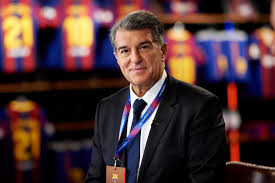
Joan Laporta has been re-elected president of FC Barcelona with a commanding 68.18 percent of votes cast in Sunday’s election, securing a five-year mandate that extends his leadership of the Catalan club until 2031 despite mounting financial pressures and ongoing legal controversies that have dominated his current tenure.
The 63-year-old lawyer defeated rival Victor Font by a decisive margin, receiving 32,934 votes compared to Font’s 14,385, representing 29.78 percent of the total ballots cast. A total of 48,480 members participated in the election from 114,504 eligible voters, producing a turnout of 42.34 percent across polling stations established at the Spotify Camp Nou and four additional locations in Catalonia and Andorra.
Laporta’s vote tally represents the second-highest total in Barcelona’s presidential election history, surpassed only by Sandro Rosell’s 35,021 votes in 2010 [FC Barcelona](https://www.fcbarcelona.com/en/club/news/4470025/joan-laporta-re-elected-as-fc-barcelona-president) [ESPN](https://www.espn.com/soccer/story/_/id/48217463/joan-laporta-re-elected-barcelona-president-landslide) . The margin of victory signals strong member support for Laporta’s leadership despite significant controversies that have marked his second spell at the helm.
“This is a resounding result and it gives us great strength. It makes us unstoppable. No one will stop us. Exciting years lie ahead,” Laporta stated shortly after the results were announced early Monday morning. “This is a wonderful club, where the members elect their president and their board of directors.”
The election took place on the same day Barcelona’s first team secured a 5-2 victory over Sevilla in La Liga, maintaining their four-point lead at the top of the table. Coach Hansi Flick and several players, including Raphinha, Pedri, and Dani Olmo, submitted their votes after the match.
Laporta’s victory marks his fourth term as Barcelona president and his second consecutive term, making him the first democratically elected president in the club’s history to lead in two separate periods. His new mandate will officially begin on July 1, 2026.
The election outcome validates Laporta’s management during one of the most turbulent periods in Barcelona’s institutional history, characterized by severe financial constraints, the traumatic departure of Lionel Messi, ongoing corruption allegations, and a costly stadium renovation project that has pushed the club’s total debt burden to unprecedented levels.
Laporta first served as Barcelona president from 2003 to 2010, presiding over what is widely regarded as the club’s golden era. During that tenure, Barcelona won four La Liga titles, two Champions League titles, and one Copa del Rey [ESPN](https://www.espn.com/espn/print?id=37579940) [ESPN](https://www.espn.com/soccer/story/_/id/37579940/oral-history-how-guardiola-co-did-unthinkable-2009) . His appointment of Pep Guardiola as manager in 2008 proved transformational, with the team achieving the historic sextuple in 2009 by winning all six available trophies in a single calendar year.
Guardiola’s Barcelona, built around academy graduates including Xavi Hernández, Andrés Iniesta, Sergio Busquets, and a young Lionel Messi, revolutionized modern football with their possession-based style and attacking philosophy. The 2009 achievement remains unmatched in football history, cementing Laporta’s reputation as one of Barcelona’s most successful presidents.
However, Laporta’s return to the presidency in March 2021 came under vastly different circumstances. He inherited approximately 1.3 billion euros in debt following the lavish spending of his predecessor Josep Maria Bartomeu and the revenue collapse caused by the COVID-19 pandemic [Local 10](https://www.local10.com/sports/2026/03/12/fc-barcelonas-100000-plus-members-vote-for-president-with-club-buried-under-a-mountain-of-debt/) [Spectrum News NY1](https://ny1.com/nyc/all-boroughs/ap-top-news/2026/03/12/fc-barcelonas-100000-plus-members-vote-for-president-with-club-buried-under-a-mountain-of-debt) .
The financial crisis forced Laporta to make the painful decision to release Messi, whose contract Barcelona could not afford to register under La Liga’s financial regulations despite the Argentine’s willingness to accept reduced terms. Messi’s tearful departure to Paris Saint-Germain in August 2021 marked one of the most controversial moments of Laporta’s second presidency and drew widespread criticism from members who had elected him partly on promises to retain the club legend.
Under Laporta’s watch since 2021, the club’s debt has increased from 1.3 billion euros to over 2 billion euros [ABC News](https://abcnews.com/Sports/wireStory/laporta-wins-5-years-president-barcelona-after-thousands-131094616) [Outlook India](https://www.outlookindia.com/sports/football/fc-barcelona-president-election-2026-result-joan-laporta-reelected) , driven primarily by the long-overdue renovation of the Spotify Camp Nou and surrounding Espai Barça complex. When combined with the stadium project costs, economist estimates place Barcelona’s total debt at approximately 3.5 billion euros, representing the highest debt burden of any football club in the world.
To navigate the financial crisis and comply with La Liga’s strict salary cap regulations, Laporta activated what he termed “economic levers” beginning in 2022. These controversial measures included selling 25 percent of the club’s La Liga television rights for the next 25 years [WTOPTV](https://wtop.com/sports/2026/03/fc-barcelonas-100000-plus-members-vote-for-president-with-club-buried-under-a-mountain-of-debt/) [Spectrum News NY1](https://ny1.com/nyc/all-boroughs/ap-top-news/2026/03/12/fc-barcelonas-100000-plus-members-vote-for-president-with-club-buried-under-a-mountain-of-debt) , selling 49 percent of Barça Vision (formerly Barça Studios) to investors, and securing stadium naming rights with Spotify.
While these asset sales generated immediate cash flow that enabled player signings including Robert Lewandowski, Raphinha, and Jules Koundé, critics including Font have argued that the strategy mortgages Barcelona’s future revenues and represents irresponsible financial management. Font’s campaign attempted to portray Laporta as having ruined the club’s long-term sustainability.
Font, a 55-year-old local businessman and fintech entrepreneur, lost to Laporta in the 2021 election and had spent the intervening five years preparing for a rematch. His platform centered on professional management structures, financial stability, and warnings that Laporta might eventually seek outside investment partners that would compromise Barcelona’s member-owned model.
“That risk is real. That is why it is so important to make a change in these elections,” Font stated during the campaign, referencing Real Madrid president Florentino Pérez’s consideration of allowing outside investors to purchase up to 10 percent of that club.
Laporta vehemently rejected such accusations and pledged to reform club statutes to require any partial sale of the club to be approved by members through referendum. He defended his financial management by highlighting reduced player wage expenditures and increased merchandise revenues, while arguing that the renovated Camp Nou would boost long-term income once completed.
The election hinged significantly on members’ assessment of Barcelona’s sporting performance under Laporta’s second presidency. Despite the financial turbulence, the club has achieved considerable success on the pitch, particularly during the 2024-25 season under German coach Hansi Flick.
Flick guided Barcelona to a domestic treble in his debut season, winning the Supercopa de España, Copa del Rey, and La Liga title [Wikipedia](https://en.wikipedia.org/wiki/Hansi_Flick) . The Supercopa victory came via a 5-2 demolition of Real Madrid in Saudi Arabia, while the Copa del Rey was secured through a 3-2 extra-time victory over Madrid. The La Liga title was clinched with a 2-0 victory over Espanyol, with goals from Lamine Yamal and Fermín López.
Barcelona’s attacking football under Flick has captivated supporters and restored belief in the club’s traditional philosophy. The emergence of 18-year-old Lamine Yamal as a generational talent, alongside strong performances from Lewandowski (25 league goals), Raphinha (18 goals in his best season), and other academy graduates, has reinforced the club’s commitment to developing homegrown talent.
However, Barcelona’s Champions League campaign ended in disappointment with a semifinal elimination against Inter Milan, losing 7-6 on aggregate despite creating numerous chances across both legs. The failure to reach the final represents unfinished business for Laporta and Flick heading into the new mandate.
Laporta’s re-election also comes amid serious legal jeopardy for the club stemming from the ongoing Negreira case. Barcelona has been charged with corruption over payments exceeding 7 million euros made between 2001 and 2018 to companies owned by José María Enríquez Negreira, the former vice president of Spain’s Technical Committee of Referees [Sky Sports](https://www.skysports.com/football/news/11095/12830520/barcelona-laliga-giants-charged-over-payments-to-former-referees-official-jose-maria-enriquez-negreira) [Wikipedia](https://en.wikipedia.org/wiki/Negreira_case) .
Prosecutors allege the payments were made to influence referee decisions in Barcelona’s favor, while the club maintains they were legitimate fees for consulting services including scouting reports on youth players and technical analysis of refereeing standards. Laporta has consistently stated that “Barcelona has never bought referees” [Wikipedia](https://en.wikipedia.org/wiki/Negreira_case) and has defended the club’s innocence throughout the investigation.
The case has deepened in recent months, with a Barcelona court ordering the club to produce original contracts and documentation to justify the payments. Investigators have found no trace of original contracts or written documentation in Barcelona’s archives [Goal.com](https://www.goal.com/en/lists/barcelona-ordered-release-negreira-contract-records-eur8m-payments-refereeing-official-missing/blt5713f4436ac60c01) , raising questions about the nature and purpose of the relationship with Negreira.
Laporta testified on November 25, 2025, defending Barcelona’s innocence while admitting the reports from his first tenure no longer existed. Former managers Luis Enrique and Ernesto Valverde testified they had never seen the alleged consulting reports [Yahoo Sports](https://sports.yahoo.com/articles/ernesto-valverde-luis-enrique-deny-140900288.html) , further complicating the club’s defense.
The Negreira case represents a significant cloud over Barcelona’s reputation and could result in criminal penalties for club officials if corruption is proven, though sporting sanctions such as title stripping or relegation appear unlikely due to statute of limitations protections in Spanish law.
Barcelona’s unique ownership structure played a central role in the election process. Unlike most major European football clubs owned by wealthy individuals or investment groups, Barcelona remains controlled by its socios, members who hold voting rights on major decisions including presidential elections. The model is shared by Real Madrid and smaller Spanish clubs including Athletic Bilbao and Osasuna, as well as major Portuguese clubs Benfica, Porto, and Sporting Lisbon.
The democratic process gives members direct accountability over club leadership but also creates political dynamics that can complicate long-term planning and strategic decision-making. Laporta’s ability to win re-election despite accumulating additional debt and presiding over ongoing corruption allegations demonstrates the importance of sporting success in member voting patterns.
The Camp Nou renovation project, which has displaced Barcelona to the smaller Olympic Stadium for home matches since 2023, represents both Laporta’s most ambitious institutional initiative and his greatest financial gamble. The renovated stadium, to be called Spotify Camp Nou under the club’s naming rights agreement, will expand capacity and create new revenue streams through premium seating, hospitality areas, and commercial spaces.
However, the project’s costs have swelled significantly beyond initial estimates, contributing to the club’s ballooning debt. Laporta has defended the investment as essential to Barcelona’s long-term competitiveness and financial viability, arguing that the increased revenues will justify the expenditure once the facility reopens, tentatively scheduled for late 2026.
Font’s defeat marks his second consecutive loss to Laporta and likely ends his ambitions for Barcelona’s presidency in the foreseeable future. “I congratulate Laporta for his unquestionable victory,” Font conceded shortly before midnight Sunday, acknowledging the decisive nature of the result.
Laporta’s victory speech emphasized themes of unity, defensive positioning against external threats, and confidence in Barcelona’s trajectory. “We will keep defending Barcelona against everything and everyone. The upcoming years will be thrilling. They will be the best of our lives,” he stated, employing combative rhetoric that has characterized his public communication style throughout both his presidencies.
The coming months will test whether Laporta can deliver on his promises to complete the stadium renovation, manage the debt burden responsibly, achieve European success on the pitch, and navigate the legal jeopardy posed by the Negreira investigation. His mandate extends through 2031, providing substantial time to execute his vision but also creating extended accountability for the consequences of his strategic decisions.
Barcelona’s membership has spoken decisively in favor of continuity, betting that Laporta’s track record of sporting success, institutional experience, and political acumen justify renewed confidence despite the formidable challenges facing one of football’s most storied institutions.
The election represents a critical juncture for Barcelona as it attempts to balance financial sustainability, competitive excellence, democratic governance, and institutional integrity during a period of unprecedented challenge and transformation in European football.