


Israel Bombs Tehran, Beirut, Baghdad
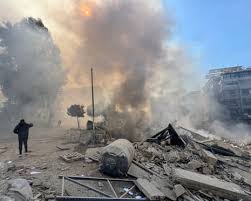
Israel launched coordinated strikes on Tehran and Beirut on Tuesday while attacks in Baghdad drew Iraq further into a widening Middle East conflict that has triggered severe economic disruption across global markets and displaced millions across the region.
The Iranian capital, subjected to near-daily bombardment since a joint United States-Israeli military offensive began on February 28, 2026, was hit by what the Israeli military described as strikes targeting “terror regime infrastructure”. The operation marked the continuation of hostilities now entering their third week, with the conflict rapidly expanding beyond its initial scope to engulf multiple countries across the Middle East.
Lebanese state media reported that Israeli airstrikes at dawn struck a residential building in Beirut’s southern suburbs, a densely populated area known as a stronghold of Hezbollah, the Iranian-backed armed group that has been engaged in cross-border attacks against Israel since the war’s outbreak.
Lebanese authorities reported that more than one million people have registered as displaced since March 2, with upwards of 130,000 individuals currently sheltering in more than 600 collective facilities across the country. The mass displacement represents one of the largest population movements in Lebanon’s recent history, placing severe strain on the nation’s limited resources and infrastructure.
Lebanon was drawn into the conflict when Hezbollah militants launched strikes against Israel following the killing of Iranian Supreme Leader Ayatollah Ali Khamenei on February 28, the first day of the US-Israeli offensive. Khamenei’s death, which occurred during the initial wave of strikes on Tehran, has been characterized by Israeli officials as a strategic objective aimed at dismantling Iran’s political and military leadership structure.
The war’s geographic expansion was further demonstrated on Tuesday when Baghdad became the target of multiple attacks, pulling Iraq deeper into a conflict that has historically positioned the country as a proxy battleground between Washington and Tehran.
A coordinated drone and rocket attack targeted the United States embassy in Baghdad in the early hours of Tuesday, while a separate strike killed four individuals at a residential compound reportedly hosting Iranian military advisors. The attacks on the diplomatic compound occurred hours after Iraqi air defenses intercepted a rocket assault on the embassy and a drone strike sparked a fire at a luxury hotel in Baghdad’s fortified Green Zone, an area frequented by foreign diplomats and government officials.
Iraq’s involvement in the conflict represents a significant escalation that threatens to destabilize a country that has spent years attempting to rebuild following decades of warfare, including the US-led invasion of 2003, the subsequent insurgency, and the campaign against the Islamic State group between 2014 and 2017. The country hosts approximately 2,500 US troops as part of an international coalition against ISIS remnants, while also maintaining close political and economic ties with Iran, creating a complex geopolitical balancing act that the current crisis has severely complicated.
The regional war has generated severe economic consequences, with global oil markets experiencing sustained volatility as the conflict disrupts crucial energy supply routes and infrastructure. Oil prices resumed their upward trajectory on Tuesday as several countries rejected US President Donald Trump’s demands that they contribute military assets to secure the Strait of Hormuz, while Iranian forces continued targeting crude-producing facilities in neighboring Gulf states.
The Strait of Hormuz, a narrow waterway between Iran and the Arabian Peninsula through which approximately one-fifth of global crude oil passes, has experienced severe traffic disruption since the war began. Iran’s Revolutionary Guards have threatened to close the strait entirely if attacks on Iranian territory continue, a move that would effectively cut off a major portion of the world’s energy supply and trigger catastrophic economic consequences.
Repeated attacks on oil infrastructure across the region, including strikes on major production fields in the United Arab Emirates and southern Iraq, have contributed to market instability and sent crude prices soaring. Global oil prices have surged more than 40 percent since the US and Israel initiated their February 28 offensive, with the increase reverberating through international markets and triggering inflationary pressures in economies worldwide.
Australia’s central bank raised its key interest rate on Tuesday, specifically citing “sharply higher fuel prices” driven by the US-Israel military campaign against Iran as a primary factor in the decision. The move reflects growing concerns among policymakers globally that sustained energy price increases could derail economic recovery efforts and trigger broader financial instability.
President Trump intensified diplomatic pressure on Tuesday by demanding that allied nations join “with great enthusiasm” a proposed international naval armada to escort oil tankers through the Strait of Hormuz, warning that failure to participate could have serious consequences for transatlantic relations.
“We strongly encourage the other nations to get involved with us and get involved quickly,” Trump stated during a White House event, according to media reports. The president warned that refusal to contribute forces would be “very bad” for the future of NATO and suggested he might delay a planned summit with Chinese leader Xi Jinping by up to a month over the issue.
However, multiple US allies have distanced themselves from military involvement in the Gulf operation, raising questions about Washington’s ability to assemble a coalition for the mission.
British Prime Minister Keir Starmer stated that London was collaborating with allies to develop a “viable” plan to reopen the strait but explicitly ruled out a NATO mission for the operation. Germany similarly declared that Berlin “has been clear at all times that this war is not a matter for NATO”, rejecting any suggestion that the Atlantic alliance should become directly involved in the Middle East conflict.
Japan, Australia, Poland, Spain, Greece, and Sweden also issued statements distancing themselves from any military commitment to operations in the Strait of Hormuz, citing domestic political constraints and concerns about further escalating regional tensions.
European Union foreign ministers discussed the crisis during meetings in Brussels on Monday but demonstrated “no appetite” for extending their existing Red Sea naval mission to include Hormuz security operations, according to statements from the bloc’s top diplomat. The EU currently operates a limited naval presence in the Red Sea focused on protecting commercial shipping from attacks by Yemen-based Houthi militants, but member states have shown reluctance to expand the mission’s geographic scope or mandate.
Western allies including Canada, France, Germany, Italy, and the United Kingdom jointly urged Israel to exercise restraint in Lebanon, where Israeli forces have announced “limited ground operations” against Hezbollah positions in southern border areas. The appeal reflects growing international concern about the humanitarian consequences of expanding ground operations in Lebanese territory, particularly given the country’s ongoing economic collapse and political fragility.
However, Israeli President Isaac Herzog defended his country’s military campaign in an interview with AFP, arguing that Europe should support “any effort to eradicate Hezbollah now”. Herzog characterized the current conflict as an opportunity to permanently diminish Iranian influence across the region by dismantling Tehran’s network of allied militias and proxy forces.
The war has engulfed the broader Middle East region, with Iran conducting strikes against at least 10 countries that host US military forces. Iran’s Revolutionary Guards reported firing approximately 700 missiles and 3,600 drones since the conflict began, targeting American military installations across Iraq, Syria, Jordan, Saudi Arabia, the UAE, Kuwait, Bahrain, Qatar, and Oman, according to statements from Iranian military officials.
More than 1,200 Iranians have been killed by US and Israeli strikes according to the last official toll released by Iran’s health ministry on March 8, though this figure could not be independently verified by international organizations. The actual death toll is believed to be significantly higher, as Iranian authorities have historically underreported military casualties and civilian deaths during conflicts.
Iranian Foreign Minister Abbas Araghchi struck a defiant tone during a press conference in Tehran on Monday, warning that the country remained prepared to continue fighting regardless of the consequences.
“By now they have understood what kind of nation they are dealing with,” Araghchi told reporters. “Iran does not hesitate to defend itself and is ready to continue the war wherever it may lead, and take it as far as necessary.”
Despite the sustained violence and more than two weeks of internet blackout imposed by Iranian authorities, some residents of Tehran and other major cities have attempted to restore a degree of normalcy. Cafes and restaurants have reopened in recent days, and the popular Tajrish bazaar in northern Tehran was reportedly busy over the weekend as residents prepared for Nowruz, the Persian new year celebration traditionally observed on March 20.
However, there has been little evidence of widespread popular uprising against Iran’s government despite the conflict and heavy casualties. Iranian security forces killed thousands of protesters during demonstrations in January 2026, according to human rights organizations, in a brutal crackdown that effectively suppressed dissent ahead of the current crisis.
The United Nations refugee agency reported that up to 3.2 million people have been displaced within Iran since the war began, fleeing combat zones in Tehran and other targeted cities for rural areas and provinces considered less likely to face bombardment. The displacement represents one of the largest internal refugee crises in Iran’s modern history and has overwhelmed the country’s already strained social services and infrastructure.
The conflict traces its immediate origins to the February 28 joint US-Israeli offensive, which caught many international observers by surprise despite months of escalating tensions between Washington, Tel Aviv, and Tehran. The operation began with coordinated strikes on Iranian nuclear facilities, military installations, and government buildings, including the compound where Ayatollah Khamenei was killed.
The Trump administration has justified the military action as a preemptive measure to prevent Iran from developing nuclear weapons and to eliminate what US officials described as an imminent threat to American forces and allies in the region. Israeli officials have similarly characterized the operation as necessary to counter Iranian support for militant groups including Hezbollah, Hamas, and various militias operating across Iraq, Syria, and Yemen.
However, the absence of United Nations authorization for the strikes and the lack of broad international support has raised questions about the legal basis for the operation under international law. Critics have argued that the offensive violates the UN Charter’s prohibition on the use of force except in cases of self-defense against armed attack or with Security Council authorization.
The war’s economic consequences extend far beyond energy markets, with global supply chains experiencing disruption as shipping companies avoid the Strait of Hormuz and surrounding waters. Insurance premiums for vessels transiting Middle Eastern waterways have increased dramatically, and several major shipping firms have suspended operations in the region entirely, routing cargo around Africa at significantly higher cost and with substantial delays.
Financial markets have experienced sustained volatility, with major stock indices declining amid concerns about the war’s potential to trigger a broader global recession. Gold prices have reached record highs as investors seek safe-haven assets, while currencies of countries dependent on Middle Eastern oil imports have weakened against the US dollar.
The conflict has also generated diplomatic friction beyond the immediate war zone, with Russia and China both condemning the US-Israeli offensive and calling for an immediate cessation of hostilities. Moscow and Beijing have blocked Western-sponsored resolutions at the UN Security Council, instead proposing measures that would condemn the initial February 28 strikes and demand withdrawal of foreign forces from the region.
As the war enters its fourth week, there appears little prospect for near-term resolution. Neither side has demonstrated willingness to pursue diplomatic negotiations, and the expanding geographic scope of the conflict suggests further escalation remains likely despite international appeals for restraint.