
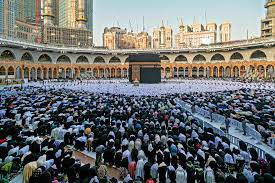
Saudi Arabia’s Supreme Court has declared that Friday will mark Eid al-Fitr, the Islamic festival celebrating the conclusion of Ramadan, following confirmation that Thursday represents the 30th and final day of the holy month.
“The Supreme Court has decided that tomorrow, Thursday, is the completion of the 30th day of the month of Ramadan. Friday is the day of the Blessed Eid al-Fitr,” the Saudi Press Agency reported on Wednesday.
The announcement follows traditional Islamic practice of determining the end of Ramadan through the sighting of the crescent moon, in accordance with the lunar Hijri calendar used across the Muslim world. The timing of Eid al-Fitr varies by geographical location depending on when religious authorities confirm the moon’s visibility.
Ramadan, observed as one of the five pillars of Islam, requires Muslims to abstain from food, drink, smoking and sexual relations from dawn until sunset. Observant Muslims are additionally encouraged to engage in increased prayer, Quranic recitation, charity and spiritual reflection during the month.
The practice of fasting during Ramadan is widely observed in Saudi Arabia, which houses Islam’s two holiest sites, the Grand Mosque in Mecca and the Prophet’s Mosque in Medina. The kingdom hosts millions of Muslims annually for pilgrimage, though attendance fluctuates based on visa policies, health concerns and regional security conditions.
This year’s Ramadan observance unfolded against the backdrop of a major military conflict that has engulfed the Middle East since late February. On February 28, 2026, the United States and Israel launched a large-scale military operation against Iran, targeting leadership facilities, nuclear installations, missile sites and military infrastructure. The initial strikes resulted in the death of Iran’s Supreme Leader Ayatollah Ali Khamenei and triggered extensive retaliatory attacks across the region.
Iran responded by launching hundreds of ballistic missiles and drones at targets in Israel and at American military installations in Bahrain, Iraq, Jordan, Kuwait, Qatar, Saudi Arabia, Turkey and the United Arab Emirates. According to reports from regional health ministries and international monitoring organizations, the conflict has resulted in over 1,400 deaths in Iran, 17 in Israel, 13 American military personnel, and dozens of casualties across Gulf states.
The hostilities have severely disrupted civilian life across the Middle East, with airports suspending operations, airspace closures affecting commercial travel, damage to residential areas and energy infrastructure, and the temporary closure of the Strait of Hormuz, a critical global oil transit route. The World Health Organization has reported that at least 18 hospitals and health facilities in Iran have been struck, while Iranian authorities have confirmed damage to schools, residential neighborhoods and civilian infrastructure.
The conflict has also drawn in Hezbollah forces in Lebanon, which resumed attacks on Israel in support of Iran, prompting Israeli military operations in southern Lebanon despite a fragile ceasefire that had been in place since 2024.
For Muslims observing Ramadan across the affected regions, the war created unprecedented challenges. Displaced families struggled to maintain fasting routines while seeking shelter from airstrikes. Humanitarian organizations reported difficulties delivering food supplies for pre-dawn and sunset meals to communities under bombardment. Prayer gatherings were curtailed in some areas due to security concerns, and traditional Ramadan charity distributions faced logistical obstacles in conflict zones.
The timing of the conflict during Ramadan carries particular significance within Islamic tradition, as the month is observed as a period of peace, reflection and communal solidarity. Historical precedents include the 1973 Arab-Israeli War, which began during Ramadan, and various conflicts in Iraq, Syria and Yemen that have intersected with the holy month in recent decades.
Saudi Arabia’s announcement of Eid al-Fitr follows standard procedures observed by the kingdom’s religious authorities. The Supreme Court’s moon-sighting committee, composed of Islamic scholars and astronomers, meets to evaluate evidence of the new moon’s visibility. Witness testimonies from reliable observers across the kingdom are examined before an official declaration is issued.
Other Muslim-majority nations typically follow Saudi Arabia’s announcement or conduct independent moon sightings based on their own religious authorities. Countries including the United Arab Emirates, Kuwait, Qatar, Bahrain and several others generally align their Eid declarations with Saudi Arabia due to geographical proximity and shared visibility of the lunar crescent.
Eid al-Fitr is traditionally celebrated with communal prayers, family gatherings, charitable donations known as Zakat al-Fitr, festive meals and the exchange of gifts. However, this year’s celebrations across the Middle East are expected to be subdued in regions directly affected by the ongoing conflict, with many families mourning losses, displacement and economic hardship caused by the war.
The conflict shows no immediate signs of resolution. United States President Donald Trump has indicated that military operations will continue, while Iranian officials have vowed further retaliation. International diplomatic efforts, including mediation attempts by Oman and emergency consultations among Arab and Muslim foreign ministers in Riyadh, have yet to produce a ceasefire agreement.
For the broader Muslim community of approximately 1.8 billion people worldwide, Ramadan and Eid represent central religious observances regardless of regional conflicts. Muslims in Europe, Asia, Africa and the Americas will mark Eid al-Fitr according to their local moon-sighting determinations and community traditions, though many have expressed concern and solidarity with those affected by violence in the Middle East.
Saudi authorities have not announced specific security measures for Eid prayers and gatherings, though heightened security protocols have been in place across the kingdom since the outbreak of hostilities. The kingdom, which has intercepted Iranian drones and missiles targeting its territory, has maintained its defensive posture while participating in regional diplomatic efforts to contain the conflict.
The conclusion of Ramadan and the beginning of Eid al-Fitr mark a transition from fasting to celebration, though the contrast between religious observance and regional warfare has created what many religious leaders describe as a period of profound tension for Muslim communities across the affected areas.