
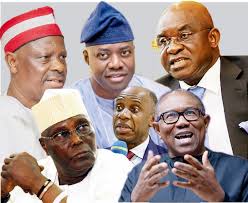
Less than two weeks after Nigeria’s opposition leaders gathered in Ibadan, Oyo State, pledging unity against the ruling All Progressives Congress (APC), their coalition is already showing serious cracks ahead of the 2027 presidential election.
The immediate trigger was the decision by former Anambra Governor Peter Obi and former Kano Governor Rabiu Musa Kwankwaso to formally exit the African Democratic Congress (ADC) for the National Democratic Congress (NDC). The move threw fresh uncertainty into efforts to build a broad anti-APC alliance and revived memories of the opposition divisions that helped President Bola Ahmed Tinubu’s victory in 2023 despite widespread public frustration.
Former Senator Dino Melaye captured the tensions bluntly, declaring that “Peter Obi excused himself from tough situation. He can only operate in an air-conditioned kitchen. Hot kitchens are not for him.”
Behind the mockery lies a deeper political reality. With less than nine months to another election cycle, Nigeria’s opposition appears trapped in familiar problems: competing ambitions, distrust, regional calculations, and internal rivalry. Many opposition supporters now fear that history may be repeating itself.
The shadow of the 2023 election still hangs heavily over every opposition discussion. While Atiku Abubakar, Peter Obi, and Rabiu Kwankwaso collectively received more votes than Tinubu, Nigeria’s electoral system rewarded the APC’s stronger national structure, regional spread, and better coordination. Low turnout and opposition fragmentation also favoured the ruling party.
The April 2026 Ibadan opposition summit was meant to address exactly those issues. But barely days after the Ibadan Declaration projected new unity, the coalition slipped into crisis as Obi and Kwankwaso left the ADC citing internal disputes and outside interference. Tensions had reportedly been building over party control, candidate calculations, and perceptions that Atiku’s camp dominated the alliance.
The Presidency moved quickly to exploit the divisions, with spokesman Bayo Onanuga questioning Obi’s political consistency and portraying him as avoiding difficult internal contests. Obi’s supporters, in turn, insist his grassroots appeal can overcome traditional political structures.
That debate now sits at the heart of opposition politics. While Obi and Kwankwaso hope to consolidate their bases in the NDC, Atiku’s bloc remains in the ADC. The immediate beneficiary is Tinubu, with a divided opposition field reducing the risk of a coordinated challenge to APC power.
But the opposition’s problems run deeper than personal rivalries alone. The absence of strong ideological alignment has made sustainable coalition-building more difficult. Most opposition parties share broad criticisms of APC governance, but beyond that, there is limited agreement on clear policy alternatives.
Some opposition figures still see opportunity in the realignment, hoping that consolidated structures may ultimately strengthen future negotiations. They also hope that rising economic frustration could shift the political landscape.
But as the coalition drama dominates headlines, a critical issue is still missing: detailed governance plans. Much of the opposition conversation remains focused on personalities and power rather than comprehensive policy platforms on issues like inflation, unemployment, electricity, and insecurity.
For many Nigerians facing mounting economic pressure, the political manoeuvring feels disconnected from daily realities. Frustration is increasingly directed not just at the ruling party, but at a political class consumed by elite power games.
Tinubu and the APC now hold the advantage. But in a political system where alliances can shift rapidly, the long-term impact of the opposition’s disarray is still uncertain. The bigger question is whether opposition leaders can find a coherent message that convinces more Nigerians that the system itself can change.
If not, even an air-conditioned political kitchen may not be enough to fix a far deeper governance crisis.