
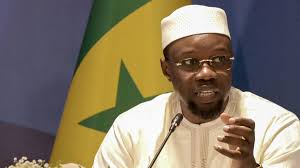
Senegal’s Prime Minister Ousmane Sonko has launched a forceful public defence of his country’s newly toughened anti-gay legislation, condemning what he described as Western attempts to impose homosexuality on the rest of the world and vowing that no external pressure would halt the application of the law.
Sonko made the remarks in a formal address to lawmakers in the West African nation on Friday, delivering some of his most direct public statements yet on an issue that has sharply divided Senegal’s relationship with Western governments and international rights organisations.
“There are eight billion human beings in the world, but there is a small nucleus called the West which, because it has resources and controls the media, wants to impose it on the rest of the world,” Sonko told lawmakers, according to AFP.
The address came weeks after President Bassirou Diomaye Faye signed into law legislation significantly stiffening the penalties for same-sex relations in the predominantly Muslim nation. The new law, enacted in late March, doubles the maximum prison sentence for what the legislation terms “acts against nature,” a legal phrase applied to same-sex conduct, raising the punishment from one to five years to between five and ten years’ imprisonment.
The legislation goes further. It introduces a separate provision sentencing those found guilty of promoting or financing same-sex relationships to between three and seven years in prison, a clause that human rights observers say could be used broadly against activists, journalists, and civil society organisations.
Senegal already maintained one of the more restrictive legal environments in West Africa regarding sexual orientation before the new law came into force. LGBTQ advocacy has long been a flashpoint in Senegalese public life, with gay rights frequently characterised in political and religious circles as a vehicle through which Western nations attempt to export values incompatible with African and Islamic traditions.
Sonko’s ascent to the prime ministership in 2024 was itself accompanied by explicit pledges to elevate the legal response to same-sex relations. Having previously campaigned on reclassifying same-sex conduct from a misdemeanour to a more serious criminal offence, his government followed through on that commitment through the legislation President Faye signed into law.
The developments place Senegal among a growing number of African countries that have moved in recent years to either introduce or strengthen laws restricting LGBTQ expression and conduct, a trend that has drawn sustained criticism from Western governments, the United Nations, and international human rights bodies who argue such laws violate fundamental rights protections.
Sonko, for his part, framed the controversy not as a rights debate but as a question of sovereignty and civilisational resistance. His government has shown no indication it intends to revisit the legislation.
AFP