
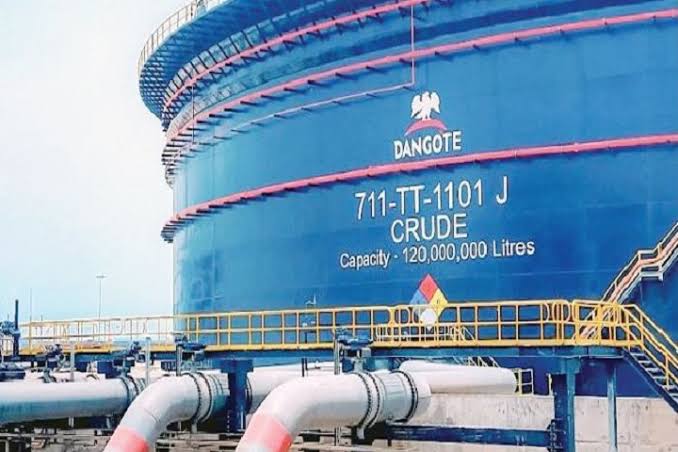
Africa’s largest refinery has pushed back against allegations that petrol produced at its Lagos facility is shipped to Lomé in Togo and then quietly returned into the Nigerian market, describing the claims as commercially illogical, contractually barred, and unsupported by trade data.
Dangote Petroleum Refinery and Petrochemicals issued the rebuttal on Tuesday, June 23, 2026, in a statement on its X handle pointedly titled “Response to Unsubstantiated Claims and Tissue of Lies.” The management said it would not normally engage what it called “baseless and unsubstantiated claims,” but chose to respond “to clear the air on this ill-motivated web of falsehoods for posterity.”
The refinery anchored its case on commercial logic. It said a core objective is to remain a leading supplier of petroleum products to Nigeria, and that “facilitating imports that compete directly with our own production would be inconsistent with this objective.” It added that its sales contracts and tender terms “expressly prohibit the resale or re-importation of products into Nigeria.”
On economics, the company put the cost of moving products from the refinery to Lomé and back at roughly $80 to $90 per metric ton, arguing that such expenses would erode margins. It said it does not provide export discounts sufficient to offset these costs or create arbitrage opportunities between export and domestic markets.
The statement also stressed traceability, noting that the refinery keeps detailed records of “lifting locations, nominated vessels, counterparties, and destination declarations where applicable.” Any suggestion that it knowingly facilitates re-importation, it said, was inconsistent with the contractual restrictions placed on buyers.
The allegations land at a delicate moment for Nigeria’s downstream sector. The 650,000 barrels-per-day refinery, built in the Lekki Free Trade Zone at a cost exceeding $19 billion, confirmed in February 2026 that it had reached full nameplate capacity, becoming the first single-train refinery in the world to do so. NMDPRA data showed it accounted for 87.55 per cent of petrol supplied to the domestic market in May 2026, representing the dominant share of national supply.
The dispute also reflects a known wrinkle in the market. Industry analyses have described a “Lomé paradox,” in which Nigerian marketers sometimes find it cheaper to buy Dangote-origin fuel through the Togolese trading hub than directly from the refinery. By April 2026, the refinery was supplying roughly 80 per cent of domestic petrol demand, while Nigeria’s fuel import bill had fallen from $14.06 billion in 2024 to $10 billion in 2025.
Regulators have moved to protect that shift. In March 2026, the NMDPRA suspended new petrol import licences, a posture critics say shields the refinery’s pricing power even as marketers retain limited import permits. The tension has sharpened amid volatile pump prices. Petrol that hovered around ₦870 per litre before this year’s Iran-related oil shock climbed toward ₦1,500 in parts of the country, with prices around ₦1,340 per litre in Abuja.
The refinery did not name any agency or individual behind the claims, but characterised them as driven by interests hostile to its expanding market presence. No regulatory body was identified in the statement as having formally raised the allegations. With a planned Nigerian Exchange listing expected later in 2026 and a Phase 2 expansion targeting 1.4 million barrels per day, scrutiny of the refinery’s trade flows is unlikely to ease.