
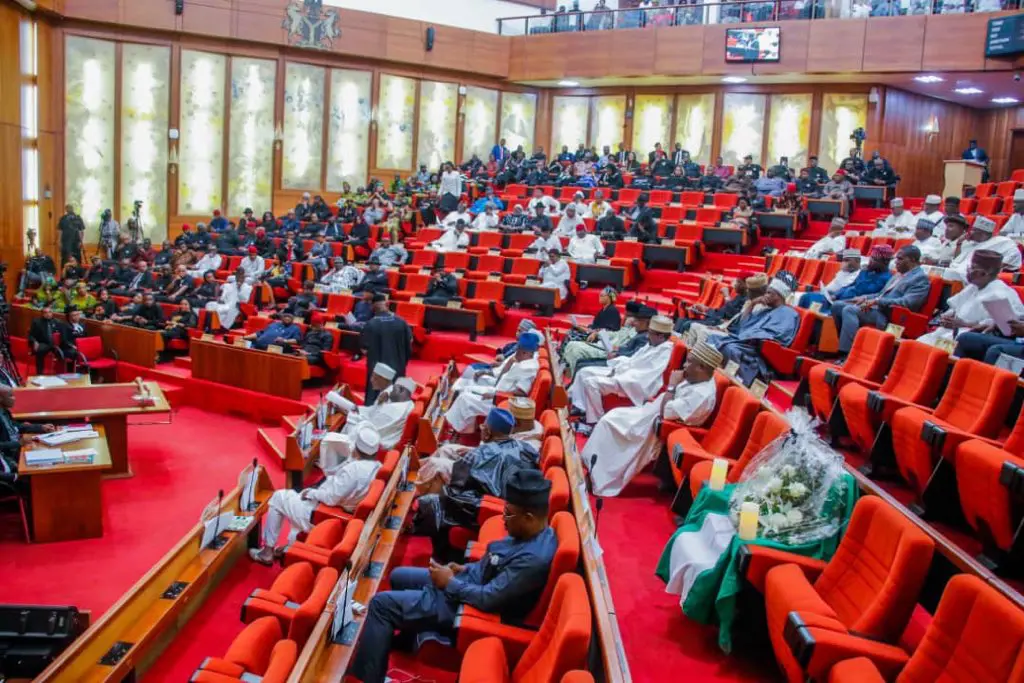
The Senate has moved to calm one of the most persistent fears surrounding Nigeria’s proposed shift to decentralised policing, insisting that the new legal framework gives the federal police clear grounds to step in wherever a state police outfit is turned into a weapon of electoral intimidation or presides over a collapse of public order.
That assurance, contained in a statement issued on Sunday by the office of the Senate Leader, Opeyemi Bamidele, arrives at a delicate moment. The Constitution of the Federal Republic of Nigeria (Alteration) (State Police) Bill, 2026, has cleared both chambers of the National Assembly, and the debate has now shifted from whether Nigeria should have state police to whether governors can be trusted with it.
According to the Senate, the numbers behind the vote tell their own story. “In the Senate, for instance, 84 out of 109 members voted clause by clause in support of the Bill. This accounted for 77.06 per cent approval at the Senate alone,” Bamidele said, presenting the tally as proof that the measure enjoyed backing well beyond the ruling party. He noted that lawmakers from the Peoples Democratic Party, the African Democratic Congress, the New Nigeria Peoples Party and the Labour Party joined members of the All Progressives Congress in supporting the proposal, “mainly in the national interest and not on a parochial basis.”
The idea itself is far from new. Nigeria operated regional and native authority police forces in the First Republic, but those outfits were folded into a single, centralised command after the military took power in the 1960s, an arrangement later entrenched in Section 214 of the 1999 Constitution, which recognises only one Nigeria Police Force. Successive calls to reverse that structure, including recommendations from the 2014 National Conference and repeated appeals by the Nigeria Governors’ Forum, went nowhere for years.
What changed the calculation was security. Waves of banditry in the North West, the long insurgency in the North East, kidnapping along major highways, farmer herder clashes in the North Central and violent crime in the South have stretched a federal force widely acknowledged to be undermanned for a country of more than 200 million people. Supporters of state police argue that officers drawn from and stationed within their own communities are better placed to gather intelligence and respond quickly, and that a single command in Abuja cannot realistically police every village in the federation.
Bamidele said the amendment deliberately separates the responsibilities of the two tiers to reduce friction. Under the proposal, the federal police would retain control over the protection of federal institutions, policing of the Federal Capital Territory, counter terrorism, organised crime, cybercrime, border security, arms trafficking, interstate criminal activities and other national security matters. State police, by contrast, would enforce state laws, maintain public order and protect lives and property within their borders.
The heart of the controversy, however, lies not in the division of labour but in the fear of abuse. Critics have warned that a governor who controls a police force could deploy it against opponents, disrupt rallies or tilt the scales in his favour during elections, concerns sharpened by the approach of the 2027 general elections.
The Senate’s answer is a layered set of checks. Bamidele explained that while a governor may nominate a state commissioner of police, the appointment would require recommendation by the National Police Council and confirmation by a two thirds majority of the relevant State House of Assembly. The National Police Council would superintend overall policy, funding and appointments, while a separate and independent State Police Service Commission would regulate day to day operations.
On the specific question of federal intervention, he set out the narrow conditions under which Abuja could take over. “The intervention can only be granted when there is an outright breakdown of public order; where a state police service is incapable of functioning; where there are serious abuses of fundamental rights; where there is partisan or electoral intimidation; and when national security is heavily strained and threatened,” he said.
He stressed that the oversight body would operate beyond the reach of any governor. “To avoid any form of abuse, the bill creates the State Police Service Commission. In design, the commission will serve as the regulatory authority of the state police system,” Bamidele said, adding that the commission would be empowered “to, without the approval or control of the governor, make rules regulating its own procedure or conferring powers and imposing duties on any officer or authority for the purpose of discharging its functions under the 1999 Constitution.”
Anticipating claims that the reform was rushed through by a dominant party, the Senate Leader traced its journey through years of consultation. He said the proposal grew out of memoranda submitted to the Senate Ad hoc Committee on the Review of the 1999 Constitution, and that lawmakers engaged the executive, the Nigeria Governors’ Forum, the Conference of Speakers of State Legislatures and the leadership of the Nigeria Police before it reached the floor. Public hearings held across the six geopolitical zones in July 2025, he added, produced overwhelming support for the creation of state police.
The legislative record aligns with that account. The House of Representatives passed the bill on 11 June 2026, with about 288 members voting in favour and four against, before the Senate followed on 24 June, adopting manual voting after its electronic system failed. The measure is formally titled the Sixth Alteration Bill and carries the designation SB.1055.
Passage by the National Assembly, though significant, does not settle the matter. As a constitutional amendment, the bill must still be ratified by at least two thirds of the country’s 36 State Houses of Assembly and then receive presidential assent before it can take effect. That threshold has historically proved a graveyard for ambitious reforms, and the state assemblies will now become the next battleground where the arguments over grassroots security and the risk of gubernatorial overreach are likely to be rehearsed all over again.
For now, the Senate is framing its work as a balance carefully struck. Bamidele maintained that the amendment was designed “to strengthen accountability and ensure that the creation of a state police enhances national security without undermining democratic governance or citizens’ fundamental rights.” Whether the safeguards prove as robust in practice as they appear on paper is a test that will only come once the first state police officers are on the streets.