
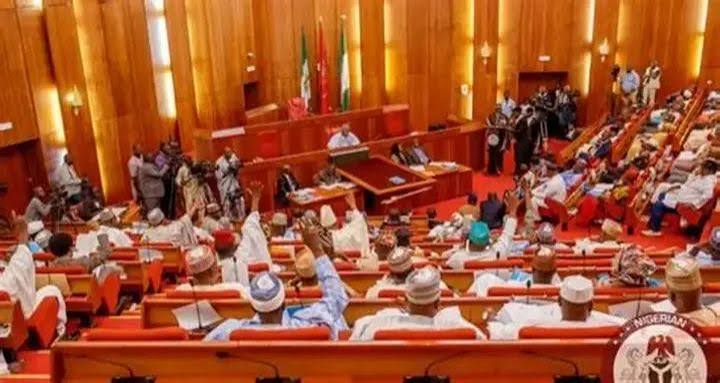
The Senate on Wednesday passed a constitutional amendment bill clearing the way for the establishment of state police services across Nigeria, marking one of the most consequential security reforms in the country’s history and a decisive break from a policing structure controlled from Abuja since independence.
The bill, titled “A Bill for an Act to Alter the Constitution of the Federal Republic of Nigeria, 1999 to Provide for the Establishment of State Police and Related Matters (Sixth Alteration) Bill, 2026 (SB. 1055),” was approved during consideration by the Committee of the Whole, presided over by Senate President Godswill Akpabio. The legislation replaces the existing Nigeria Police Force framework with a dual structure comprising a Federal Police Service and State Police Services.
Senators voted manually on the 26-clause bill by raising their hands, with a majority surpassing the mandatory two-thirds threshold of 73 supporting all the clauses. The chamber abandoned electronic voting after technical glitches threatened to disenfranchise some senators. A delegation including Kaduna Governor Uba Sani, Ogun Governor Dapo Abiodun, Ondo Governor Lucky Aiyedatiwa and the Chief of Staff to the President, Femi Gbajabiamila, witnessed the proceedings.
Leading the debate, Senate Leader Opeyemi Bamidele argued that the “realities of contemporary Nigeria” had proven that a central policing system was no longer fashionable. He noted that the country is a vast federation of 36 states and the Federal Capital Territory facing terrorism, banditry, kidnapping, communal conflicts and farmer-herder clashes.
The reform responds to a deepening security crisis. The National Bureau of Statistics reported that between May 2023 and April 2024, Nigeria recorded an estimated 2,235,954 kidnapping incidence cases. SBM Intelligence put the number of kidnap victims between July 2024 and June 2025 at 4,722, with 762 killed and ransom payments averaging N2.57 billion. The strain on the force is structural. Its personnel strength of 371,800 leaves roughly one officer to 540 citizens, far below recommended ratios, and the 2026 budget allocated the police N1.3 trillion.
The bill’s passage caps a rapid legislative sequence. The House of Representatives passed its version on June 11, 2026, with 289 members voting in favour and one against. President Bola Tinubu transmitted the executive bill, dated June 15, 2026, which Akpabio read on the Senate floor on Tuesday.
To address fears of abuse, lawmakers built in safeguards. Under Clause 17, each State Police Service will be headed by a Commissioner of Police appointed by the governor and confirmed by the state legislature, while the Federal Police remains under the Inspector-General. Section 17(7) bars a state commissioner from arresting, detaining or deploying force against any person or party merely for criticising the government, except in accordance with the law. Bamidele said the bill prohibits any governor from directing police against opponents and bars the use of police powers for partisan, ethnic, religious or personal purposes.
Critics remain wary. The memory of First Republic Native Authority police forces, routinely used to intimidate opponents and rig elections, underpins long-standing resistance to decentralised policing.
The bill faces further hurdles. It now requires passage by the House, presidential assent, and approval by a majority of state Houses of Assembly before becoming law. At least two-thirds of the 36 states must ratify the amendment.