
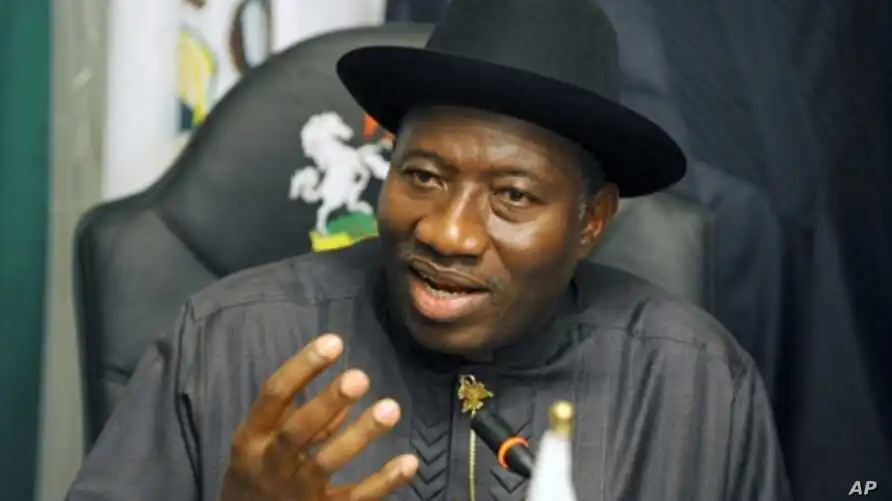
Former President Goodluck Jonathan has moved swiftly to shut down a circulating report claiming he was offered ₦500 billion to enter the 2027 presidential race and pull South-South votes away from Peter Obi, describing the entire account as a fabrication designed to drag him into a controversy he had no hand in.
The rebuttal came through his Special Adviser on Media, Dr Ikechukwu Eze, in a statement issued on Sunday in Abuja. Eze said the publication, which he traced to what he called a “little-known website,” falsely attributed a claim to the former president that he had been approached with the sum to contest against Obi, the presidential candidate of the National Democratic Congress, NDC, in order to divide the vote in the oil-rich southern region.
“The report failed to state where or when Jonathan allegedly made such a claim, who was present or who purportedly made the alleged offer,” Eze said. He argued that the absence of these basic details exposed the story as one that “failed to meet the most basic standards of journalism,” insisting it “bore all the hallmarks of fake news deliberately crafted to mislead the public and drag the former president into unnecessary political controversy.”
Eze acknowledged that the country was entering a period in which false attributions tend to multiply, but urged citizens to treat the report as baseless in its entirety. He appealed to Nigerians to verify sensational claims before passing them along, a caution that speaks to a wider pattern already visible as the 2027 contest takes shape.
The claim, though dismissed, touches a genuine nerve in the emerging opposition arithmetic. The South-South is Jonathan’s home turf. A native of Otuoke in Bayelsa State, the former president remains one of the most recognisable political figures from the region, and any suggestion that he could be persuaded to run carries weight precisely because his entry would reshape voting patterns across the Niger Delta.
Obi, on the other hand, is from the South-East and has built a national following that cuts across regional lines. He emerged as the NDC’s presidential candidate at a special convention held in Abuja on Saturday, May 30, 2026, formally accepting the nomination of a party that only secured official registration earlier in the year. In his acceptance remarks, Obi anchored his message on insecurity and governance, declaring that “no nation can thrive when citizens can no longer sleep with their eyes closed.”
His path to the NDC ticket has been a winding one. Obi first held elective office as governor of Anambra State under the All Progressives Grand Alliance, APGA. He later joined the Peoples Democratic Party, PDP, serving as its vice-presidential candidate alongside Atiku Abubakar in 2019. Ahead of the 2023 election, he made a celebrated switch to the Labour Party, LP, riding the youth-driven Obidient Movement to a third-place finish with roughly a quarter of the votes cast. He subsequently aligned with the African Democratic Congress, ADC, before internal disputes pushed him out, and in May 2026 he moved to the NDC alongside former Kano State governor Rabiu Musa Kwankwaso, a realignment widely read as an attempt to weld the opposition into a single front.
Against that backdrop, a narrative suggesting that a South-South heavyweight could be financially induced to fracture Obi’s base is politically loaded. It plays directly into anxieties within opposition ranks that a divided field could hand President Bola Tinubu, who is expected to seek re-election under the All Progressives Congress, APC, a smoother route to a second term. The general election is scheduled for January 16, 2027.
What makes the vote-splitting story especially delicate is that Jonathan’s political standing is itself unsettled. A faction of the PDP led by former Minister of Special Duties, Kabiru Tanimu Turaki, ratified him as its presidential candidate on the same Saturday in May, at a convention that was hurriedly relocated after police sealed off the A-Class Event Centre in Wuse 2, Abuja, the venue originally announced for the gathering.
That blockade followed a warning from the Minister of the Federal Capital Territory, Nyesom Wike, directing hotels and event centres not to host party factions not recognised by the Independent National Electoral Commission, INEC. The Turaki bloc pressed ahead regardless, moving to its secretariat in the Garki area, where the ratification was completed in about twenty minutes. Jonathan did not attend. His ally, Bayelsa lawmaker Fred Agbedi, received the certificate on his behalf.
The PDP is currently split into two rival camps. The faction led by Turaki adopted Jonathan, while the wing backed by Wike and recognised by INEC nominated former senator Sandy Onor as its presidential candidate. Onor has accepted his nomination, but Jonathan has neither accepted nor rejected the endorsement handed to him, keeping his intentions deliberately open. In a recent meeting with supporters in Abuja, the former president counselled patience, noting that a “presidential race is not a computer game” and that he would “consult widely before making any decision.”
That measured silence is part of what makes any story putting concrete figures and motives in his mouth so easy to challenge. Beyond the PDP tussle, the 2027 field is already crowded. Atiku Abubakar has moved to the ADC, while Oyo State governor Seyi Makinde accepted the presidential nomination of the Allied People’s Movement, APM, at an event in Ibadan on the same eventful weekend in May, further scattering the opposition vote that many strategists had hoped to consolidate.
Jonathan’s rapid disavowal fits a familiar rhythm in Nigerian politics, where the run-up to elections routinely produces manufactured quotes, doctored statements and anonymous “revelations” that spread faster than they can be checked. His team’s decision to respond formally, rather than ignore the report, suggests a calculation that leaving such a claim unanswered could allow it to harden into accepted fact, particularly given how neatly it slots into existing suspicions about attempts to weaken Obi’s regional support.