
Pressure over the phantom Presidential Foreign Intervention Promotion Council (PFIPC) has continued to mount inside the National Assembly, with the House of Representatives and the Senate charting opposite courses on how to confront a scandal that has already unsettled the Presidency and drawn President Bola Tinubu into issuing a 30-day investigative order.
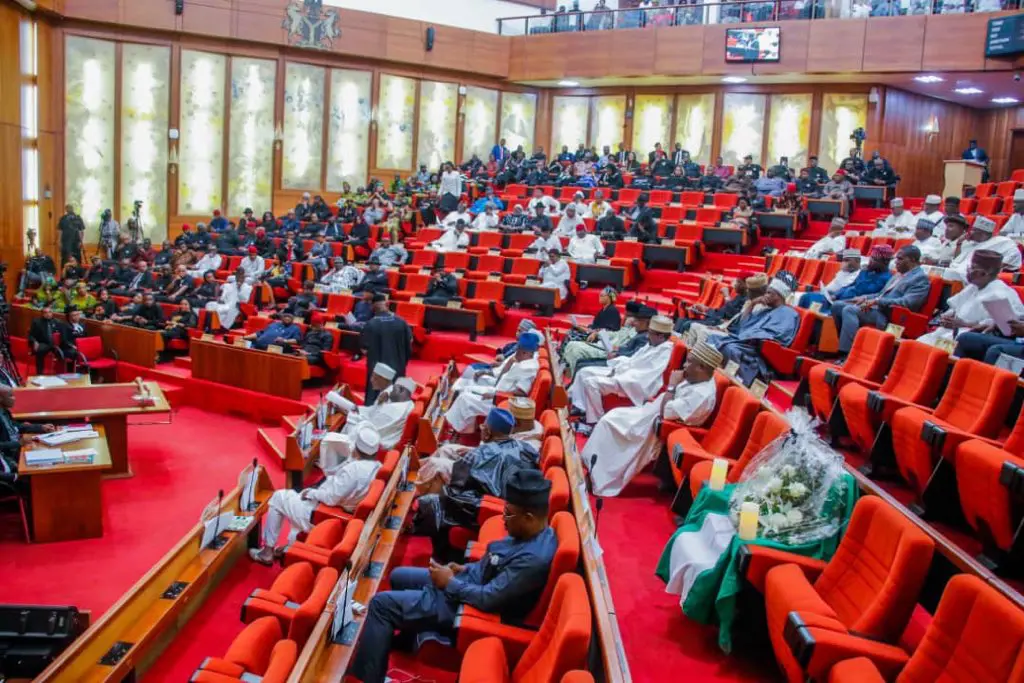
At plenary on Wednesday, the House of Representatives summoned the Minister of Budget and Economic Planning alongside the Director-General of the Budget Office of the Federation to explain how more than N1.3 billion was inserted into the 2026 budget for a body the Presidency insists never existed. The resolution followed a motion of urgent public importance moved by Yusuf Gagdi, the All Progressives Congress lawmaker from Plateau State, during a session presided over by Speaker Tajudeen Abbas. The chamber described the episode as evidence of deep-seated weaknesses in Nigeria’s appropriation process and public financial management.
Gagdi argued that the appearance of the allocation for an agency without legal footing pointed to a structural failure rather than a clerical slip. “The ease with which an unestablished entity was processed through official channels suggests a systemic vulnerability rather than an isolated administrative lapse,” he said. The House further constituted an ad-hoc committee to trace how the provision travelled from the executive proposal through legislative approval, and directed that all ministries, departments and agencies listed in the 2025 and 2026 Appropriation Frameworks be checked against their legal instruments of establishment. Lawmakers also asked the Office of the Accountant-General of the Federation to confirm that no funds had been released and that no payment warrants would be issued to the disputed body pending the inquiry.
Adding a personal account, Deputy Speaker Benjamin Kalu revealed that his office once granted an audience to representatives of the group after receiving a letter dated May 2, 2025, bearing the Presidency’s insignia and identifying the sender as both the Presidential Economic Advisory Council and the PFIPC. He said the correspondence carried a Federal Secretariat address and a “.gov.ng” website, which prompted verification before any meeting. According to Kalu, the delegation eventually showed little interest in the policy issues it had raised, appearing more concerned with taking photographs.
The mood differed sharply in the Senate. Deputy Senate President Barau Jibrin, presiding over plenary, repeatedly questioned the wisdom of a fresh probe, noting that the President had already tasked the Independent Corrupt Practices and Other Related Offences Commission (ICPC) with the matter. The motion’s sponsor, Senator Suleiman Abdulrahman Kawu of Kano South, pushed back, drawing a distinction between the criminal inquiry assigned to the ICPC and Parliament’s duty to examine how the agency cleared the appropriation process. Barau reluctantly allowed the motion to be presented but ruled that the chamber should await the ICPC’s findings, effectively setting the investigation aside.
That reluctance has become the fault line of the wider controversy. The African Democratic Congress (ADC) rejected the sufficiency of an in-house probe. Its National Publicity Secretary, Bolaji Abdullahi, said in a statement, “We insist, however, that only an independent judicial panel will be able to provide answers beyond all reasonable doubt to the many questions that this historic scandal has thrown up.” The party warned that assigning the case to an executive agency risked making the President “a judge in his own case,” and demanded that the Chief of Staff, Femi Gbajabiamila, proceed on leave while the release of a full, unredacted report is guaranteed.
The party’s presidential candidate, Atiku Abubakar, echoed the call, proposing a panel drawn from the Federal Government, the ADC, the Peoples Democratic Party, the National Democratic Coalition, the Nigerian Bar Association, civil society groups and retired judges. Atiku maintained that the government cannot credibly investigate itself.
The demands stem from a dispute that erupted publicly in June. The Presidency issued a disclaimer on June 11 distancing itself from the council, and Gbajabiamila stated that he had petitioned security agencies as far back as October 2025 after forged appointment letters surfaced. The self-styled Director-General, Adeniyi Adeyemi Matthew, who is standing trial at the Federal High Court in Abuja on charges of conspiracy, forgery and impersonation, has countered that his purported appointment and the agency’s budget entry deserve independent scrutiny. At a press conference on June 25, he accused Gbajabiamila of demanding a large share of a claimed take-off grant, allegations the Chief of Staff has firmly denied through his counsel, Kemi Pinheiro, who has threatened a N10 billion defamation suit. Adeyemi has since said he never met Gbajabiamila in person and could not confirm whether the Chief of Staff was involved.
Rights groups have kept up the pressure. The Human Rights Writers Association of Nigeria (HURIWA), through its National Coordinator Emmanuel Onwubiko, argued that the probe had already lost the appearance of independence because the President dismissed the allegations before investigators began work. “When the President appears to have reached a conclusion before investigators commence their work, the outcome becomes predictable in the eyes of Nigerians,” the group said. The Human and Environmental Development Agenda (HEDA), led by Olanrewaju Suraju, similarly urged that Gbajabiamila be relieved of his duties temporarily to remove any perception of interference. Afenifere, through its National Organising Secretary Abagun Kole Omololu, disclosed that it had sought an audience with the President, describing the matter as one that touches on public accountability and the Omoluabi ethos of the Yoruba.
Away from the political arena, the human cost surfaced in Ogbomoso, Oyo State, where Pa Adetunji Ajayi Adeniyi recounted how police operatives searched his home twice in the early hours of Saturday looking for his son, Adebayo Adeniyi. He said the officers scaled his fence around 12:30 a.m., forced open wardrobes and seized the phones belonging to him and his wife before returning them later, then took him in for questioning on Monday. “I don’t know the offence of my son. You just said he is wanted,” he said, maintaining that the young man works with the government in Abuja and is not a troublemaker.
With the ICPC’s clock ticking toward its August deadline, the case has settled into a contest between two versions of accountability: an executive-led inquiry the Presidency insists is sufficient, and the independent panel that opposition figures, lawyers and civil society say is the only route to public confidence. The Adeyemi trial resumes at the Federal High Court on July 14.