
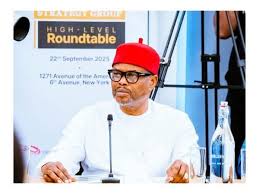
The man at the centre of one of the most audacious impersonation scandals to hit the Nigerian public service in years has broken his silence, insisting he is not on the run even as the Nigeria Police Force moves to place him before a judge on forgery and impersonation charges.
Adeniyi Adeyemi, who styled himself Director-General of the Presidential Foreign Intervention Promotion Council, a body the Presidency insists was never created, told Channels Television’s Politics Today on Monday that he had stepped back from public view purely out of fear for his safety. “Definitely, I’m ready. I’m ready to show my face. I’m not hiding. I’m only fearing for my life because I have it on good authority that my life is in danger,” he said. He further alleged that there had been several attempts on his life, though he offered no names and no supporting detail.
His comments landed on the eve of a scheduled arraignment before the Federal High Court in Abuja. In a charge marked FHC/ABJ/CR/562/2025, filed on 27 November 2025 by police prosecutor Wisdom Madaki, Adeyemi and two co-defendants face eight counts bordering on forgery, impersonation and related offences. An earlier attempt to take his plea on 16 June collapsed after he was reported indisposed, prompting Justice Mohammed Umar to adjourn the matter. Investigators say he ran the phantom council from the second floor of the Federal Secretariat Complex, Phase III, in the heart of the federal capital, before his arrest.
The prosecution’s witness list reads like a roll call of the state machinery the council allegedly imitated. It includes the Chief of Staff to the President, Femi Gbajabiamila, alongside officials of the Office of the Accountant-General of the Federation and a Deputy Superintendent of Police. Documents to be tendered reportedly cover a note verbale sent to the Ministry of Foreign Affairs, approvals purportedly obtained to open accounts with the Central Bank of Nigeria, and a request for self-accounting status forwarded to the Accountant-General.
What has kept the affair alive in public debate is not merely one man’s alleged nerve, but how far the deception travelled. The 2026 Appropriation Act carried an allocation of more than N1.3bn for a “Presidential Economic Advisory Council/PFIPC”, an entry that has raised uncomfortable questions about how a body with no legal foundation slipped through budgetary scrutiny in a national spending plan of N68.32tn. The scandal surfaced publicly through a disclaimer signed by Gbajabiamila on 11 June, describing Adeyemi as an impostor, followed by a fuller statement on 1 July from presidential spokesman Bayo Onanuga stating that investigators found the appointment letter had been forged.
Adeyemi’s own account has shifted and deepened the intrigue. He told the programme that the N400m he allegedly paid to secure the appointment was borrowed, and that his creditors had since petitioned the Economic and Financial Crimes Commission for a refund. “I borrowed this money. In fact, those that I borrowed this money from have reported to the EFCC,” he said. He has accused Gbajabiamila of collecting that sum through a proxy, demanding a further N200m, and seeking 48 per cent of a purported N27.4bn take-off grant. Gbajabiamila’s lawyers have branded the claims “false and gravely defamatory” and filed a N10bn defamation suit. Adeyemi later conceded, in an interview with activist Martins Otse, that he had never met Gbajabiamila in person.
The international dimension has widened further. A United States lobbying outfit, Von Batten-Montague-York, said over the weekend it was ready to help Adeyemi seek asylum and whistleblower protection, with its chairman claiming to have briefed members of former President Donald Trump’s team and intending to approach the US Congress. President Bola Tinubu, for his part, has directed the Independent Corrupt Practices and Other Related Offences Commission to conclude a full investigation within 30 days.
The episode has revived long-running concerns about internal controls in Nigeria’s public finance system, where padded line items and ghost entities have periodically been exposed. Whether Tuesday’s proceedings mark the beginning of accountability or another drawn-out courtroom saga, the case has already exposed how easily the symbols of state authority can be counterfeited.