
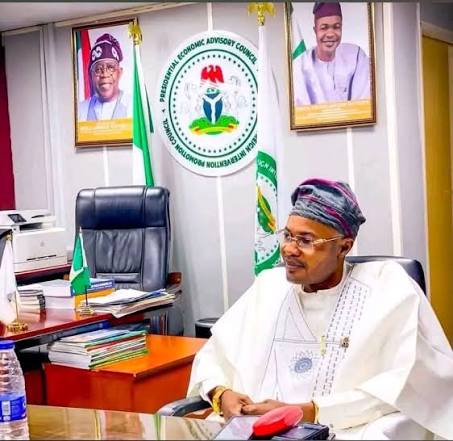
Prince Adeniyi Adeyemi, the man at the centre of one of the most curious impersonation scandals to hit the seat of government in recent years, is scheduled to finally take his plea before a Federal High Court in Abuja on Tuesday, July 14, as the police move to arraign him over an agency the Presidency insists never existed.
Adeyemi, who styled himself Director-General of the so-called Presidential Foreign Intervention Promotion Council (PFIPC), is to be arraigned alongside two others by the Inspector-General of Police. In a charge marked FHC/ABJ/CR/562/2025, filed on November 27, 2025, by police prosecutor Wisdom Madaki, the three defendants face eight counts bordering on forgery, impersonation and related offences.
The road to this arraignment has been anything but straight. Court records reviewed by several newspapers show the matter has suffered a string of adjournments since the charge was filed, arising from defence requests, court scheduling problems and repeated claims of ill health. When the case came up on June 16 for the defendants to enter their pleas, Adeyemi was reported indisposed, prompting Justice Mohammed Umar to adjourn proceedings. Earlier sittings had collapsed for similar reasons, including one date on which the judge was away at a judicial workshop and another on which the defendant simply failed to appear, citing illness.
The origins of the case trace back to a petition. According to the police investigation report, the Chief of Staff to the President, Femi Gbajabiamila, first alerted the Inspector-General of Police and the Director-General of the State Security Service on October 17, 2025, accusing Adeyemi of forgery and impersonation and urging a full investigation. The IGP Monitoring Unit was assigned to the matter, and on October 27, 2025, operatives arrested Adeyemi at the office he was said to be running on the second floor of the Federal Secretariat Complex, Phase III, Abuja. He was held for 23 days before his release on November 19 on administrative bail granted on health grounds, after his lawyers submitted a medical report.
What investigators say they uncovered gives the scandal its weight. According to details attributed to the Presidency, Adeyemi was found to be operating 34 bank accounts, nine of them opened in the names of purported government bodies. The controversy deepened when the disowned PFIPC surfaced with a N1.3 billion allocation in the 2026 Appropriation Act, raising uncomfortable questions about how an agency the government says does not exist found its way into the national budget in the first place.
The prosecution has lined up a notable cast of witnesses. Beyond Gbajabiamila, the list includes Paul Emmanuel, Jeremiah Imoukhede and Ituah Sylvester, two civil servants from the Office of the Accountant-General of the Federation, Akimbo Shola and Adamu Balongu, and a Deputy Superintendent of Police. Also named are individuals said to have been posted to work with Adeyemi at the fictitious body, a hotel owner in Abuja, and a Maitama-based Anglican clergyman.
The documentary evidence is equally striking. Prosecutors intend to tender the police investigation report, Gbajabiamila’s petition of October 17, 2025, and what they describe as Adeyemi’s fake presidential appointment letter dated March 8, 2024. Other exhibits include a note verbale allegedly sent to the Ministry of Foreign Affairs, approvals purportedly obtained to open accounts with the Central Bank of Nigeria, a request for self-accounting status forwarded to the Accountant-General, and correspondence on the take-off of the council. There is also a letter seeking collaboration on land acquisition and office space across all 36 states. The police stated in the court document that “the prosecution shall at the trial call any other related witness or witnesses to prove its case.”
The Adeyemi matter does not stand alone. It has become a reference point in a wider national conversation about oversight failures in the federal bureaucracy, and it is unfolding almost in tandem with the case of former Minister of Science and Technology, Uche Nnaji, who is set to be arraigned by the Independent Corrupt Practices and Other Related Offences Commission over allegations of certificate forgery. President Bola Tinubu had earlier directed the ICPC to conduct a thorough investigation into the activities of the fictitious council and submit its findings within 30 days.
For now, all eyes turn to Justice Umar’s courtroom on Tuesday. After months of false starts, the question is whether the arraignment will hold this time, or whether the case that exposed how a phantom agency slipped into Nigeria’s finances will suffer yet another delay.