
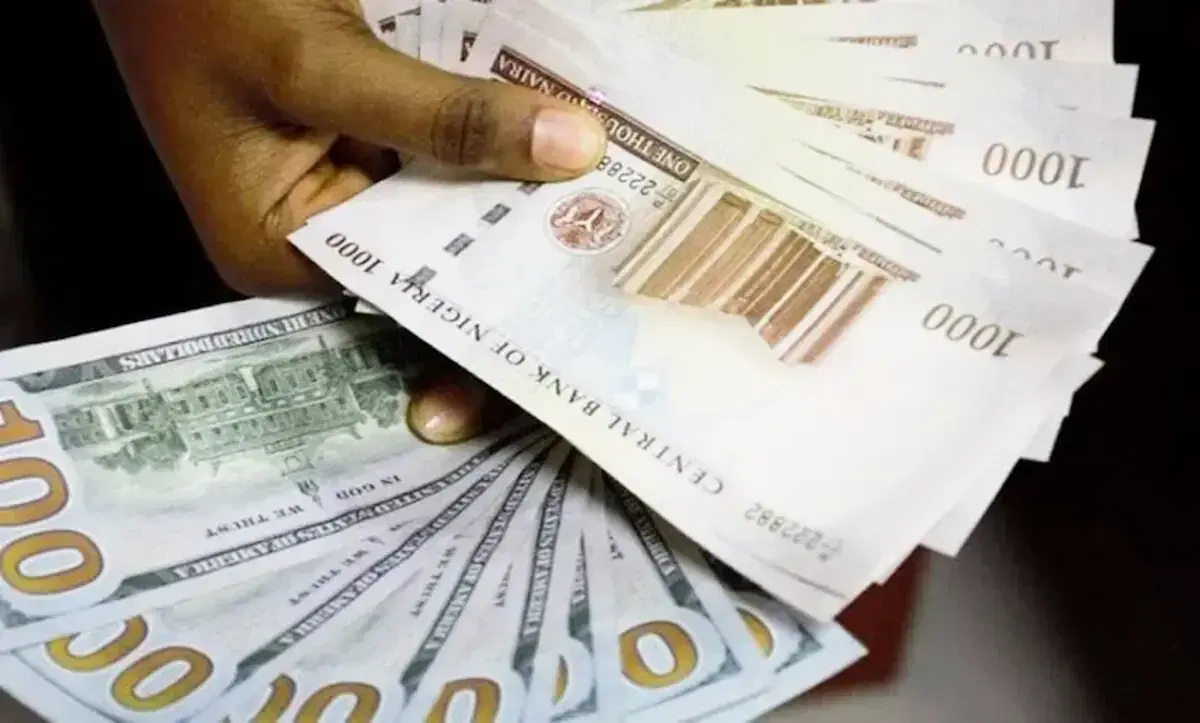
The Nigerian naira lost more ground in the parallel market on Monday, sliding to N1,420 against the United States dollar from N1,406 recorded at the close of last week, even as the currency held its footing in the official window. The divergence has quietly reopened a gap that policymakers spent much of the first half of the year trying to close, and it hands traders a fresh reminder that stability in one segment of the market does not automatically translate to calm across the board.
According to figures published by the Central Bank of Nigeria, the naira actually firmed slightly at the Nigerian Foreign Exchange Market, the official trading floor known as NFEM, where the indicative rate eased to N1,380.5 per dollar from N1,381.7 at the previous weekend. That marginal N1.2 gain in the formal market sits awkwardly beside the softer street rate, and the practical effect is a wider premium. The spread between the parallel and official markets stretched to N39.5 per dollar on Monday, up sharply from N24.3 the previous weekend, its broadest in several sessions.
Turnover told part of the story. Interbank activity at NFEM thinned considerably, with reported volume falling by 21.2 percent, a slowdown that mirrors a broader cooling in trading through July. Data from the Financial Markets Dealers Association showed weekly market turnover roughly halved to about 1.72 billion dollars from 3.39 billion the previous week, a sign that fewer deals, rather than any dramatic shift in fundamentals, are shaping day to day pricing. When liquidity dries up in the official window, unmet demand tends to spill into the parallel market, and that is precisely the pressure now showing up in the street rate.
The context matters, because the naira has spent 2026 in far calmer waters than in the recent past. The currency opened the year with a run of gains, touching around N1,367 per dollar officially in early July before drifting back toward N1,380. That stability has been underpinned by a genuinely strong external position. Nigeria’s gross external reserves climbed to 51.77 billion dollars as of July 10, up an impressive 38.61 percent from 37.33 billion dollars a year earlier, and now sit at levels last seen more than a decade and a half ago. The Central Bank has attributed the build up to steadier oil earnings, sustained diaspora remittances, renewed foreign portfolio inflows and the foreign exchange reforms it has pursued since the exchange windows were unified in mid 2023.
Those reforms remain the backdrop to every naira story. When the current administration floated the currency in June 2023, official rates lurched from around N460 to well past N1,500 by the close of 2024 before settling near N1,435 at the end of 2025. Set against that turbulence, a move of N14 in the parallel market reads less as a crisis and more as ordinary noise, the kind of seasonal wobble that surfaces when school fees, summer travel and mid year import demand converge on a thinner market.
Still, the widening premium is worth watching. The Central Bank has repeatedly said one aim of its reforms is to narrow the distance between the official and street rates, and a spread creeping back toward N40 runs against that grain. In his statement at the last Monetary Policy Committee meeting, deputy governor Muhammad Sani Abdullahi noted that “exchange rate pressures have remained contained, with relative stability in the foreign exchange market indicative of improved market liquidity, reduced speculative positioning and the presence of adequate external buffers.” He added that sustaining depth and liquidity would be “critical to enhancing the market’s resilience and capacity to absorb potential external and domestic shocks.”
For now, the fundamentals lean in the naira’s favour. Reserves are firm, inflation eased to a monthly pace of 1.75 percent in May even as the annual figure ticked up to 15.93 percent, and the CBN has kept its benchmark rate at 26.5 percent to guard the gains. Whether the parallel market steadies or continues to drift will depend, as it so often does, on how quickly dollars return to the official floor.