


Oil Fears Return As US, Iran War Reignites Over Hormuz
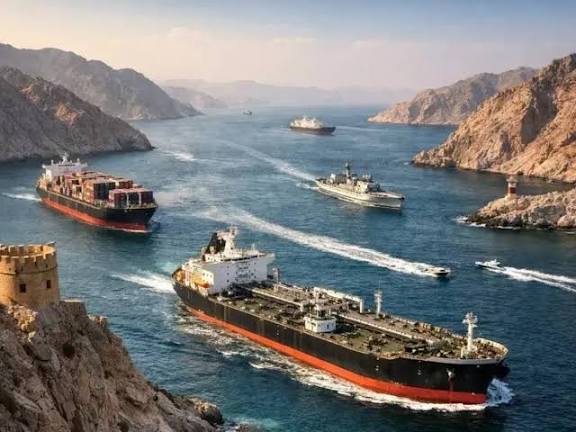
American warplanes pounded targets across southern Iran again on Thursday while Tehran fired drones and missiles at United States bases and allies in the Gulf, driving the reignited war over the Strait of Hormuz into a punishing sixth day and reviving fears of a fresh global oil shock. The US military said it launched another wave of strikes on Iran, with Iranian media reporting explosions on Qeshm Island, Bandar Abbas and Chabahar, while Iran said it carried out retaliatory attacks targeting US assets in Kuwait, Bahrain and Jordan. Bahrain and Kuwait sounded air raid sirens as the exchanges spread once more across the world’s most sensitive energy corridor.
The renewed fighting has shattered a truce that had briefly calmed the region. On 17 June, Trump and Iranian President Masoud Pezeshkian signed a memorandum of understanding to end the war and the blockades of the strait, a deal Washington said would reopen Hormuz and halt Iran’s nuclear advance. That understanding unravelled within weeks. On 8 July, the interim truce between the United States and Iran broke down after Iran struck multiple commercial ships in the Strait of Hormuz, and President Donald Trump declared the agreement finished, describing Tehran’s leadership in hostile terms.
To understand the present danger, one has to trace the conflict to its start. Tensions had escalated in the lead up to 2026, stemming from failed nuclear negotiations in Geneva and a prior 12 day air conflict in 2025. The full war opened on 28 February 2026, when the United States and Israel launched massive joint strikes on Iran, an operation Trump announced as major combat operations. Iran’s response was to reach for its most potent geographic weapon. Within days it declared the Strait of Hormuz closed and began attacking shipping. Beginning on 4 March 2026, Iranian forces declared the strait closed, and the UK Maritime Trade Operations Centre reported 10 attacks on ships as of 8 March, attacks that killed five crew members on two vessels.
The economic consequences were immediate and severe. Following the closure of the strait, oil and LNG exports were stranded, causing Brent crude to surge past 120 dollars per barrel and forcing QatarEnergy to declare force majeure on all exports. The combined oil output of Kuwait, Iraq, Saudi Arabia and the United Arab Emirates dropped by a reported 6.7 million barrels per day by 10 March, and by at least 10 million barrels per day by 12 March. The International Energy Agency has described the episode as the largest supply disruption in the history of the global oil market. In response, the United States and others released 400 million barrels of oil from strategic reserves, the biggest release on record, while Japan tapped its own stockpile.
The latest cycle of violence has followed a grim rhythm of strike and counterstrike. On 11 July, US forces said they hit about 140 Iranian military targets in their third round of strikes that week, after CENTCOM accused Iran’s Islamic Revolutionary Guard Corps of attacking a Cyprus flagged container ship in the strait. On 13 and 14 July, two United Arab Emirates tankers, MT Al Bahiyah and MT Mombasa, were hit during transit, killing an Indian seafarer and prompting India to summon Iran’s senior diplomat in New Delhi to lodge a strong protest. The United States reimposed its naval blockade of Iranian ports, and on 15 July, the US military completed a second wave of strikes aimed at degrading Iran’s ability to target vessels, hitting command centres, air defence sites and coastal surveillance facilities including at Bandar Abbas, after an earlier 90 minute round of attacks on Greater Tunb Island.
Amid the bloodshed came one gesture of de escalation. Trump said Iran had released an American woman wrongfully detained since December 2024, later identified by her attorney as Dena Karari, praising Tehran’s gesture of goodwill. Yet the rhetoric on both sides has hardened. Trump warned that the coming week would grow far worse for Iran unless it returned to talks, threatening power stations and bridges, while Iran’s leadership signalled it now regards the conflict as an existential struggle and its foreign ministry said there were no plans for negotiations.
The human toll is mounting. The missing crewman from the Cyprus flagged vessel, a man from Pune, India, was confirmed dead on 14 July when his body was recovered by the Omani Navy. Iranian authorities have reported dozens of deaths from the renewed American strikes, including military personnel killed in attacks on the country’s southeast, and the evacuation of a hospital in Ahvaz.
For the markets, the fear is that the fragile calm of June is gone for good. Brent crude for September delivery stood at 78.82 dollars a barrel earlier this week, its highest since 22 June, as maritime traffic through the strait collapsed, with just six vessels tracked crossing over one recent 12 hour window compared with 18 to 22 daily crossings earlier this month. The World Bank, in its April Commodity Markets Outlook, projected that energy prices would surge 24 percent in 2026 to their highest level since Russia’s invasion of Ukraine, with Brent forecast to average 86 dollars a barrel, up from 69 dollars in 2025, and warned prices could reach 115 dollars if facilities suffered more damage. The strait, it noted, handles about 35 percent of global seaborne crude oil trade, which is why every projectile fired near it echoes through economies far removed from the Gulf.
Nigeria sits squarely inside that echo. As an oil exporter that still leans on imported and locally refined fuel priced off global crude, the country feels the shock from both directions. In 2025, about 62 percent of the petrol consumed in Nigeria, some 11.85 billion litres, was still imported, but by February 2026 domestic refineries led by the Dangote Refinery were estimated to supply around 92 percent of daily petrol demand. That shift has not spared consumers. Higher global crude prices raise feedstock costs for domestic refiners, so pump prices rise regardless of where the fuel is processed, with petrol climbing from below 900 naira per litre before the escalation to as high as 1,600 naira in some states. The International Food Policy Research Institute has framed Nigeria’s position as a dual reality, noting that the country stands to gain from higher export earnings even as the same price spikes squeeze households through fuel, fertiliser and food channels.
Whether this sixth day marks the peak of the crisis or merely another rung in a longer escalation remains uncertain. Talks between the two sides have not been formally declared dead, and mediators in the Gulf have repeatedly pulled the parties back from the brink before. For now, though, the pattern is one of widening strikes, a closed waterway, and a watching world counting the cost at the pump.