
Court Dismisses Suit to Recognise Turaki-Led PDP Leadership
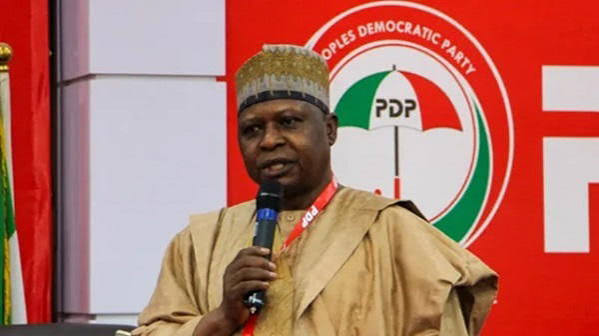
The battle for control of the Peoples Democratic Party returned to familiar ground on Friday, as a Federal High Court in Abuja struck out a suit that sought to force the electoral umpire to recognise the Kabiru Turaki led Interim National Working Committee, leaving one of Nigeria’s oldest political parties still split down the middle barely eighteen months before the 2027 general election.
Justice Salim Olasupo Ibrahim held that the plaintiffs, drawn from the party’s Board of Trustees and its founding bloc, lacked the legal standing to bring the action, and that the dispute at its heart was an internal party affair over which the court had no jurisdiction. The suit, marked FHC/ABJ/CS/1159/2026 and filed on June 4 by a legal team led by Chief Chris Uche, a Senior Advocate of Nigeria, had asked the court to compel the Independent National Electoral Commission to publish the names of the Turaki led interim leadership on its official website.
The plaintiffs were the Board of Trustees Chairman and former Senate President, Adolphus Wabara; the Board’s Secretary and former Niger State governor, Muazu Babangida Aliyu; former Information Minister, Jerry Gana; the party elder, Olabode George; two former Women Affairs Ministers, Maryam Ciroma and Zainab Maina; the Board and National Executive Committee member, Esther Uduehi; and the PDP itself. The court struck out the party as a plaintiff, ruling that those who filed the action had not obtained the PDP’s authorisation to sue in its name.
In his ruling, Justice Ibrahim held that the Supreme Court judgment the plaintiffs relied upon did not amount to an order directing INEC to accord recognition to the Turaki led body, and that the reliefs sought had become academic. He noted that the convention which produced the leadership currently recognised by INEC had been monitored by the commission, and that courts do not determine hypothetical questions. He also upheld preliminary objections filed by INEC and by members of the leadership aligned with the Federal Capital Territory Minister, Nyesom Wike, who had earlier been joined as defendants, among them the National Chairman recognised by INEC, Abdulrahman Mohammed. One online medium reported that the court awarded ten million naira in costs, a detail not confirmed across all accounts of the proceedings.
Reacting through its National Publicity Secretary, Ini Ememobong, the Turaki camp said the fight was far from over. “While we respect the judgment of the trial court, we respectfully consider that it is against the extant judgments of the appeal and apex courts, leaving the plaintiffs with no option but to appeal the judgment and the rulings therein. The plaintiffs have accordingly briefed their lawyers to take immediate steps to appeal the rulings and judgment,” the statement read. Ememobong added, “We are hopeful that as we climb the ladder of the law upwards, the victory of truth over lies, principles over compromise and the survival of true opposition and multi party democracy will be assured.”
Friday’s judgment is only the latest turn in a leadership crisis that has run for more than a year and has produced a tangle of conflicting court decisions. The roots lie in the party’s elective national convention held in Ibadan on November 15 and 16, 2025, an exercise backed by the Oyo State governor, Seyi Makinde, and the Bauchi State governor and chairman of the PDP Governors Forum, Bala Mohammed. That convention produced Turaki as national chairman and, in the same breath, suspended several allies of Wike, including the National Secretary, Samuel Anyanwu, and the National Legal Adviser, Kamaldeen Ajibade, over alleged anti party activities.
The convention was contested almost from the moment it ended. It had proceeded on the strength of interim orders granted by the Oyo State High Court on November 3 and renewed on November 14, 2025, even as rival orders from the Federal High Court in Abuja sought to halt it. On November 21, 2025, the Wike aligned bloc, led by Abdulrahman Mohammed and Anyanwu, approached the Federal High Court to restrain the Turaki group from parading itself as the party’s leadership and to secure access to the national secretariat. In December 2025, INEC declined to recognise the Ibadan leadership, pointing to subsisting court orders that restrained it from acting on the outcome.
From there, the rulings multiplied and often contradicted one another. On January 30, 2026, the Federal High Court in Ibadan, presided over by Justice Uche Agomoh, nullified the convention for defying existing orders. On February 27, 2026, the Oyo State High Court, through Justice Ladiran Akintola, moved in the opposite direction, validating the same convention in Suit No. I/1336/2025 and affirming Turaki as substantive chairman after granting all thirteen reliefs sought. The Court of Appeal in Abuja then entered the fray on March 9, 2026, dismissing the Turaki camp’s appeal against the ruling that barred INEC from recognising the Ibadan outcome, and ordering the faction to pay two million naira in costs.
Matters came to a head at the end of March. The Wike aligned faction held a separate national convention in Abuja that produced Abdulrahman Mohammed as national chairman, and on March 30, 2026, Justice Joyce Abdulmalik of the Federal High Court in Abuja nullified the Ibadan convention afresh, barred INEC from recognising it, and directed security agencies to grant the Wike camp access to the party headquarters. INEC subsequently listed the officers from the Abuja convention, with Anyanwu as National Secretary, on its records. The Supreme Court appeared to settle the question on April 30, 2026, when a panel, by a majority of three to two, nullified the November 2025 Ibadan convention. It was after that judgment that the Wabara led Board of Trustees reappointed Turaki and his team into an Interim National Working Committee, forwarded their names to INEC on May 4, and, when the commission did not act, returned to court in the suit that has now been struck out.
The infighting has unfolded against the backdrop of a steep decline in the party’s national standing. The PDP governed Nigeria from 1999 to 2015 before losing the presidency to the All Progressives Congress, and it remained the country’s principal opposition through the 2023 election. Since then its structure has thinned dramatically. Between 2024 and early 2026, at least ten of its governors decamped to the APC, among them Sheriff Oborevwori of Delta, Umo Eno of Akwa Ibom, Peter Mbah of Enugu, Douye Diri of Bayelsa, Siminalayi Fubara of Rivers, Ademola Adeleke of Osun, Agbu Kefas of Taraba, Ahmadu Fintiri of Adamawa, Caleb Mutfwang of Plateau and Dauda Lawal of Zamfara. By early March 2026, only Makinde in Oyo and Bala Mohammed in Bauchi remained in the party, while the APC’s tally of governors had climbed to thirty one of the thirty six states. The African Democratic Congress has since overtaken the PDP as the largest minority bloc in the Senate, although the PDP still leads other opposition parties in the House of Representatives and across most state assemblies.
The stakes of the leadership question are therefore practical as well as symbolic. Whichever camp INEC recognises controls the party’s finances, its secretariat at Wadata Plaza in Abuja, and, most consequentially, the authority to nominate candidates and issue the forms through which aspirants contest the 2027 elections. Fresh disputes between the two camps over access to INEC nomination processes have already surfaced, a sign that the recognition battle is beginning to spill into the mechanics of candidate selection.
For now, the party remains formally in the hands of the leadership that emerged from the Abuja convention and carries INEC’s recognition, while the Turaki camp presses its case that the courts have not spoken the final word. With the matter headed once more to the Court of Appeal, and with the electoral calendar tightening, the PDP faces the prospect of entering the pre election season with its command structure still contested in court, a position that its rivals in the ruling party are unlikely to let pass unnoticed.