
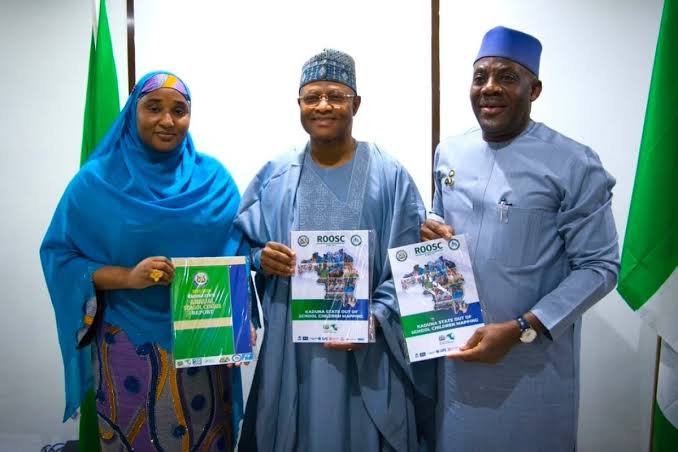
The Federal Government has adopted Kaduna State’s household mapping model as the national framework for identifying out-of-school children, marking a major policy shift from estimate-based planning to data-driven interventions aimed at returning millions of children to classrooms across Nigeria .
Minister of Education, Dr. Olatunji Alausa, announced the decision on Thursday following a meeting with Kaduna State Governor, Uba Sani, in Abuja . Under the new approach, the Federal Ministry of Education, in collaboration with the National Bureau of Statistics (NBS), will conduct a nationwide household mapping exercise across the 36 states and the Federal Capital Territory to determine the exact number of out-of-school children, their locations, and the households they belong to .
The initiative replaces the long-standing reliance on broad projections with verified household-level data, enabling governments to design targeted interventions and deploy resources more effectively . Alausa said, “With this exercise, we now know where these children are and the households they belong to. That gives us the opportunity to work closely with the Kaduna State Government to bring them back to school” .
Governor Sani described the move as a significant endorsement of Kaduna State’s data-driven approach to governance, noting that the household mapping framework has been instrumental in reducing the number of out-of-school children in the state from about 550,000 to fewer than 180,000 . According to the governor, the model provides accurate data that enables government authorities to identify vulnerable children, target interventions effectively, and allocate resources where they are most needed .
Alausa cited Kaduna State as a practical example of the benefits of the new approach, noting that while previous estimates placed the state’s out-of-school population at about 585,000 children, the household mapping exercise conducted by the state government revealed that the actual figure is fewer than 200,000 . The minister commended Governor Sani for pioneering the initiative, describing the Kaduna model as a game-changer that provides a clearer understanding of the out-of-school challenge .
Nigeria has one of the largest populations of out-of-school children in the world, with estimates ranging from 15 million to about 20 million . The challenge has been linked to several factors, including poverty, insecurity, socio-cultural barriers, child labour, early marriage, displacement caused by conflict, and inadequate education infrastructure .
The Federal Government has identified expanding access to education as a major component of President Bola Tinubu’s Renewed Hope Agenda, introducing reforms including the Nigerian Education Data Initiative, school infrastructure upgrades, the student loan programme, curriculum reforms, and other measures aimed at improving data-driven education planning .
Alausa recently disclosed that the government has enrolled more than one million out-of-school children into classrooms over the past 24 months, contributing to a decline in the estimated number of children outside the formal education system . He attributed school dropouts largely to poverty, while noting that government interventions aimed at expanding access have yielded significant results . The minister added that nearly 88,000 schools have been rehabilitated, more than 6,000 classrooms constructed, while 1.7 million instructional materials have been distributed nationwide .
To sustain the progress, Alausa said the government is implementing five major social protection programmes, including a $500 million World Bank Community Resilience project and the $1.2 billion HOPE programme, which focuses on health, basic education and economic empowerment . The Adolescent Girls Initiative for Learning and Empowerment (AGILE) has also helped enrol more than one million girls in school through conditional cash transfers and the provision of learning materials .
Governor Sani reaffirmed Kaduna State’s commitment to working with the Federal Ministry of Education to expand access to quality education, describing education as one of the most valuable investments any government can make . He expressed satisfaction that the state’s household mapping initiative has been adopted as the national model for tackling the out-of-school children challenge .