
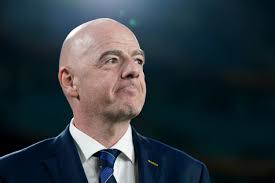
Gianni Infantino’s decade of near total control over world football has entered its most precarious stretch, with the Canadian Prime Minister, Mark Carney, becoming the first sitting head of government from a 2026 World Cup host nation to publicly withdraw confidence in the FIFA president over a shelved plan to sell part of the tournament’s commercial machinery to private investors.
Carney, whose country co-hosted the tournament alongside Mexico and the United States, told reporters in Toronto on Wednesday that Infantino’s failure to run the proposal past FIFA’s senior management should be “fatal” to his tenure. “Certainly I don’t have confidence in Mr Infantino, after this point, given what transpired,” he said, adding that the episode was not how any business, small or global, ought to be run.
The proposal at the centre of the crisis was FIFA Forward Enterprise, a commercial subsidiary that would have bundled the governing body’s broadcasting, sponsorship, ticketing, hospitality and licensing rights together with the operational delivery of its tournaments, including the men’s and women’s World Cups and the Club World Cup.
FIFA proposed raising 4.2 billion dollars by selling roughly 20 per cent of FFE on an equity valuation of about 20 billion dollars, retaining a majority holding, with the anchor investor named as Thrive Eternal, a New York firm founded by Joshua Kushner, brother of Jared Kushner, who is son in law to United States President Donald Trump.
The story broke in The Times of London on Tuesday, 28 July. UEFA responded within hours, arguing bluntly that the World Cup was “not FIFA’s to sell.” By Wednesday, CONCACAF said it was deeply concerned at not being consulted, the Asian Football Confederation expressed disappointment, and the European Union weighed in against the idea. Reports that same day said Infantino had written to member associations offering each of them 40 million dollars if they backed the plan, with a sign up deadline of 19 September. British Prime Minister Andy Burnham, who took office on 20 July, was among the loudest political voices against the proposal.
On Thursday, UEFA announced that no European national team would take part in any FIFA competition while the plan remained alive, a threat carrying real weight given that three of the four semi finalists at the 2026 World Cup, won by Spain, were European. CONCACAF’s 41 members then rejected the proposal unanimously.
Friday brought the resignation of Infantino’s special adviser Carlos Cordeiro, the former United States Soccer Federation president, who said he had no involvement in the plan and opposed it without reservation. By the early hours of Saturday, 1 August, Infantino had conceded, saying the project had created divisions that no longer served its stated purpose. “As a result, this proposal will not proceed,” he said.
Infantino convened a crisis meeting of FIFA’s senior leadership at the organisation’s Africa office in Sale, across the Bou Regreg river from Rabat, on Wednesday, 5 August. FIFA said afterwards that Secretary General Mattias Grafström and the Management Board members present had reaffirmed their full support for the president, describing him as the only official elected by all 211 member associations.
The statement conceded ground on process. It acknowledged that the FIFA Council and member associations had felt excluded, that errors were made in handling the fallout after the plan leaked, and that an apology had been sent separately to the Council and the associations. A formal review is to be presented to the Council at its next meeting. FIFA nonetheless maintained that the actions taken were within its regulatory framework, and said it would now channel its energies into strengthening the existing FIFA Forward programme.
Separately, an internal memo from Grafström to staff, reported by Reuters, described the sequence of events as sad and reproachable and said the project had been permanently abandoned, without naming Infantino.
FIFA’s financial trajectory explains why the stakes are so high. Cycle revenue rose from about 6.42 billion dollars in 2015 to 2018 to a record 7.568 billion dollars for 2019 to 2022. The 2023 to 2026 budget was originally set at 11 billion dollars in 2022 and later revised upward to 13 billion dollars, while reserves stood at a record 3.97 billion dollars at the end of 2022, an equity ratio of 58 per cent. FIFA reported 2.66 billion dollars in revenue for 2025 alone, about 225 million dollars ahead of target, driven largely by the 2.13 billion dollars generated by the expanded 32 team Club World Cup. At the 76th FIFA Congress in Vancouver on 30 April 2026, delegates approved a record 14 billion dollar budget for the 2027 to 2030 cycle, including 2.7 billion dollars for FIFA Forward, which FIFA described as an eightfold increase on development funding available before 2016.
Under the current Forward 3.0 phase, each member association can apply for up to 8 million dollars between 2023 and 2026, taking total Forward disbursements to about 5.075 billion dollars across Infantino’s presidency. FIFA’s own 2025 financial report put Infantino’s pay package at roughly 6 million dollars, comprising a basic salary of 2.6 million dollars and a bonus of 2.78 million dollars after a 33 per cent increase.
Critics of FFE argued that the subsidiary would have created a commissioner style role for him beyond 2031 on far higher terms, a reading FIFA has not endorsed.
For the Nigeria Football Federation, the sums were not abstract. Under the proposal, the NFF stood to receive 20 million dollars in grants, up from the 8 million dollars available in the present four year cycle, with the figure rising to 22 million dollars for 2031 to 2034 and 24 million dollars for 2035 to 2038.
Former NFF president Amaju Pinnick, now deputy chairperson of the FIFA Men’s National Teams Competitions Committee, publicly defended the plan in a television interview before it was withdrawn, arguing that member associations were themselves the shareholders and beneficiaries. Combined with existing Forward entitlements, he put the potential total at 40 million dollars, saying that at that level “you don’t need the government to run football.” He acknowledged he had not received official communication on the proposal but said he believed wide consultation had taken place. The NFF as an institution has not issued a formal position on Infantino’s future.
While Europe, Asia and CONCACAF declared a loss of confidence, CAF withheld judgement, leaving Infantino hopeful of support from the continent’s 54 associations. Five influential African administrators, among them CAF first vice president Fouzi Lekjaa of Morocco, Hany Abo Rida of Egypt, Djibrilla Hamidou of Niger and Ahmed Yahya of Mauritania, issued statements welcoming the withdrawal while backing the president. CAF president Patrice Motsepe, speaking days before the controversy broke, said simply: “I personally support Gianni Infantino.” Other CAF vice presidents, including Ghana’s Kurt Okraku, have stayed silent.
The pattern is not new. Sepp Blatter first used development grants to win African backing in his 1998 election against Lennart Johansson; Infantino renamed the Goal Project as FIFA Forward and multiplied the sums.
The 77th FIFA Congress and presidential election are scheduled for Rabat on 18 March 2027, with nominations closing on 18 November 2026 and no challenger yet declared. An Extraordinary Congress can be requested by 43 or more member associations, though removing a sitting president requires a far broader majority. A contested election would need 106 votes to secure a majority.
Pressure is also building on adjacent fronts. European Leagues, representing more than 1,300 clubs, said “FIFA must not be allowed to continue taking unilaterally disruptive decisions” and rejected further expansion of FIFA competitions pending reform, criticising the four week window given to assess a possible 64 team World Cup in 2030. Oceania’s executive committee is due to meet, and CAF’s executive committee was scheduled to sit on Thursday with the abandoned plan still on its agenda.
Whether Rabat’s show of internal unity holds, and whether Africa’s silence hardens into endorsement or fractures, will determine if Infantino reaches March 2027 with his presidency intact.