


137 Nigerians Deported In Five Flights As Europe Hardens Return Rules
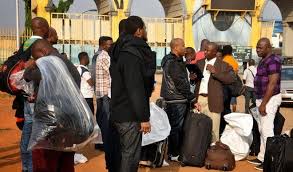
Five chartered aircraft touched down at the cargo terminal of the Murtala Muhammed International Airport in Lagos between February and June 2026, each carrying Nigerians whose residence claims in Europe had run out. Together, the five operations returned at least 137 Nigerian citizens from Germany, according to monitoring reports compiled by the Deportees Emergency Reception and Support (DERS) team and Refugees4refugees.org, and sighted by The Journal.
The breakdown shows 27 Nigerians deported in February, 37 returned directly by Germany as part of a 50 person joint European Union operation in March, and 24, 23 and 26 in April, May and June respectively. The pattern points to a hardening of enforcement, with Germany increasingly relying on chartered aircraft rather than scheduled commercial flights, and increasingly sharing those aircraft with other European states.
The first documented batch arrived on February 18, 2026. According to Refugees4refugees.org, the flight was operated by World2fly and departed Stuttgart, landing in Lagos shortly before 2 pm. The operation was enforced principally by Germany, although one person described in the report as severely ill and mentally unfit was transferred from Slovakia to join the 26 people removed from German territory. The monitoring group identified Baden Württemberg as a leading participant, noting that Stuttgart had hosted both the December 2025 and February 2026 operations to Nigeria.
The same report alleged that some of those removed had serious health conditions, while others had lived and worked in Germany for years. It cited the case of a single mother and her three children removed from the Sindelfingen district of Stuttgart despite reportedly holding documentation relating to their residence status. The family, according to the report, later returned to Germany after a volunteer intervened and local foreign authorities confirmed the removal had been carried out in error.
That February operation coincided with Nigeria’s participation in preparations for the Voluntary National Review of the Global Compact for Migration, ahead of the 2026 International Migration Review Forum in New York. The DERS team stated that no Nigerian government agency sent representatives to receive the returnees at the airport, and that they were moved away from the terminal without adequate assistance.
On March 10, a further 50 people were flown to Lagos in a joint EU operation hosted by Germany in cooperation with Spain, Austria and Belgium, with Germany accounting directly for 37. The monitoring records describe it as the largest single deportation involving Nigerians within the three year period referenced. A batch of 24, including women and a minor, followed in early April aboard a World2fly charter that departed Frankfurt, organised through German authorities with Frontex support. Twenty three were returned in May, and 26 arrived on June 17.
The Nigerian batches sit inside a much larger German enforcement drive. Figures compiled in the Asylum Information Database show that Germany carried out 22,787 deportations in 2025, including 3,628 minors, representing a 13.5 per cent rise over the 20,084 recorded in 2024, which itself was about 25 per cent above the roughly 16,000 of 2023.
The trend, however, has since turned. Federal Interior Ministry data reported in response to parliamentary questions put deportations at 4,807 in the first quarter of 2026, down 1,344 from the 6,151 recorded in the same quarter of 2025, the first such decline in five years. Turkey received the highest number at 601, followed by Georgia with 266, North Macedonia with 230, Spain with 192, and Morocco and Algeria with 178 each. The same records show 547 children aged up to 13 and 146 adolescents aged 14 to 17 among those removed.
Federal Interior Minister Alexander Dobrindt has responded by announcing draft legislation intended to raise removals on a sustained basis. “My idea is that we make agreements directly with Afghanistan to enable repatriations,” he said in an earlier interview with Focus magazine on a related front, underlining Berlin’s readiness to negotiate returns directly with countries of origin.
Alongside forced removals, Germany’s Federal Ministry of the Interior reports that 16,576 people left voluntarily in 2025 under the REAG/GARP assistance programme, a 60 per cent increase on the previous year, with 4,166 departing under the scheme between January and March 2026, about 30 per cent above the same period of 2025. Refugees4refugees.org reported that a Nigerian delegation led by the National Commission for Refugees, Migrants and Internally Displaced Persons met on March 20, 2026 with facilitators of Germany’s ARRIVES voluntary return project, a meeting the group characterised as consent to deportation presented as voluntary return. That characterisation is the group’s own position and has not been confirmed by the commission.
The flights arrive as the European Union rewrites its removal rules. The European Commission proposed a Regulation establishing a Common European System for Returns in March 2025. The Commission confirmed that a political agreement was reached between the European Parliament and the Council on June 1, 2026. The regulation repeals Directive 2008/115/EC, in force since 2008, and introduces a European Return Order recorded in the Schengen Information System, meaning a removal decision issued in one member state can be enforced in another without fresh proceedings. It also contemplates return hubs outside EU territory where direct repatriation proves impracticable. The Pact on Migration and Asylum entered into force on June 12, 2026.
The reform is driven by an enforcement gap. Commission documents note that only around 20 per cent of third country nationals ordered to leave the EU actually do so. Eurostat figures show that 33,860 people were returned to third countries in the fourth quarter of 2025, a 13 per cent rise year on year, with Germany accounting for 7,690, or 22.7 per cent, the largest share of any member state. Across the whole of 2025, about 132,660 people were repatriated against 492,175 orders to leave, roughly 27 per cent.
Nigeria’s exposure to European enforcement is neither new nor isolated. During his Abuja visit in 2023, then German Chancellor Olaf Scholz said about 14,000 Nigerians in Germany faced possible removal, with roughly 12,500 in tolerated status largely because of missing identity documents. Refugees4refugees.org reported that by May 2025 Germany had already hosted 167 removals to Nigeria across four charter flights that year, enforcing 143 directly, ahead of Austria with 15 and Cyprus with nine. Official German statistics from 2019 put the number of people of Nigerian migration background in Germany at about 72,000, the largest sub Saharan African community there, although more current figures are not publicly consolidated.
The pressure is multi directional. The Nigerians in Diaspora Commission confirmed in March 2026 that 40 of 42 Nigerians arrested in Mozambique had been returned in three batches, describing the process as a violation of their rights. In June 2026, the United States Department of Homeland Security listed 110 Nigerians among 355 West Africans slated for removal. Ireland removed six Nigerians in a Frontex coordinated operation in late July 2026, with officials there indicating further charters through the year.
Economically, the diaspora remains central. Central Bank of Nigeria data put remittance inflows at 21.806 billion dollars in 2025, effectively flat against 21.811 billion dollars in 2024, while external reserves reached 51.86 billion dollars on July 14, 2026. CBN Governor Olayemi Cardoso has said the bank is targeting one billion dollars in monthly inflows by year end, up from above 600 million dollars currently. At home, headline inflation eased to 15.91 per cent in June 2026 from 25.29 per cent a year earlier, according to the National Bureau of Statistics, though food inflation stood at 17.52 per cent.
Migration rights advocates have consistently argued that removal policies must carry adequate safeguards for vulnerable persons and procedures firm enough to prevent wrongful expulsion, a concern the Sindelfingen case brings into focus. With the EU’s new return architecture taking effect and Berlin drafting fresh legislation to accelerate removals, the monthly charter to Lagos appears unlikely to stop. Whether Nigeria meets those aircraft with a reception and reintegration system remains the open question.