
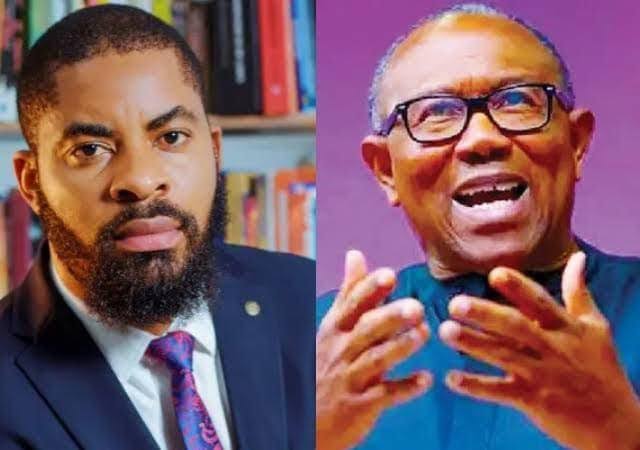
A renewed row over the place of religion in Nigeria’s politics has flared as the 2027 campaign gathers pace, after human rights lawyer and activist Deji Adeyanju accused opposition presidential candidate Peter Obi of reviving the faith based mobilisation that shaped the bitter 2023 contest.
Adeyanju, in a post on his verified social media account on Tuesday, argued that Nigerian elections should turn on ideas and competing visions rather than religion. “Elections should be about ideas, policies and competing visions for Nigeria. Religion and politics should never be allowed to become instruments of division,” he wrote. “The church is not a place for political campaigns or political gimmicks, and politicians are not pastors. Pastors and religious leaders should stop giving politicians platforms to campaign or seek endorsements in church.”
His comments followed Obi’s appearance at a Sunday worship service at Koinonia Global, where the former Anambra State governor was acknowledged by the founder of Eternity Network International, Apostle Joshua Selman. According to accounts of the service, Obi used the occasion to speak on governance, arguing that the country could make progress if public officials stopped diverting public funds and committed to doing what is right. Adeyanju maintained that such appearances blur the line between worship and political activity, describing the visit as a possible return to “the same politics of religious mobilisation that divided Nigerians in 2023.”
The activist was careful to spread his criticism across the divide. He also condemned what he said was the gathering of religious clerics by a governor the previous week to endorse President Bola Tinubu. “The gathering of religious clerics by a governor last week to endorse Tinubu is also condemnable,” he said, adding a broader warning: “At what cost will it be when we continue to divide ourselves along religious lines using the weapon of politics? At what cost?”
At the centre of the debate is the Electoral Act 2026, which replaced the 2022 law ahead of the next general election. Adeyanju cited the Act as expressly prohibiting the use of places of worship for political campaigns and barring campaigning on religious, tribal or sectional grounds.
The prohibition is not new. Its predecessor, the Electoral Act 2022, provided under Section 92(3) that places designated for religious worship, police stations and public offices should not be used for political campaigns, rallies or processions, or to promote or attack political parties, candidates or their programmes. Ahead of the 2023 elections, the electoral commission repeatedly reminded parties of the restriction, warning that campaign language should not be tainted with words likely to injure religious, ethnic or sectional feelings. Enforcement, however, has historically been weak, and visits by candidates to churches and mosques have long been a fixture of Nigerian campaigning.
The country’s own constitution frames the wider principle. Section 10 of the 1999 Constitution establishes Nigeria as a state that shall not adopt any religion, a provision legal commentators cite in arguing that governance should rest on neutral constitutional grounds rather than theological ones.
The sharpness of the current exchange is rooted in the last election. The 2023 presidential race was widely read through a religious and ethnic lens, partly because the ruling party fielded a ticket of two Muslim candidates, President Tinubu and Vice President Kashim Shettima, a decision that drew sustained criticism from Christian bodies. Obi, then the candidate of the Labour Party, drew heavy support from southern and Christian voters and from the youth led Obidient Movement. He finished third with about 25 per cent of the vote, behind Tinubu and former Vice President Atiku Abubakar.
The 2027 contest is shaping up as a rematch of those three figures on new platforms. Obi now leads the Nigeria Democratic Congress, having moved from the Labour Party through the African Democratic Congress. Tinubu is seeking re election on the platform of the All Progressives Congress, while Atiku is expected to run on the African Democratic Congress. The general election is scheduled for 16 January 2027.
Religion has also acquired an international dimension since 2023. Nigeria was returned to the United States list of Countries of Particular Concern in October 2025 over alleged violations of religious freedom, a designation the Federal Government has rejected as an inaccurate reading of a broad security crisis affecting Nigerians of all faiths. That controversy has kept questions of religion, identity and the state firmly in public debate as the campaign season opens.
The dispute over Obi’s church visit reflects a tension that has trailed Nigerian democracy for decades. Politicians across parties routinely court worshippers in churches and mosques, seeking endorsements from influential clerics, even as the law discourages the practice and the constitution bars the state from favouring any faith.
Supporters of such appearances argue that faith communities are legitimate spaces for public engagement and that attending a service is not the same as campaigning. Critics, including Adeyanju, counter that any use of the pulpit for political visibility sets a dangerous precedent in a country where religious identity already overlaps heavily with regional and ethnic divisions.
What is confirmed is that the legal restriction on campaigning in worship centres remains on the books, that both the governing party and the opposition have been accused of leaning on religious platforms, and that the practice has rarely attracted penalties. What remains uncertain is whether the 2027 campaign will be conducted on the policy terms its critics demand, or whether faith will once again become a defining fault line. Adeyanju put the stake plainly, warning that the divisions of 2023 should not be allowed to repeat. “All is not fair in politics,” he said.