
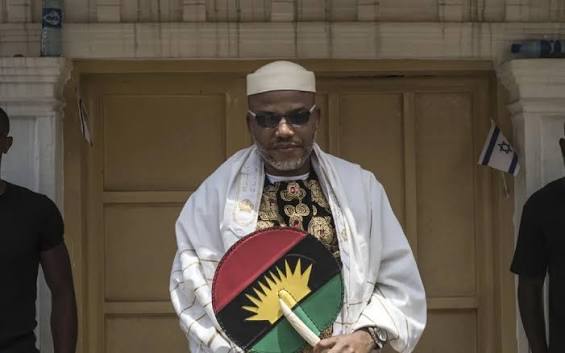
More than nine months after a Federal High Court in Abuja sentenced Nnamdi Kanu to life imprisonment for terrorism, the appeal he filed against that judgment has still not been listed for hearing, a delay that has now pushed the Indigenous People of Biafra, IPOB, to threaten a total boycott of elections across the South East and beyond.
According to a statement by its spokesman, Emma Powerful, the group gave the Federal Government 14 days to ensure that the appeal is listed and heard, warning that failure to meet the demand would trigger a mass withdrawal from future polls. IPOB questioned the legal basis for Kanu’s conviction and continued detention, asked under which law he remained imprisoned, and said the government had two options: release him, or appear in court to defend both the conviction and the jurisdiction under which his trial was conducted.
The ultimatum has revived one of the most divisive legal and political questions in the country. It also draws attention to a striking contrast at the heart of the case, between the speed of the prosecution and the slow movement of the appeal.
Court records show that on 20 November 2025, Justice James Omotosho convicted Kanu on all seven counts of a terrorism charge in case number FHC/ABJ/CR/383/2015. He was sentenced to life imprisonment on counts one, four, five and six, to 20 years on count three, and to five years on count seven, with the terms to run concurrently. The prosecution, led by Adegboyega Awomolo, SAN, had applied for the death penalty, arguing that Kanu’s broadcasts incited violence that led to the deaths of security personnel and the destruction of public property, and that the Eastern Security Network operated as IPOB’s armed wing. The judge said he settled for life imprisonment rather than death out of a scriptural consideration for mercy. Kanu is serving the sentence at the Sokoto Medium Security Custodial Centre.
The dispute now centres on what has happened since. According to filings by Kanu and his family, a notice of appeal was lodged on 4 February 2026 in case number CA/ABJ/CR/393/2026. The record of appeal was transmitted on 9 March 2026, and his brief of argument was filed on 5 June 2026 and served on the Federal Government. The family says the period allowed for the government to file its respondent’s brief has since lapsed without any filing, and that the matter has not been listed for hearing.
In letters dated 10 August 2026 to the President of the Court of Appeal and 15 August 2026 to the Chief Justice of Nigeria, Kanu personally requested the urgent listing of his appeal, a pending bail application and a separate suit. The family, in a statement by Prince Emmanuel Kanu, stressed that Kanu was not asking the courts to rule in his favour, only that the cases be placed before the appropriate panels and determined according to law. A separate matter is also pending at the Supreme Court, filed on 7 November 2025, challenging the apex court’s December 2023 decision that reversed his earlier acquittal and ordered the continuation of his trial.
IPOB, defending the boycott threat, argued that its supporters took part in the 2023 general election rather than staying away, yet the disputed results and subsequent court challenges came to nothing. A collective refusal to vote, the group said, would amount to a political statement by people who had lost confidence in the electoral process.
The matter has a long history. Records show Kanu was first arrested in Lagos in October 2015 and later charged with treasonable felony and unlawful possession of arms. He was granted bail in 2017 but fled the country after soldiers reportedly raided his family compound in Afaraukwu, Umuahia. He was arrested in Kenya in June 2021 and returned to Nigeria, and has remained in custody since. On 13 October 2022, the Court of Appeal discharged and acquitted him, but the government obtained a stay and appealed. On 15 December 2023, the Supreme Court set aside that acquittal and ordered his trial to continue. The case passed through four judges of the Federal High Court before Justice Omotosho, who took over in March 2025 after an earlier recusal, brought the ten year proceedings to a close.
Beyond IPOB, calls for a political resolution have grown louder across the political and traditional establishment. Governors of the South East, socio cultural bodies such as Ohanaeze Ndigbo, the World Igbo Congress and figures across party lines have urged President Bola Tinubu to consider clemency, arguing that Kanu’s continued detention deepens insecurity in the region. Some traditional rulers, including monarchs outside Igboland, have made similar appeals. Supporters of that view point to earlier amnesty arrangements extended to other armed actors, suggesting a comparable political solution could apply.
The case sits within a broader pattern of separatist prosecution. A Finnish court convicted another Biafra agitator, Simon Ekpa, on 1 September 2025 and sentenced him to six years’ imprisonment for terrorism related offences, a lighter penalty than Kanu received. Ekpa has appealed.
What is confirmed is that Kanu stands convicted and sentenced, that his appeal and Supreme Court suit have been filed, and that neither has been heard. What remains open is when the Court of Appeal will list the matter. Legal observers note that appeals of this weight can take several months, though terrorism cases are often prioritised.
For now, two positions stand in tension. The government maintains that Kanu was lawfully tried and convicted for offences that cost lives. His supporters insist that the delay in hearing his appeal, set against the swiftness of his prosecution, raises questions of fairness. The 14 day deadline set by IPOB will test whether that pressure moves the case, or hardens the deadlock further ahead of the 2027 elections.