
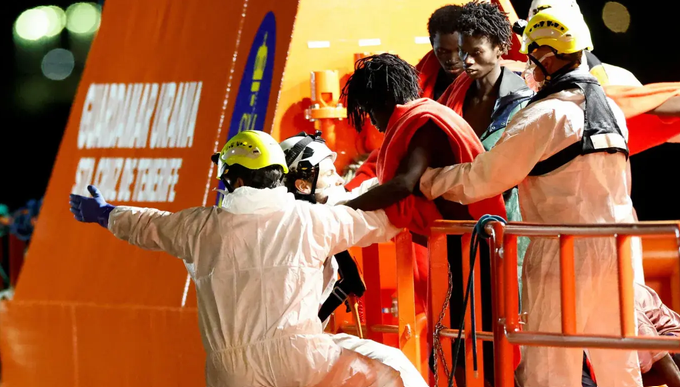
A perilous journey across the treacherous waters of the Atlantic Ocean has ended in devastating loss after Spanish emergency services intercepted a wooden vessel carrying dozens of exhausted survivors and the remains of those who perished during a gruelling, nearly month-long ordeal at sea.
According to maritime reports and search-and-rescue agencies, as many as 83 West African migrants are feared dead after their boat spent 27 days drifting hopelessly in open ocean waters before rescue teams reached it roughly 65 nautical miles off Arguineguín, Gran Canaria.
The tragic voyage highlights the escalating human toll along the Atlantic migration corridor – a dangerous maritime passage stretching from the coastlines of West Africa to Spain’s Canary Islands, which continues to claim thousands of lives each year.
A Desperate Journey Turns Fatal
The wooden vessel reportedly set sail from Gambia in early August with an estimated 127 passengers on board, all seeking passage toward European shores in search of refuge, economic stability, and better livelihoods.
Instead, the boat became stranded in unpredictable ocean currents and rough weather, leaving its occupants stranded without sufficient food, fresh water, or navigational support. For 27 agonising days, the passengers endured scorching temperatures by day, freezing oceanic winds by night, and severe dehydration.
When Spain’s maritime rescue agency, Salvamento Marítimo, finally located the drifting vessel on Wednesday, only 44 survivors – all men from sub-Saharan Africa – were found alive.
Rescue workers recovered five bodies from the vessel, but adverse weather conditions—including 20-knot winds and swell heights exceeding 2.5 metres—prevented emergency teams from retrieving several other remains spotted in and around the craft. Three survivors suffering from acute trauma and extreme physical exhaustion were airlifted to Gran Canaria in critical condition via medical helicopter, while the remaining survivors were transported by sea to local emergency medical stations early Thursday morning.
Activists and Regional Authorities React
Rights activist Helena Maleno Garzón, founder of the prominent non-governmental organisation Caminando Fronteras (Walking Borders), stated that testimonies gathered from survivors indicate at least 83 individuals perished before rescue teams arrived. Many of the deceased are believed to have been lost at sea or to have succumbed to starvation and dehydration as days turned into weeks.
The incident has sparked renewed criticism from political leaders and international rights organisations regarding the lack of safe, regulated migration routes.
Fernando Clavijo, President of the Canary Islands Regional Government, publicly condemned the continuing loss of life along the route, emphasising that international governance bodies cannot accept the Atlantic Ocean becoming a massive graveyard for African youth.
“It is intolerable that lives continue to be lost in this manner,” Clavijo expressed, urging European and African nations to intensify efforts to address the root drivers of irregular maritime departure while strengthening search-and-rescue coordination across coastal borders.
The Growing Appeal and Danger of the Atlantic Route
Over the past three years, the Atlantic corridor between West Africa and the Canary Islands has emerged as one of the world’s deadliest maritime routes for irregular migration.
As security measures and naval patrols tightened across traditional Mediterranean pathways through North Africa, smuggling networks increasingly redirected desperate travellers toward Atlantic launch points in Senegal, Mauritania, and Gambia.
However, navigating the Atlantic Ocean presents severe natural hazards:
- Unpredictable Currents: Strong open-ocean currents frequently push low-powered wooden craft off course into vast expanses of open water.
- Overcrowded Craft: Smugglers routinely pack dozens of individuals into wooden fishing pirogues designed for short coastal trips rather than ocean crossings.
- Extended Voyages: Deprived of GPS equipment, crews often run out of fuel, leaving passengers adrift for weeks without shelter or emergency rations.
For many young West Africans facing persistent unemployment, political instability, and economic distress across the sub-region, the immense risk associated with the Atlantic passage has not deterred thousands from embarking on the perilous trek.
Human rights advocates continue to call on regional bodies – including the Economic Community of West African States (ECOWAS) and the European Union – to establish human-centred migration policies, expand lawful immigration pathways, and address youth unemployment across West African nations to prevent further loss of life on the high seas.