
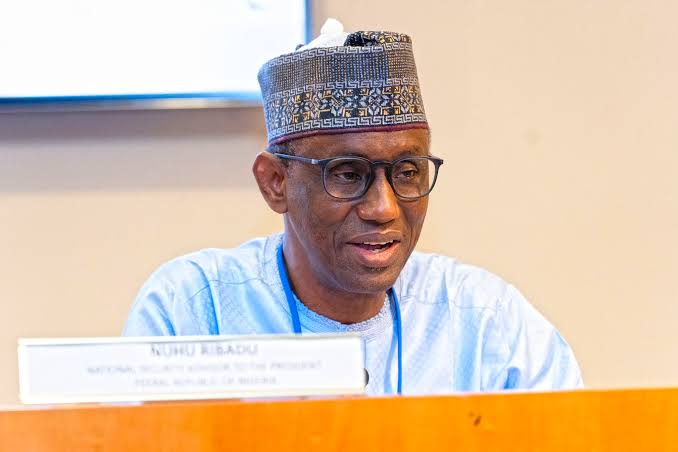
National Security Adviser Mallam Nuhu Ribadu has endorsed plans for a new National Baseline Survey on illicit small arms and light weapons, arguing that Nigeria can no longer rely on figures collected a decade ago to guide its response to the proliferation of illegal firearms.
Speaking through the Director of External Affairs in the Office of the NSA, Mr Solomon Feyintola, at a workshop reviewing the 2016 National Baseline Survey, Ribadu said the earlier exercise had provided a useful foundation but was limited by methodological and coordination shortcomings. An accurate, updated national baseline, he said, would serve as a strategic security asset, improving the targeting of counter-proliferation and disarmament efforts and helping authorities track weapons within communities and across borders.
“The proliferation of illicit small arms and light weapons is not an abstract policy concern. It is a deadly threat to the safety of our people,” Ribadu stated. He linked the availability of such weapons to banditry, communal conflicts, farmer-herder clashes, organised crime, terrorism and insurgency, adding that government’s response must rest on reliable evidence rather than estimates.
The 2016 survey, conducted by the then Presidential Committee on Small Arms and Light Weapons with technical support from the Small Arms Survey, estimated that approximately 6.4 to 6.5 million firearms were in civilian hands at the time. It found that about 14 per cent of Nigerian households possessed at least one firearm, equating to roughly 17 firearms per 100 persons. The findings informed subsequent policy measures, including the establishment of the National Centre for the Control of Small Arms and Light Weapons (NCCSALW) and the development of a National Action Plan. However, officials now describe those numbers as insufficient for analysing the current threat environment.
Director and Deputy High Representative of the United Nations Office for Disarmament Affairs, Dr Adedeji Ebo, told the workshop that the security landscape had changed considerably since 2016. “Today, you cannot conduct a solid national threat analysis in 2026 based solely on data from 2016,” he said. Ebo stressed that updated quantitative and qualitative data were essential to determine the number and types of illicit weapons in circulation, identify trafficking routes, assess their impact on communities and measure progress on arms marking, tracing and record-keeping. Accurate national figures, he added, are also critical for Nigeria’s reporting under the Arms Trade Treaty and the ECOWAS Convention on Small Arms and Light Weapons.
Director-General of the NCCSALW, retired DIG Johnson Kokumo, described illicit small arms and light weapons as among the most persistent threats to peace, security and sustainable development in Nigeria and the wider West African and Sahel regions. He noted that the weapons continue to facilitate banditry, terrorism, communal violence and organised crime while weakening social cohesion. Operational measures alone, he argued, cannot resolve the problem without sound information on the nature, scale, distribution, sources and drivers of proliferation. “Sound policy must be anchored in sound evidence,” Kokumo said.
The workshop was convened to examine the strengths and weaknesses of the 2016 exercise and to shape the methodology, scope and implementation framework for the next national assessment. Participants included officials from the United Nations Office for Disarmament Affairs and the United Nations Regional Centre for Peace and Disarmament in Africa. Ribadu called for a whole-of-government and whole-of-society approach involving security agencies, state and local governments, traditional and religious institutions, civil society and communities, alongside continued international partnerships.
Recent operational activity underscores the scale of the challenge. Security agencies have recovered and submitted thousands of weapons for destruction, while major seizures, including hundreds of rifles intercepted by Customs, continue to highlight the flow of illicit arms into the country. Officials have also pointed to the diversion of government-owned weapons as one source feeding non-state actors.
A fresh baseline survey is expected to provide the evidence base for Nigeria’s next National Action Plan on small arms control and to strengthen the country’s leadership in regional and global disarmament efforts. Whether the exercise succeeds will depend on improved coordination, methodological rigour and sustained political commitment to translating data into targeted interventions.