
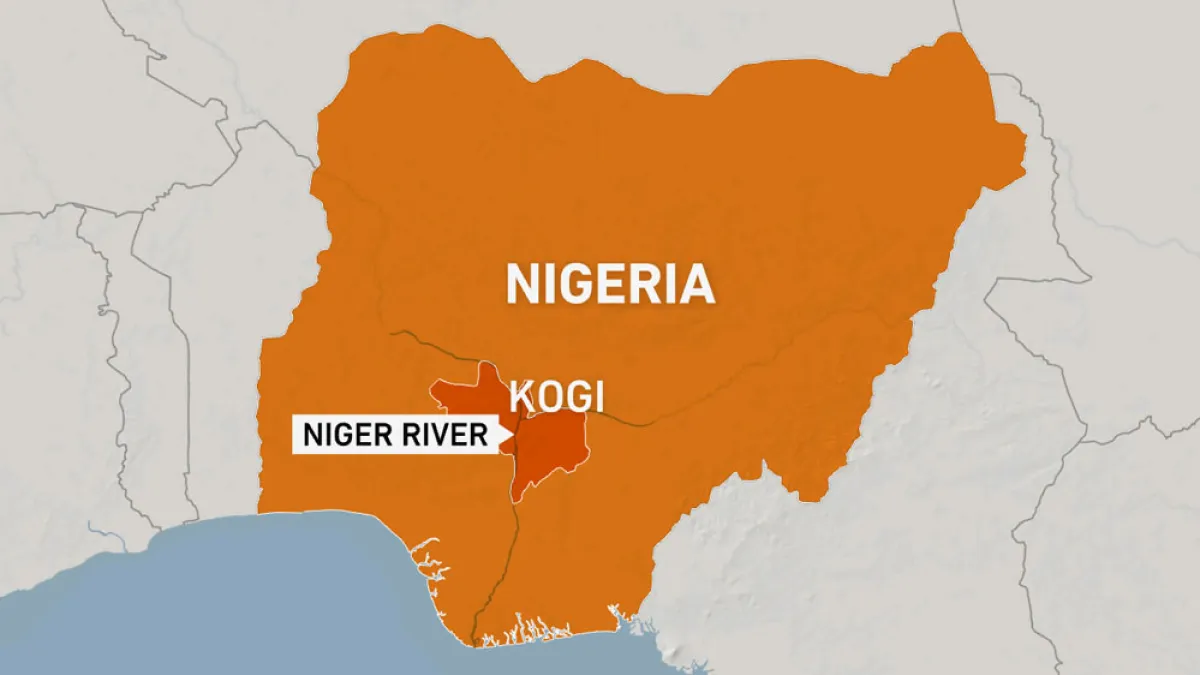
The European Union has asked the Kogi State Government for 50 hectares of land, with a Certificate of Occupancy, to serve as the operational base for a proposed water transport corridor linking Lagos and Ikorodu with Ajaokuta, a request that now sits before the state’s approval process.
The request was made on Friday in Lokoja by a delegation led by Massimo De Luca, Head of Cooperation at the EU Delegation to Nigeria and ECOWAS, according to a statement issued by the Kogi State Government. The Deputy Governor, Joel Salifu, who received the team on behalf of Governor Ahmed Usman Ododo, said the state was open to credible investment but that the land request would pass through the appropriate procedures, including consideration by the Kogi State Economic Council, before any decision. He said he would present the request to the governor and that government would communicate its position after consultations.
De Luca told the meeting that the project was designed to move bulk goods by water and reduce pressure on Nigeria’s road network, and that it would be driven by SeaLink alongside local and international financial partners including the Nigerian Export Import Bank and European financial institutions. He said other large companies could join as the project expands. No investment value, financing structure or timeline was disclosed.
The Kogi visit forms part of a wider itinerary. A day earlier in Asaba, the same delegation presented the Sea Link proposal to Delta State officials, where the Deputy Governor, Monday Onyeme, received the team on behalf of Governor Sheriff Oborevwori. De Luca described a corridor running from Lagos along the coastal route to Burutu, then up the River Niger through Onitsha to Ajaokuta, with the rehabilitation of Burutu Port a central component. He said discussions were under way to assemble the financing, with a consortium expected to participate. The Delta government pledged support and cooperation.
SeaLink is not a new proposition. The Sealink Promotional Company Limited was registered at the Corporate Affairs Commission in November 2011 as a special purpose vehicle promoted by NEXIM Bank, the Federation of West African Chambers of Commerce and Industry and Transimex of Cameroon, with its first board meeting held in Douala in December of that year. NEXIM conducted the initial feasibility study in 2013 and secured a 302,000 dollar grant through the African Development Bank under the Nigerian Technical Cooperation Fund. The project has been valued at about 61.5 million dollars. In March 2023, navigational charts for the lower River Niger, produced jointly by Nigerian Navy hydrographers and the National Inland Waterways Authority with funding from NEXIM and Afreximbank, were unveiled. At that event, the bank’s then managing director, Abba Bello, attributed the channel’s decline to the closure of Burutu Port in the mid 1970s, which he said led to years of siltation and navigational difficulty.
That history explains why the current proposal carries both promise and risk. The Federal Government approved a contract of about N34.8bn in December 2008 to dredge 572 kilometres of the lower River Niger from Warri in Delta State to Baro in Niger State, cutting through eight states. The work was inaugurated in Lokoja in September 2009 with a three year completion plan, and the Federal Executive Council approved an additional N8.5bn in November 2011, taking the value to roughly N43.3bn. The scope covered capital dredging, river training works, navigational aids, new inland ports at Baro, Idah and Lokoja, and the rehabilitation of Onitsha Port. Government announced completion of the capital dredging in stages, with President Goodluck Jonathan confirming it at a NIWA forum in August 2014. More than a decade later, traffic on the channel remains thin, Baro Port has seen little commercial activity since commissioning, and maintenance dredging has depended on intermittent funding.
The commercial case rests on how much freight Nigeria still pushes onto tarmac. A former NIWA managing director, George Moghalu, has said that about 90 per cent of the country’s bulk cargo moves by road, and that between 60 and 65 per cent of containerised cargo arriving Nigerian ports is destined for the South East, principally Onitsha and Aba. A separate assessment presented this year by Kombo Theophilus Johnson to an engineering audience put road transport at roughly 61 per cent of Nigeria’s freight revenue, and estimated that the dredged Niger routes, including the Baro to Lagos corridor, could carry up to one million tonnes of cargo annually. The two figures measure different things, tonnage in one case and revenue share in the other, but both point the same way.
Precedent also exists for the concession model implied by the EU proposal. A 30 year concession for Onitsha River Port was signed on 1 July 2022 with Universal Elysium Consortium Limited, with projected government earnings of about N23bn over the period, and the then Minister of Transportation, Mu’azu Sambo, indicated that Baro, Lokoja and Oguta would be considered afterwards. Onitsha has yet to function as a port of destination for international cargo.
For Kogi, the location matters. Ajaokuta was planned around water access, with the steel complex intended to receive bulk raw materials by river. The plant has been dormant since work stalled in 1983. The 2026 Appropriation allocated N22bn to the steel sector, of which Ajaokuta Steel Company received N6.5bn, with no revenue projected for the year. The Minister of Steel Development, Shuaibu Abubakar Audu, said in July that talks with a Chinese investor were at an advanced stage, that an agreement could be signed before the end of 2026, and that revival would require between 1.5bn and 2bn dollars. Whether the corridor finds anchor cargo at Ajaokuta depends substantially on that outcome.
The EU’s interest fits its Global Gateway strategy, under which the bloc has committed 150bn euros to African infrastructure by 2027, covering transport, energy and digital connectivity. De Luca said in early 2025 that about 700m euros in cooperation had been implemented in Nigeria between 2021 and 2024.
What is confirmed at this point is narrow. A delegation has presented a proposal, named SeaLink and NEXIM as drivers, and asked two states for support, one of them for land. What is not established is the cost, the financing close, the ownership structure, the volume commitments or any start date. Kogi’s formal response, and whether the consortium reaches financial close, will be the first real tests.