
Nigeria’s Federal Government has fixed 1 October 2026 as the start date for a scheme that will give students in public senior secondary schools and public tertiary institutions 100 megabytes of free internet data every day to reach approved educational websites and learning platforms, with about five million learners expected to benefit in the first phase.
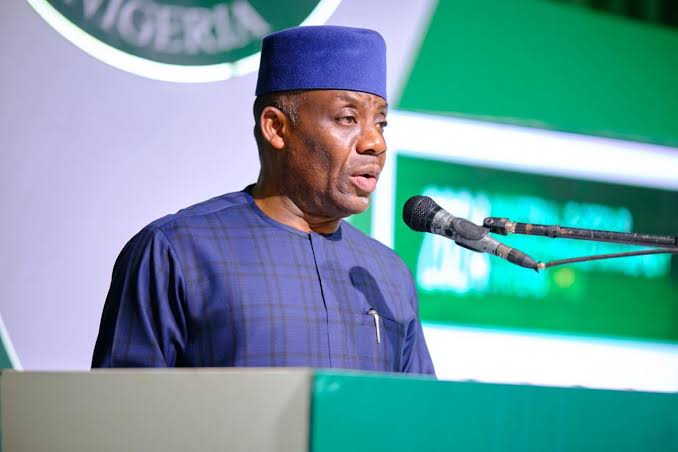
The Minister of Education, Dr Tunji Alausa, announced the date on Thursday, 10 September, in Abuja at the launch of the Initiative for Zero Rated Access to Educational Platforms and Content in Nigeria, organised by the Nigerian Communications Commission. He said the programme would begin with senior secondary and tertiary students before being extended to other categories of learners, and that no learner should be denied educational content “simply because he or she cannot afford data”. The commission is coordinating the rollout with the Federal Ministry of Education, mobile network operators and the Association of Licensed Telecommunications Operators of Nigeria.
The mechanics were set out by the NCC Director of Policy, Competition and Economic Analysis, Ayuba Shuaibu, who said the framework “adopts the operator’s consult model for the initial rollout”, under which participating operators supply the daily 100MB allowance for use on approved sites. He said the commission and the ministry would jointly decide which platforms qualify, with learning management systems, digital libraries, educational repositories, teacher development platforms and technical and vocational training services among the expected categories. Participants remain bound by existing rules on cybersecurity, consumer protection, child protection and data protection, and the framework carries provisions on net neutrality, fair competition and inclusivity. MTN Nigeria, Airtel Nigeria and Globacom were named among the operators backing the scheme by the NCC Executive Commissioner for Technical Services, Abraham Oshadami, who commended their “commitment to support its implementation by providing free data allowances”. The NCC Executive Commissioner for Stakeholder Management, Rimini Makama, said the aim was that no learner is shut out “because of where they live or what their family earns”.
The affordability problem the scheme targets is documented. The commission approved a 50 per cent increase in voice, data and SMS tariffs in January 2025, the first significant adjustment in more than a decade, after sustained pressure from operators. The regulated benchmark price of one gigabyte of mobile data rose from about N287.50 to N431.25, while actual retail prices settled higher, generally between about N475 and N637.50 depending on operator and bundle. MTN briefly published increases of up to 200 per cent on some plans before adjusting, and the Nigeria Labour Congress and the National Association of Nigerian Students protested the decision at the time. Those prices remain in force.
Demand has grown regardless. Commission statistics for July 2026 put active telephony subscriptions at 195.11 million and teledensity at 90 per cent, with mobile internet subscriptions at 157.27 million and broadband subscriptions at 124.42 million, giving broadband penetration of 57.40 per cent. Monthly data consumption reached 1.66 million terabytes in July, up from 1.53 million in June and from about 1.13 million terabytes in July 2025. Over a recent twelve month period, Nigerians consumed roughly 15.32 billion gigabytes and spent an estimated N6.6 trillion on data. Penetration is improving but still short of the 70 per cent target set for the end of 2025 under the national broadband plan, a level the sector had not reached by August 2025, when penetration stood at 48.8 per cent.
What the allowance is worth in cash terms is modest but real. A daily 100MB works out at roughly 3GB a month, which would cost somewhere between about N1,300 and N1,900 at prevailing retail rates, or about N43 to N64 a day. For a household on the N70,000 national minimum wage with two students, that is a meaningful saving over a school term, though not a substitute for a full data plan. The volume itself also sets the limit of what the scheme can do. One hundred megabytes stretches comfortably across text based materials, past question papers, PDFs and lightweight learning portals, but sustained video lectures and large file downloads would exhaust it within minutes, which means the initiative is best suited to reading and reference rather than streamed instruction.
Two further constraints sit outside the framework. Coverage remains uneven: the Universal Service Provision Fund has put the number of Nigerians in underserved or completely unserved areas at 27.91 million, and fixed broadband is thin, with only about 265,000 fibre to the home subscriptions nationwide by mid 2026. Device access is the second gap. Free data assumes a phone, tablet or computer in the learner’s hands, and World Bank assessments cited in policy debate suggest a large share of Nigerians lack basic digital skills, with far fewer able to operate laptops than smartphones. The National Information Technology Development Agency has said it started from a digital literacy baseline of about 50 per cent in 2024 and is targeting 70 per cent by 2027 and 95 per cent by 2030, partly through the three million technical talent programme and the National Digital Literacy Framework.
The initiative also fits a wider push to digitise the system’s records. Alausa listed the Nigeria Education Data Infrastructure, the Digital Nigeria Education Management Information System and the Learner Identification Number among ongoing projects, said more than 240,000 schools have been geo mapped and geolocated, and confirmed that the Annual School Census is being digitised to produce firmer figures on enrolment, teaching staff, classrooms, laboratories, libraries, connectivity and school safety. Those systems matter directly to the data scheme, because eligibility will have to be verified for each of the five million intended beneficiaries, and no verification mechanism has been published.
Alausa separately disclosed that the government is working on regulations covering internet access for children below 16, to be accompanied by content standards. He said material made available to children must be appropriate, credible, safe and aligned with the curriculum, and that details would follow.
Several questions therefore remain open ahead of 1 October. The list of approved platforms has not been released. It has not been stated publicly whether operators will absorb the cost of the allowance indefinitely or be reimbursed through the Universal Service Provision Fund or another mechanism, a point that carries weight given that operators spent years arguing for cost reflective pricing before the 2025 tariff review. Neither the duration of the initial phase nor the timeline for extending it to junior secondary and primary learners has been set out. For students, the practical test will be simpler: whether the allowance appears on their lines from 1 October, and whether the platforms it opens are the ones their examinations actually require.