
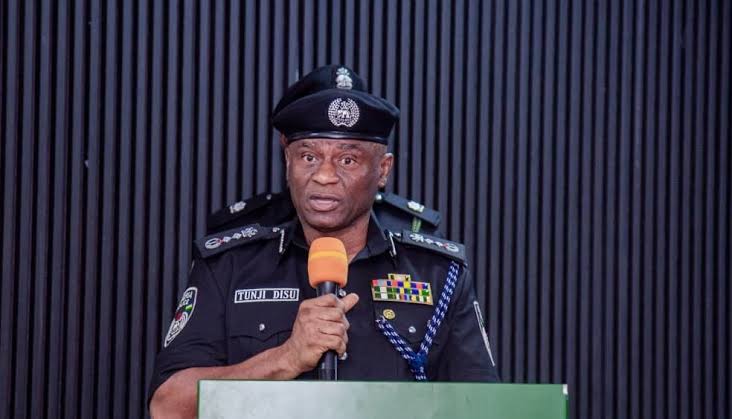
The Nigeria Police Force has moved to soften the fallout from the Inspector General of Police’s remarks on citizens filming officers, insisting that Olatunji Disu is not opposed to the practice itself but to what the Force describes as its misuse for social media entertainment. The clarification, issued on Saturday, 12 September 2026 by the Force New Media Officer, Aliyu Giwa, in a series of posts on X, came days after Disu’s comments drew criticism from lawyers, senior advocates, human rights groups and a political party, and it runs into a settled point of law that the police clarification does not address directly.
According to Giwa, the IGP’s concern focuses on situations where officers are provoked, ridiculed, filmed for entertainment or subjected to unnecessary intrusion while working. He said a distinction should be drawn between responsible documentation and the deliberate exploitation of police encounters for content, adding that the Force remained open to legitimate scrutiny because responsible recording could both expose misconduct and protect officers from false allegations. He also confirmed that body cameras were part of a broader conversation on accountable policing, a point critics had raised, and rejected framing the matter as police against the public or the IGP against the Nigerian Bar Association.
The dispute began at a courtesy visit by the NBA leadership to Disu at the Force Headquarters in Abuja earlier in the week, during which the IGP said a recent court judgment on filming officers had “jolted” the Force and become “very, very demoralising”, particularly for personnel deployed to highways, forests and other dangerous locations. He acknowledged that citizens could record officers performing public duties, but urged restraint and questioned whether lawyers would accept people entering their offices or courts to record them without limit. He also alleged that some people had begun recording officers in settings such as restaurants, beyond the scope of official duty.
What gives the argument its edge is that the question Disu reopened has already been decided by a court. On 17 March 2026, the Federal High Court in Warri, Delta State, delivered judgment in suit number FHC/WR/CS/87/2025, Maxwell Nosakhare Uwaifo against the Inspector General of Police and three others. Justice Hyeladzira Nganjiwa held that Nigerians have a constitutional right to record, photograph and document police officers performing their duties in public. The court further directed that officers must wear visible name tags and display their force numbers, declared anonymous policing unlawful, and prohibited officers from harassing, intimidating or arresting citizens who record them, or seizing their devices and deleting footage. The applicant, a legal practitioner who said he was stopped by unidentified officers at a checkpoint between Benin and Warri in May 2025, was awarded 5 million naira in damages for the breach of his fundamental rights and 2 million naira in litigation costs. The case was brought as a public interest action.
The legal profession has largely closed ranks around that ruling. On Friday, 11 September, three Senior Advocates of Nigeria, Olu Daramola, Olalekan Ojo and Isiaka Olagunju, said citizens retained the right to record officers on public duty. Daramola said the law was settled, describing the Warri judgment as “binding and subsisting” and noting that it went beyond recognising the right to record by also requiring officers to identify themselves. Ojo said recording could promote transparency and preserve evidence of misconduct, but cautioned that citizens could expose themselves to danger where officers reacted badly. Olagunju said the IGP might have a valid point on privacy and safety, but that recording public officers who failed to do their jobs properly should be encouraged. The human rights lawyer Inibehe Effiong made a similar case, anchoring the right in Section 39 of the 1999 Constitution, which guarantees freedom of expression and the freedom to receive and impart information, and arguing that the protection extends to the devices through which information is recorded and shared.
The NBA President, Oyinkansola Badejo-Okusanya, who was present at the meeting where Disu raised the matter, took a more measured line. She affirmed the right of citizens to film officers on lawful public duty while calling for clearer rules to guard against intrusion into officers’ private lives, particularly when they are off duty. The Committee for the Defence of Human Rights and the African Action Congress backed the right to record, with the AAC citing the prevalence of illegal checkpoints and impersonators in police uniform as reasons Nigerians needed to document who stops them. Not all commentary sided against the IGP: the public affairs analyst Rufus Egbagba said Disu’s position should not be read as an attempt to shield erring officers.
The wider context is a policing culture reshaped by the smartphone and by the memory of the 2020 End SARS protests, which were driven in part by citizen recordings of alleged brutality. The Warri judgment sits within that trajectory, treating the phone camera as a tool of accountability rather than a threat to it, and it aligns with the broader constitutional guarantee of free expression. Against that backdrop, the Force’s distinction between documentation and entertainment addresses a real problem, the ridicule and provocation of officers for online clout, but it does not alter the legal position, which turns on whether an officer is performing public duties in a public place rather than on the recorder’s motive or intended audience.
For now, the practical question is one of enforcement rather than principle. A subsisting court order already bars officers from harassing citizens who film them in public or seizing their phones, and the Force has not indicated any intention to challenge that ruling. The police symposium the IGP proposed for Owerri, Imo State, where the issue is to be discussed further, and the pace at which body cameras are actually deployed, will show whether the Force’s stated commitment to accountable policing is matched in practice. Until a higher court says otherwise, the law recognised in Warri remains the standard, and the debate the IGP reopened is, in legal terms, largely a debate about how that standard is applied.