
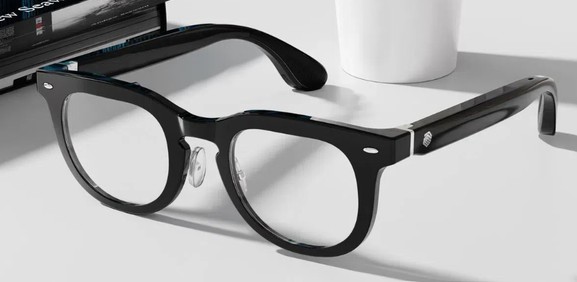
As millions of AI-powered smart glasses roll out globally, secret recording technology is entering everyday life – leaving commuters, venues, and privacy advocates fighting back against invisible lenses.
Imagine stepping onto a crowded BRT bus at Oshodi after an exhausting day at work. You find a standing spot, hold the overhead rail, and lock eyes with a fellow passenger wearing a stylish pair of dark-rimmed designer spectacles. No smartphone raised in your direction, no ring light, and no obvious sign of a recording rig. Yet, somewhere inside those sleek frames, a miniature camera lens is silently capturing your face, recording your movements, and broadcasting your image to thousands of online viewers across the globe in real time.
In late December, a commuter on the New York subway decided she had endured enough of this silent intrusion. Spotting a man wearing a pair of high-tech Meta smart glasses while filming passengers, she reached out, grabbed the device directly off his face, and snapped the frames clean in two.
To thousands of internet onlookers who watched the incident go viral, she was instantly hailed as a public hero – a symbol of resistance against an era where public spaces feel increasingly like open-air surveillance studios.
The Silent Invasion on the Streets
This dramatic confrontation on an underground train represents the front line of a rapidly expanding cultural battleground. What began as a niche tech gimmick has evolved into a global consumer phenomenon, bringing smart glasses to city squares, public parks, high-street shops, and transport hubs worldwide.
Unlike traditional smartphones, which require lifting a device and aiming a screen, these smart eyewear devices let users answer phone calls, navigate hands-free with artificial intelligence, and take photographs or short video clips with a simple, subtle touch to the temple arm.
Tech giant Meta, whose partnership with iconic eyewear brand Ray-Ban has dominated the market, is leading this revolution. To date, the company has sold over seven million pairs of these high-tech frames, priced at a few hundred pounds each.
Industry analysts predict that if competing technology brands match Meta’s commercial success, sales could explode in the coming years, placing as many as 100 million smart cameras on the faces of everyday citizens across the globe.
Spontaneous Charm or Unwanted Intrusions?
For digital content creators, the technology offers unprecedented creative freedom. Pearse Vallely, a 31-year-old internet personality from Ballymurphy in West Belfast, earns his living by capturing first-person perspectives of urban life.
Walking through his local city centre wearing Meta Ray-Bans, Vallely records his everyday encounters with strangers, greeting passers-by with lighthearted, rhyming banter. One of his videos gained over 600,000 views on TikTok alone.
Vallely maintains that the charm of his content depends on keeping interactions authentic, lighthearted, and natural. He stressed that he has never posted a clip if someone asked him not to, and noted that no viewer or passer-by has ever contacted him petitioning for a video to be removed.
“I think it’s because of the nature of my conversation with them,” Vallely explains. “They know I’m not making an eejit out of them; I’m doing it positively.”
To address built-in privacy concerns, Meta designed the frames with an embedded indicator light on the front, which pulses white when video is actively recording, paired with a distinct flash when taking static photos – safety features that Meta claims standard smartphones lack. The company has also released software updates that automatically disable the camera function if the indicator light is physically tampered with or covered up.
Vallely notes that most people he interacts with notice the tiny illuminated light on his frames, and he makes an effort to inform strangers after recording them if he can catch up with them down the street.
“It’s okay to have a 30-second conversation with someone,” Vallely insists. “I think that’s something we’re losing due to technology, and I’m trying to use technology to spin it around.”
While Vallely argues that his intentions are purely positive, he acknowledges why public anxiety is rising. “People know it’s me doing it, while other people do it on troll accounts,” he admits. “No matter what is invented, people are going to use things for the wrong reasons.”
Banning the Lens: Businesses Push Back
As these devices proliferate, public friction is escalating beyond isolated subway incidents. Across various industries, private venues and event organisers are instituting outright bans on wearable camera tech.
Wetherspoons, a major pub chain operating nearly 800 venues across the United Kingdom, strictly forbids patrons from wearing smart glasses to record footage inside its establishments. Explaining the stance, a company spokesperson stated that smart glasses breached “common sense by enabling surreptitious surveillance.”
Similarly, Monopoly Events, the organisation behind Comic Con Northern Ireland, issued a total ban on the devices across its events following widespread concerns from attendees about hidden recordings.
The legal reality, however, remains remarkably lenient in many jurisdictions. Under current Northern Irish law, for example, filming individuals in public spaces – even discreetly – is generally legal because citizens in public areas do not possess a legal “reasonable expectation of privacy.” Filming only crosses into unlawful territory if it escalates into stalking, criminal harassment, voyeurism, or occurs in private spaces where explicit privacy expectations exist.
Harassment, Street Pick-ups, and Secret Footage
This legal grey zone precisely alarms privacy advocates and women’s rights organisations. Across platforms like TikTok and Instagram, videos tagged with hashtags such as #howtogetagirlfriend regularly attract hundreds of thousands of views. In these clips, male creators wearing smart glasses approach unsuspecting women on streets or public transport, film their reactions to flirtatious pick-up lines, and ask for their phone numbers – often without initial consent.
Elaine Crory, a women’s sector lobbyist at the Women’s Resource and Development Agency, highlights how wearable technology strips away a person’s ability to protect themselves from unwanted attention.
“Right now, if you’re filming with a camera or with your phone, I usually can see that and then avoid that,” Crory warns. “But you may not be aware you’re being filmed with an AI camera.”
Crory points out that without visible handheld phones, these devices can be exploited for illegal acts, including covert upskirting. While individuals can request social media platforms to remove videos after they are published online, and private venues can erect warning signs, she argues that existing laws are completely outpaced by technological innovation.
“A person has no legal redress if they are filmed in the street, on a bus, in a classroom,” Crory notes.
Addressing these concerns, the Department of Justice (DoJ) noted that while regulating commercial smart glasses falls outside its jurisdiction, existing criminal legislation remains active if behaviour crosses legal thresholds, pointing to offences such as upskirting classified under voyeurism statutes.
Meanwhile, Instagram head Adam Mosseri addressed public pushback during a recent Q&A session, stating that if users upload content “taking advantage of people and harassing them… then we’re going to take the content down.”
In Scotland, law enforcement has already stepped in, launching an active police investigation in July following public complaints about a TikTok creator who used smart glasses to film unsuspecting members of the public.
A Lifeline for the Visually Impaired
Yet, amidst the fiery privacy debate, complete bans risk obscuring a vital side of the story; for millions of people living with disabilities, smart glasses represent a life-changing medical breakthrough.
Geoff McConville, an optometrist stocking Meta glasses in his Belfast practice, acknowledges legitimate worries surrounding misuse, but emphasises their transformative potential. His visually impaired patients rely on the built-in artificial intelligence to read physical newspapers, navigate street signs, and translate ambient text using automated voice audio.
“For my elderly, visually impaired patients, they are ground-breaking,” McConville says. “They are amazing.”
Meta echoed this position in an official statement, stressing that the smart frames deliver “critical new technology for people who are low-sighted or hard of hearing and limiting how people can use this technology would be a major step backwards.”
The tech company acknowledged public concerns on boundary setting, adding: “Naturally some places shouldn’t be filmed at all and that’s reasonable but, rules should be applied consistently.”
Living in the Open-Air Studio
As tech manufacturers prepare to flood global markets with tens of millions of AI-powered glasses over the coming years, society finds itself at a critical crossroads. The line separating innocent public interaction from non-consensual surveillance grows thinner with every new device sold.
As tech-savvy youth in Lagos, Abuja, and Port Harcourt embrace social media trends and import the latest gadgets, these sleek camera frames are rapidly making their way into West Africa. From bustling markets in Computer Village to high-end lounges in Victoria Island, the arrival of wearable cameras brings the global privacy debate directly to Nigerian soil.
When anyone’s designer spectacles could be secretly recording your every move, a troubling question lingers: in a country where street culture thrives on open interactions, will walking down a Nigerian street ever feel truly private again?